
Chrysina
Kirby, 1828
Jewel Scarabs
Species Guides
4- Chrysina beyeri(Beyer's scarab)
- Chrysina gloriosa(glorious beetle)
- Chrysina lecontei(Leconte's chrysina)
- Chrysina woodi(Wood's jewel scarab)
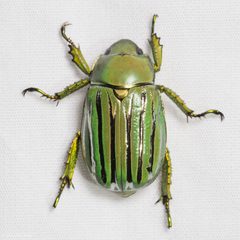
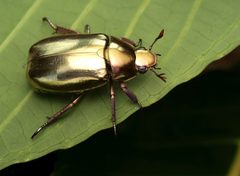
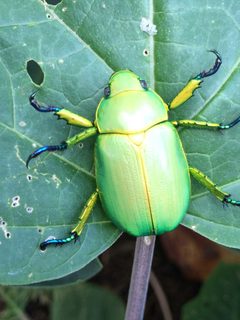
Chrysina is a of large, charismatic scarab beetles commonly known as jewel scarabs. are noted for their brilliant metallic iridescence, with coloration ranging from silver and gold to green, blue, and purple. The genus contains approximately 100 distributed from the southwestern United States through Mexico and Central America to northern South America. Adults are and readily attracted to lights. Larvae develop in decaying wood.
Pronunciation
How to pronounce Chrysina: /kɹɪˈsaɪnə/
These audio files are automatically generated. While they are not always 100% accurate, they are a good starting point.
Identification
Distinguished from other Rutelinae by the combination of large size, robust body form, and brilliant metallic structural coloration. Separated from the superficially similar Plusiotis (now synonymized) by genitalic and other subtle morphological characters. Within the genus, identification relies on color pattern, body proportions, and male genitalic structure. The metallic iridescence is produced by circularly polarized light-reflecting structures in the elytral , a feature rare among beetles. activity and strong attraction to ultraviolet and mercury vapor lights are characteristic field traits.
Images
Appearance
Medium to large scarabs, typically 15–35 mm in length. Body robust and broadly oval. and pronotum often exhibit brilliant metallic iridescence due to structural coloration from helicoidal stacks of microfibrils in the . Coloration varies by and includes silver, gold, green, blue, purple, and tones, sometimes with contrasting stripes or maculations. , with 10 segments. Legs stout, adapted for climbing vegetation. present in some species, with males often possessing more pronounced horns or on the and pronotum.
Habitat
Montane forests and woodlands, particularly in 'sky island' mountain ranges of the southwestern United States and Mexico. Associated with coniferous and mixed conifer-hardwood forests at moderate to high elevations. frequently found on trees, especially junipers. Larval consists of decaying logs and stumps in forested areas.
Distribution
Southwestern United States (Arizona, New Mexico, Texas, southern California) south through Mexico and Central America to northern South America (Colombia, Ecuador). Center of diversity in the mountains of Mexico and Central America. Specific documented localities include the Davis Mountains and Chisos Mountains (Texas), Huachuca Mountains, Chiricahua Mountains, Madera Canyon, and Pinaleno Mountains (Arizona), and numerous mountain ranges in Panama, Colombia, and Ecuador.
Seasonality
active primarily during summer months, with peak activity coinciding with monsoon season in the southwestern United States (July–August). , with greatest activity during the first four hours after sundown.
Diet
feed on foliage of juniper trees (Juniperus spp.) and possibly other conifers. Larvae feed on decaying wood in rotting logs and stumps.
Life Cycle
Complete with , larva, pupa, and stages. Larvae develop in decaying hardwood or conifer logs, requiring several years to mature. Adults emerge in summer, with timing varying by elevation and latitude. No detailed studies published for most .
Behavior
Strictly ; become active shortly after dusk and are strongly attracted to ultraviolet and mercury vapor lights. Adults climb vegetation to feed on foliage. When disturbed, may drop from plants and feign death. capability well-developed; adults may disperse between mountain ranges.
Ecological Role
Larvae contribute to wood decomposition and nutrient cycling in forest . function as folivores on coniferous trees, though densities generally low enough to prevent significant damage. The includes relictual restricted to Pleistocene cool-wet refugia, making them indicators of historical climate stability and conservation priorities for montane biodiversity.
Human Relevance
Highly prized by amateur and professional collectors worldwide due to spectacular metallic coloration. Commercial collection and sale of specimens occurs internationally. Collection pressure, combined with climate change impacts on montane , raises conservation concerns for some . Chrysina gloriosa is among the most sought-after North American scarabs. No agricultural or economic pest status.
Similar Taxa
- PlusiotisFormerly recognized as a separate ; now synonymized with Chrysina based on morphological and molecular evidence. Historical specimens may bear this name.
- CotalpaAnother North American ruteline with metallic coloration, but generally smaller, with different antennal club structure and lacking the brilliant jewel-like iridescence of Chrysina.
- ParabyrsopolisShares Rutelinae and habits, but smaller, less robust, and with more subdued coloration; pronotum and proportions differ.
More Details
Structural Coloration
The brilliant metallic colors of Chrysina are produced by structural coloration rather than pigments. The elytral contains helicoidal stacks of microfibrils that reflect circularly polarized light. This photonic crystal structure was first described by Caveney (1971) and has been the subject of continued optical physics research. Some reflect both left- and right-handed circularly polarized light, producing particularly striking visual effects.
Conservation Genetics
A reference-quality assembly exists for Chrysina gloriosa (642 Mb, scaffold N50 72 Mb), developed to support connectivity studies and conservation decision-making. The exhibits population structure across sky island mountain ranges, with genetic divergence correlating with geographic isolation.
Taxonomic History
The formerly recognized as Plusiotis was synonymized with Chrysina, consolidating approximately 100 under the older name. Recent revisions have reorganized species into species-groups (veraguana group, oreicola group) based on morphological and distributional patterns. Several new species have been described from Central and South America in the past two decades.
Sources and further reading
- BugGuide
- GBIF taxonomy match
- iNaturalist taxon
- NCBI Taxonomy
- Catalogue of Life
- Amblycheila cylindriformis on white | Beetles In The Bush
- pleasing fungus beetles | Beetles In The Bush
- A reference quality genome assembly for the jewel scarab Chrysina gloriosa
- A new species of Chrysina Kirby, 1828 (Coleoptera: Scarabaeidae: Rutelinae: Rutelini) from Ecuador and inclusion into proposed veraguana species-group
- A Monographic Revision of The Jewel Scarabs Genus Chrysina from Panama, Colombia, and Ecuador (Coleoptera: Scarabaeidae: Rutelinae: Rutelini)
- Theoretical framework to describe the reflection of circularly polarized light by a natural photonic crystal: elytron of a Chrysina resplendens scarab