
Chrysina beyeri
(Skinner, 1905)
Beyer's scarab, Beyer's jewel scarab
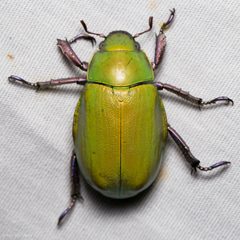
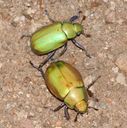
Chrysina beyeri, commonly known as Beyer's scarab or Beyer's jewel scarab, is a of shining leaf chafer in the Scarabaeidae. This bright green is native to the southwestern United States and northern Mexico, with records from southeastern Arizona, Texas, and the Mexican states of Chihuahua, Sinaloa, and Sonora. The species is known to come to mercury-vapor and ultraviolet lights at night in oak/juniper woodland .

Pronunciation
How to pronounce Chrysina beyeri: /kɹɪˈsaɪnə ˈbeɪəri/
These audio files are automatically generated. While they are not always 100% accurate, they are a good starting point.
Identification
Images
Habitat
Oak/juniper woodland in mountainous regions of the southwestern United States and northern Mexico. The has been collected at lights in such woodland .
Distribution
Nearctic region: United States (Arizona, Texas); Neotropical region: Mexico (Chihuahua, Sinaloa, Sonora). The is native to Chihuahua in Mexico and southeastern Arizona in the United States.
Seasonality
have been observed in July and August in Arizona, with records from blacklight collecting trips during the summer monsoon season. The appears to be active during the warmer months when nighttime lighting conditions are favorable.
Behavior
are attracted to mercury-vapor and ultraviolet lights at night. They have been observed flying to light sheets set up in oak/juniper woodland, often in company with other scarab including C. gloriosa, Lucanus mazama, and Parabyrsopolis chihuahuae.
Human Relevance
A target for collectors due to its attractive metallic coloration. The species is one of three Chrysina species occurring in Ramsey Canyon, Arizona, a well-known locality for scarab collectors.
Similar Taxa
- Chrysina woodiVery similar in size and general bright green appearance, but distinguished by having green legs and blue versus the blue-purple legs and tarsi of C. beyeri
- Chrysina gloriosaAnother bright green jewel scarab occurring in the same region and , often collected together at lights
More Details
Etymology
The specific epithet 'beyeri' presumably honors an individual, though the original description by Skinner (1905) should be consulted for confirmation.
Taxonomic history
Originally described by Skinner in 1905, this has remained in the Chrysina, which comprises the North American jewel scarabs.
Sources and further reading
- BugGuide
- Wikipedia
- GBIF taxonomy match
- iNaturalist taxon
- Catalogue of Life
- Sphecidae | Beetles In The Bush
- An irresistible sight! | Beetles In The Bush
- 2018 Arizona Insect Collecting Trip “iReport” | Beetles In The Bush
- Lycidae | Beetles In The Bush
- Get to Know the Threecornered Alfalfa Hopper, a (Maybe) Serious Crop Pest