
Parabyrsopolis chihuahuae
(Bates, 1888)
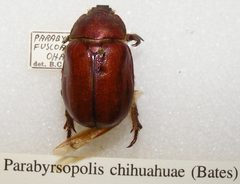
Parabyrsopolis chihuahuae is a scarab beetle in the Scarabaeidae, Rutelinae. The was described by Henry Walter Bates in 1888 and is native to western Mexico and the southwestern United States. It belongs to a of flower chafers that are typically associated with woodland and scrubland .
Pronunciation
How to pronounce Parabyrsopolis chihuahuae: //ˌpærəˌbɜrˈsɒpəlɪs tʃɪˈwaːˌweɪ//
These audio files are automatically generated. While they are not always 100% accurate, they are a good starting point.
Images
Habitat
Juniper/oak/pinyon woodland in mountainous areas of the southwestern United States and Mexico. Based on collection records, occurs in oak woodland and mixed conifer-hardwood forest at moderate to high elevations.
Distribution
Native to western Mexico (Aguascalientes, Chihuahua, Durango, Jalisco, México, Michoacán, Sinaloa, Sonora) and the southwestern United States (Arizona). The name references the Mexican state of Chihuahua, indicating the type locality or core range.
Seasonality
have been collected in July and August in Arizona, suggesting peak activity during the summer monsoon season.
Behavior
are attracted to ultraviolet light sources at night, as evidenced by collection at blacklight setups. This activity pattern is typical for many ruteline scarabs.
Human Relevance
Collected by entomologists for scientific study and personal collections. Documented in biodiversity surveys of the Sky Islands region of southeastern Arizona.
More Details
Collection History
Documented in the 2018 Arizona collecting trip report by Ted C. MacRae, where it was collected at blacklight in Ramsey Canyon, Huachuca Mountains, Arizona. This represented a first record for the collector, suggesting the is uncommon or locally distributed in the United States portion of its range.