
Macrodactylus subspinosus
(Fabricius, 1775)
American Rose Chafer, Rose Chafer
Macrodactylus subspinosus, commonly known as the American Rose Chafer, is a scarab beetle native to North America. It is a significant agricultural and horticultural pest that feeds on the foliage, flowers, and fruit of numerous plants, including roses, grapes, apples, and peaches. emerge in late May to mid-June, live 3–6 weeks, and aggregate on plants using plant volatiles to locate feeding sites. The undergoes complete with larvae deep in soil and feeding on plant roots.
Pronunciation
How to pronounce Macrodactylus subspinosus: //ˌmækroʊˈdæktɪləs sʌbˈspaɪnoʊsəs//
These audio files are automatically generated. While they are not always 100% accurate, they are a good starting point.
Identification
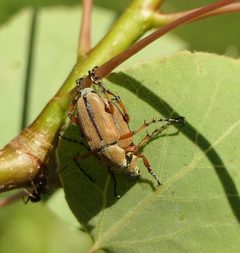
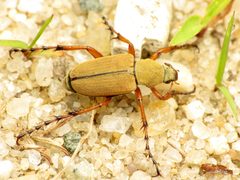
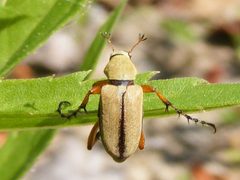
Distinguished from the European Rose Chafer (Cetonia aurata) by its Nearctic distribution and smaller size. Separated from other Macrodactylus by the combination of abbreviated exposing the , yellowish-tan hairy body, and six long spiny legs. Larvae resemble other scarab but occur in sandy soils feeding on grass and weed roots. can be aged by degree of hair wear: younger beetles retain more yellow hairs, older beetles show black on and .
Images
Appearance
have a yellowish-tan body covered in dull yellow hairs, measuring 8–13 mm in length. The are abbreviated, leaving part of the exposed. Six long, spiny legs are reddish-brown and darken distally. are short, , and clubbed with flat plates. Chewing mouthparts are present. With age, hairs wear off the and , revealing black underlying ; females often appear darker due to greater hair loss during mating. Females are more robust than males. are oval, white, shiny, and approximately 1 mm. Larvae are white, C-shaped with a brown head capsule and three pairs of legs. Pupae are yellowish-brown and about 15 mm long.
Habitat
Found in sandy soils where females oviposit 15 cm deep. Larval includes soil among grass roots, weeds, and ornamental garden plants. habitat spans agricultural fields, vineyards, orchards, and gardens where plants occur. Sandy substrate is critical for oviposition and larval development.
Distribution
Native to the Nearctic region. Range extends from Eastern Canada (Ontario, Quebec) west to Colorado and south to Texas. Additional records from Montana, Nebraska, North and South Carolina, South Dakota, Wisconsin, Iowa, Indiana, Maryland, and Massachusetts. Also reported from Neotropical regions including Rica, Jamaica, and Nicaragua, though these may represent introductions or misidentifications.
Seasonality
emerge from late May to mid-June following of overwintered larvae. Adult lifespan is 3–6 weeks. hatch in 1–3 weeks. Larvae feed through summer, then burrow deep into soil to overwinter. One per year.
Diet
feed on foliage, flowers, and fruit of diverse plants including roses, grapes, apples, peaches, chestnuts, and other garden flowers and fruits. On roses, adults skeletonize leaves. Larvae feed on roots of grasses, weeds, and ornamental garden plants.
Host Associations
- Rosa - foliage and flower herbivoreSkeletonizes leaves; namesake
- Vitis - foliage, flower, and fruit herbivoreDamages grapes at bloom; problematic for vineyards
- Malus - foliage and fruit herbivoreApple feeding observed
- Prunus persica - foliage and fruit herbivorePeach feeding observed
- Castanea - foliage and fruit herbivoreChestnut feeding observed
- Poaceae - root herbivoreLarval ; grass roots
- various weeds - root herbivoreLarval
- ornamental garden plants - root and foliage herbivoreBoth larvae and
Life Cycle
Complete with one annually. Overwintered larvae pupate in late May at approximately 18 mm length. emerge, feed, and mate for 3–6 weeks. laid in sandy soil at 15 cm depth hatch in 1–3 weeks. Larvae feed on roots through summer, then burrow deep to overwinter. occurs the following spring.
Behavior
aggregate on plants using volatile chemical cues. Feeding damage releases plant volatiles that attract additional beetles via olfactory orientation. Males preferentially orient toward virgin females, though the specific mechanism (female vs. plant volatiles induced by virgin female feeding) remains unresolved. Adults are and active flyers. Swarming observed, with densities exceeding 100 individuals per vine reported in vineyards.
Ecological Role
Herbivore that can reach densities causing significant defoliation and fruit damage. Larval root feeding may limit plant growth. mediated by plant volatiles creates localized high- feeding patches. Role in nutrient cycling through soil burrowing and root herbivory likely but unquantified.
Human Relevance
Major pest of agricultural crops and ornamental plants. Economic damage documented in vineyards, orchards, and rose gardens. Skeletonization of leaves reduces photosynthetic capacity; flower and fruit feeding reduces yield. Larval root feeding stunts plant growth. Management includes hand-picking for small and for large- . Not legally protected; subject to control measures.
Similar Taxa
- Cetonia aurataAlso called 'rose chafer' but European; distinguished by complete covering , metallic green- coloration, and Palearctic distribution
- Macrodactylus angustatusCongeneric ; may overlap in range; specific distinguishing features require examination of genitalia and detailed morphological comparison
- Phyllophaga spp.May beetles/june beetles; similar larval form and scarab ; distinguished by larger size, different adult activity period, and complete
- Osmoderma scabraHermit beetle; larvae similar C-shaped in soil; distinguished by larger size, different (decaying wood), and
Misconceptions
'rose chafer' causes confusion with the unrelated European Cetonia aurata, which belongs to a different (Cetoniinae) and has different , appearance, and distribution.
More Details
Aggregation Pheromone System
The uses a unique system where feeding damage releases plant volatiles that attract conspecifics. This differs from typical scarab systems and represents plant-insect interaction-mediated aggregation.
Aging Technique
Degree of hair wear on and provides a reliable field method for distinguishing older from younger , with females typically showing more wear due to mating activity.
Soil Preference
Sandy soils are specifically selected for oviposition, potentially limiting distribution in heavy clay or compacted soils.