
Macrodactylus
Dejean, 1821
rose chafers, American rose chafers
Species Guides
3- Macrodactylus angustatus
- Macrodactylus subspinosus(American Rose Chafer)
- Macrodactylus uniformis(Western Rose Chafer)
Macrodactylus is a of scarab beetles in the Scarabaeidae, commonly known as rose chafers or American rose chafers. The genus contains at least 110 described distributed primarily in the Americas. are typically associated with vegetation, and some species are documented agricultural pests of crops such as maize. Larval stages are soil-dwelling and develop in association with organic matter or plant roots.
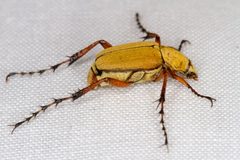
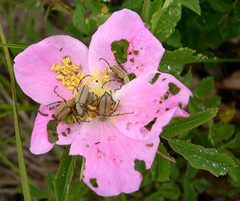
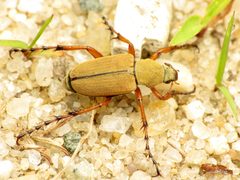
Pronunciation
How to pronounce Macrodactylus: /ˌmæk.roʊˈdæk.tɪ.ləs/
These audio files are automatically generated. While they are not always 100% accurate, they are a good starting point.
Images
Habitat
Associated with vegetation including shrubs and agricultural crops; larvae are soil-dwelling. Specific have been documented in maize fields in highland regions of Central Mexico and in association with Baccharis salicifolia shrubs.
Distribution
Primarily distributed in the Americas. Documented from Mexico, Central America (Guatemala, El Salvador, Honduras), and the United States (including Vermont). The Central American at least 20 described .
Host Associations
- Zea mays - pestMacrodactylus nigripes documented as pest of maize crops in Central Mexico
- Baccharis salicifolia - feeding and mating siteMacrodactylus nigripes observed feeding on leaves and mating on this shrub
Life Cycle
Larval stage is soil-dwelling and represents the primary form. Larvae of multiple (M. ocreatus, M. nigripes, M. uniformis) have been described from Mexico. emerge from soil to feed and reproduce.
Behavior
exhibit a sequence of including from soil, to vegetation, leaf feeding by moving across leaf margins to obtain fragments, and mate-finding. Females may exhibit 'calling' behavior to attract males. Distribution patterns in agricultural settings vary by regime: clumped distributions observed in mixed and organic fertilization plots, regular and clumped in conventional fertilization.
Ecological Role
Phytophagous insects that interact with plants through feeding and chemical-mediated attraction. Some function as agricultural pests in maize systems.
Human Relevance
Some are agricultural pests of maize crops. Research interest in chemical and plant location mechanisms due to economic impact.
Similar Taxa
- Stag beetles (Lucanidae)Larvae are superficially similar—large, cream-colored with brown and jaws—requiring careful identification to distinguish from Macrodactylus larvae
- Maybugs/Cockchafers (Melolontha)Larvae share similar and soil-dwelling habit, leading to potential confusion in larval identification
- Lesser stag beetles (Dorcus parallelipipedus)Larvae resemble Macrodactylus larvae in general appearance and use
More Details
Chemical ecology research
Studies have identified volatile compounds from plants (α-pinene, trimethylindan, cyclohexylbenzene from Baccharis salicifolia) that may mediate attraction of Macrodactylus nigripes . Molecular modeling research has examined odorant-binding protein affinity for volatile organic compounds in M. mexicanus to understand host plant location mechanisms.
Agricultural management relevance
regime affects abundance and spatial distribution in crop systems. Organic fertilization has been observed to promote higher abundance compared to conventional fertilization in Central Mexican maize fields.
Sources and further reading
- BugGuide
- Wikipedia
- GBIF taxonomy match
- iNaturalist taxon
- NCBI Taxonomy
- Catalogue of Life
- Stag Weekend 5th – 7th June – Celebrate and save threatened Stag beetles - Buglife Blog - Buglife
- Description of the Larvae of Three Species ofMacrodactylusDejean (Coleoptera: Scarabaeidae: Melolonthinae) from Mexico, with Notes on the Reproductive Behavior ofMacrodactylus ocreatusBates
- Effects of fertilization in maize crops on abundance and distribution of Macrodactylus nigripes (Coleoptera: Melolonthidae) from highlands of Central Mexico
- Molecular modeling of host plant location of Macrodactylus mexicanus1: affinity of odorant-binding proteins for volatile organic compounds
- Ecology of shrimps on the eel-grass bed. 2. Leander macrodactylus and others
- Review of the species of Macrodactylus Dejean (Coleoptera: Scarabaeidae: Melolonthinae) from the Central American Nucleus
- Chemical profile of the volatiles of Baccharis salicifolia (Asteraceae) and interaction with Macrodactylus nigripes (Coleoptera: Melolonthidae)