
Phileurus valgus
(Olivier, 1789)
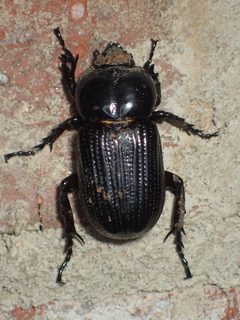
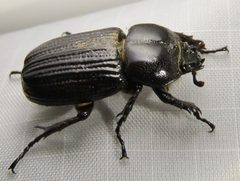
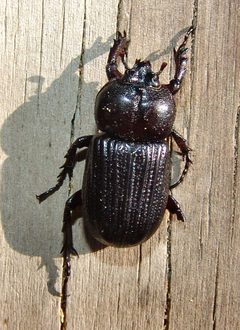
Phileurus valgus is a small dynastine scarab beetle in the tribe Phileurini, distributed from the southern United States through Central America and into South America. are attracted to lights and have been found under bark of decaying wood. Larvae develop in rotting wood cavities. The is sometimes mistaken for bess beetles (Passalidae) due to its flattened, parallel-sided body form.
Pronunciation
How to pronounce Phileurus valgus: /faɪˈlɪərəs ˈvælgəs/
These audio files are automatically generated. While they are not always 100% accurate, they are a good starting point.
Identification
Distinguished from larger dynastines by small size and lack of prominent horns. Separated from true bess beetles (Passalidae) by antennal structure and other scarabaeid characteristics. The combination of small on and pronotum, flattened body, and association with decaying wood distinguishes it from other small scarabs.
Images
Habitat
Found in wet bottomland forests and areas with decaying wood. recorded under loose bark of standing dead trees with soft, well-decayed wood. Larval consists of wood cavities in dead trees.
Distribution
Widely distributed from the southern United States (Alabama, Arkansas, Florida, Georgia, Illinois, Indiana, Kansas, Kentucky, Louisiana, Maryland, Michigan, Mississippi, Missouri, Nebraska, New Mexico, North Carolina, Ohio, Oklahoma, South Carolina, Tennessee, Texas, Virginia) through Mexico, Central America, the Caribbean, and into South America (Argentina, Brazil, Bolivia, Colombia, Ecuador, Paraguay, Peru, Venezuela, and others).
Seasonality
have been recorded from June through September based on collection records. Attraction to lights suggests activity.
Host Associations
- Tilia sp. - larval Reared from larvae collected in cavity of dead basswood tree
- Quercus marilandica - larval Reared from larvae collected in blackjack oak snag
- Quercus palustris - microhabitat found under bark of standing dead pin oak
Life Cycle
Complete with described stages. Third instar larva and pupa described from Argentine specimens. Larvae develop in -filled galleries beneath bark and within wood cavities of dead trees. Specific developmental duration unknown.
Behavior
are and attracted to lights. When disturbed, adults do not produce sounds—unlike true bess beetles which stridulate. Adults have been found in of up to several individuals under loose bark.
Ecological Role
Decomposer in forest , contributing to wood decay and nutrient cycling through larval feeding in dead wood.
Similar Taxa
- Odontotaenius disjunctusTrue bess with similar flattened, parallel-sided body form; distinguished by stridulatory and passalid characteristics
- Cyclocephala spp.Small dynastines sometimes mistaken for May beetles; distinguished by body shape and antennal club structure
Misconceptions
Sometimes mistaken for bess beetles (Passalidae) due to convergent body form, but belongs to Scarabaeidae. The resemblance represents convergent to similar rather than close phylogenetic relationship.
More Details
Sound production
possess structures known to be used by other beetles for sound production, but actual stridulation has not been documented. This contrasts with true bess beetles, which produce audible 'kissing' sounds when handled.
Taxonomic history
Originally described by Olivier in 1789. The Phileurus is primarily Neotropical, with only two ranging north into the United States.
Sources and further reading
- BugGuide
- Wikipedia
- GBIF taxonomy match
- iNaturalist taxon
- NCBI Taxonomy
- Catalogue of Life
- Scarabaeidae | Beetles In The Bush | Page 3
- Archives | Beetles In The Bush
- Coleoptera | Beetles In The Bush | Page 10
- Description of the pupa and redescription of the third instar of Phileurus valgus (Olivier) (Coleoptera: Scarabaeidae: Dynastinae: Phileurini)