
Odontotaenius disjunctus
(Illiger, 1800)
patent-leather beetle, horned passalus, betsy beetle, Jerusalem beetle
Odontotaenius disjunctus is a large, -capable but predominantly that inhabits decaying hardwood logs in temperate North American forests. exhibit subsocial , including cooperative care and via stridulation. The plays a significant role in wood decomposition through specialized gut microbiomes that digest lignocellulose.
Pronunciation
How to pronounce Odontotaenius disjunctus: /oʊˌdɒntoʊˈteɪnjəs dɪsˈdʒʌŋktəs/
These audio files are automatically generated. While they are not always 100% accurate, they are a good starting point.
Identification
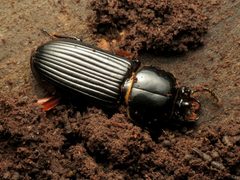
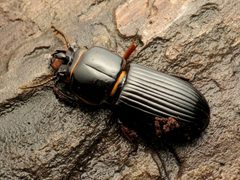
Distinguished from other Passalidae by the combination of large size (>3 cm), shiny black with grooved , and presence of a small horn between the . The horn separates it from hornless passalid . The stridulatory sound produced when disturbed is diagnostic at the level. Two divergent mitochondrial lineages occur in sympatry across the range; these are morphologically indistinguishable but detectable via assay.
Images
Habitat
Strictly saproxylic; found within rotting logs and stumps of deciduous trees, particularly oak (Quercus) and hickory (Carya). Occupies well-decomposed wood that falls apart readily. Rarely observed outside wooden substrates except during mate searching or to new logs. Requires humid microenvironments with stable temperature and moisture conditions provided by water-retentive decaying wood.
Distribution
Eastern and central North America, from southern Canada (Ontario, Manitoba) through the eastern United States (Florida to Massachusetts, west to Minnesota, Nebraska, Kansas, Oklahoma, Texas) and into the Neotropics (Brazil). Most abundant in temperate deciduous forests with high humidity. Two genetically divergent lineages occur in broad sympatry throughout the southern Appalachian Mountains and surrounding regions.
Seasonality
Active year-round within logs due to buffered microclimate. search for mates and new logs primarily during spring and summer. Females lay the majority of during summer months. Offspring disperse from parental tunnels in late spring following .
Diet
feed on decaying wood of deciduous trees, particularly oak and hickory. Larvae consume a mixture of wood particles, fungi, and parental secretions (regurgitated, pre-digested wood and ). Wood digestion depends on a fiber-associated microbiome in the dominated by Lactococcus and Turicibacter.
Host Associations
- Quercus - food sourceoak logs
- Carya - food sourcehickory logs
Life Cycle
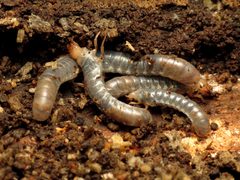
, larva, pupa, . Larvae develop in parental tunnels over approximately one year, receiving continuous parental care. Developmental time can be as short as 3 months under optimal conditions with abundant food. Adults may live up to one year. Offspring overwinter in parental burrows and disperse in late spring.
Behavior
Subsocial: cooperate in care, feeding larvae with regurgitated, pre-digested material. Both adults and larvae produce audible stridulatory sounds by rubbing the sixth abdominal tergite against the surface of folded metathoracic wings; signals communicate danger, courtship, disturbance, and other contexts. Adults are predominantly despite capability; will walk long distances rather than fly. Males compete for females and territory using the horn to flip opponents. Infanticide occurs when non-reproducing adults usurp occupied burrows. Adults exhibit aggressive and avoidance toward non-nestmate conspecifics.
Ecological Role
Primary decomposer of decaying hardwood in temperate forests. Accelerates wood decomposition through feeding and tunneling activities. Specialized lignocellulose digestion via gut facilitates nutrient cycling in forest . The occupies a food resource largely unavailable to most other organisms, reducing .
Human Relevance
Considered beneficial for forest health due to wood decomposition services. Harmless to humans and not a pest of living trees or structures. Used as a model organism for studies of subsocial , stress physiology, gut microbiome function, and biomechanics (documented to pull 50 times body weight). declines documented due to deforestation and fragmentation; does not tolerate forest fragmentation well.
Similar Taxa
- Other PassalidaeO. disjunctus is distinguished by its large size, cephalic horn, and North American temperate distribution; tropical passalids often lack horns or have different horn morphologies
- Lucanidae (stag beetles)Both have enlarged or horns and large size, but stag beetles lack the grooved and stridulatory of passalids; males typically show more pronounced mandibular dimorphism
Misconceptions
Despite suggesting otherwise, this is not a Jerusalem (a name also applied to unrelated beetles in the Stenopelmatus) and is not a true beetle of Jerusalem or religious significance. The name "patent-leather" refers to the shiny appearance, not any commercial use.
More Details
Genetic structure
Two divergent mitochondrial lineages (5.9–7.5× divergence between vs. within clades) occur in broad sympatry, often syntopic within the same rotting logs. A simple assay has been developed to distinguish lineages.
Parasite interactions
Commonly infected by the Chondronema passali in the abdominal cavity. modestly reduces cardiac stress response magnitude, though baseline rate is unaffected.
Gut microbiome
harbors distinct fiber-associated bacterial enriched in Lactococcus and Turicibacter, analogous to but phylogenetically distinct from fiber-digesting microbiomes of wood-feeding . Wood particles in the gut serve as crucial microhabitats for cellulose- and xylan-degrading bacteria.
Sources and further reading
- BugGuide
- Wikipedia
- GBIF taxonomy match
- iNaturalist taxon
- NCBI Taxonomy
- Catalogue of Life
- Horned passalus, Odontotaenius disjunctus (Illiger) (Insecta: Coleoptera: Passalidae: Passalinae)
- Infanticidal Behavior in the Subsocial Beetle Odontotaenius disjunctus (Illiger) (Coleoptera: Passalidae)
- Behavioral Interactions Between Non-Cohabiting Bess Beetles, Odontotaenius disjunctus (Illiger) (Coleoptera: Passalidae)
- Habitat-Specific Movement and Edge-Mediated Behavior of the Saproxylic InsectOdontotaenius disjunctus(Coleoptera: Passalidae)
- The Heartrate Reaction to Acute Stress in Horned Passalus Beetles (Odontotaenius disjunctus) is Negatively Affected by a Naturally-Occurring Nematode Parasite
- Wood fibers are a crucial microhabitat for cellulose- and xylan- degrading bacteria in the hindgut of the wood-feeding beetle Odontotaenius disjunctus
- A novel d-xylose isomerase from the gut of the wood feeding beetle Odontotaenius disjunctus efficiently expressed in Saccharomyces cerevisiae
- Two Divergent Genetic Lineages within the Horned Passalus Beetle, Odontotaenius disjunctus (Coleoptera: Passalidae): An Emerging Model for Insect Behavior, Physiology, and Microbiome Research