
Xyloryctes jamaicensis
(Drury, 1773)
Eastern Rhinoceros Beetle, Rhinoceros Beetle, Unicorn Beetle
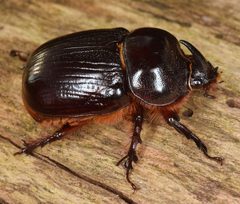
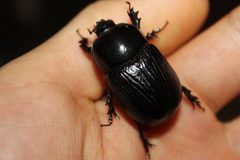
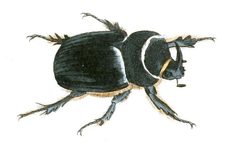
Xyloryctes jamaicensis, commonly called the Eastern Rhinoceros Beetle or Unicorn , is a medium-sized rhinoceros beetle in the Scarabaeidae, Dynastinae. Males possess a prominent horn projecting from the , used in combat with other males. The is native to eastern and central North America, ranging from southern Canada through the eastern United States and into Mexico. are and frequently attracted to lights.
Pronunciation
How to pronounce Xyloryctes jamaicensis: //zaɪloʊˈrɪktiːz ˌdʒæmeɪˈsɛnsɪs//
These audio files are automatically generated. While they are not always 100% accurate, they are a good starting point.
Identification
Distinguished from other North American rhinoceros beetles by the single, forward-projecting horn in males (not branched or paired). Smaller than Dynastes (Hercules beetles). Separated from Strategus aloeus (Ox Beetle) by horn shape and body proportions. Xyloryctes thestalus, a southwestern species, is similar but geographically separated; identification to species level may require examination of geographic range and subtle morphological differences.
Images
Appearance
Medium-sized scarab beetle with robust, oval body. Males possess a single, curved horn projecting forward from the ; horn size varies individually. Females lack the horn and have a rounded head. Body coloration is typically dark brown to black. are (clubbed with plate-like segments). are smooth to slightly textured, covering the completely.
Habitat
Deciduous woodlands and forest edges. Associated with wooded areas containing suitable larval substrate. have been observed in dry, mixed conifer forest with oaks at elevations around 7,000 feet. specificity for larvae poorly documented but presumably involves decaying wood or soil with organic matter.
Distribution
Eastern and central North America: Canada (Ontario, Quebec), United States (widespread in eastern and central states from New England south to Florida, west to Texas and north to Minnesota, Wisconsin), and Mexico (Coahuila, Hidalgo, Nuevo León, Puebla, Veracruz).
Seasonality
active during summer months, with peak activity in July and August. , frequently attracted to artificial lights after dark.
Life Cycle
Complete with , larva, pupa, and stages. Larval development presumably occurs in decaying wood or soil rich in organic matter, typical of Dynastinae, but specific substrate requirements for this are not well documented. Larval period duration unknown.
Behavior
. are clumsy fliers and frequently attracted to lights at night. Males use their horns in combat with other males, presumably for access to females. activity observed after sunset in urban and woodland settings.
Ecological Role
Larvae likely contribute to decomposition of decaying wood and nutrient cycling in forest , though specific ecological impacts for this are undocumented. may feed on plant exudates or fermenting materials, but this is inferred from related species and not confirmed.
Human Relevance
Occasionally encountered at porch lights and blacklights, where it attracts attention due to horned male . Sometimes mistaken for larger rhinoceros beetle . No documented economic importance as pest or beneficial species.
Similar Taxa
- Xyloryctes thestalusSimilar size and , but geographically separated; X. thestalus occurs in southwestern United States (New Mexico, Arizona) and Mexico, while X. jamaicensis is eastern and central. Subtle differences in male horn shape and body proportions may exist.
- Dynastes tityusAnother North American rhinoceros beetle, but much larger (up to 60+ mm), with paired horns in males and distinct yellow-green coloration; easily distinguished by size and horn configuration.
- Strategus aloeusOx beetle is larger, with three horns in males (two thoracic, one cephalic); horn configuration immediately distinguishes it from single-horned Xyloryctes.
More Details
Taxonomic Note
The epithet 'jamaicensis' is misleading; the species is not native to Jamaica but to continental North America. The name likely refers to the type locality or historical collection origin, not current distribution.
Research Gaps
Despite being a widespread and conspicuous , detailed ecological studies are lacking. The 1965 paper by R.E. Woodruff on Ontario explicitly noted that observations were 'fragmentary' and identified need for further research on , larval , and . This situation persists.
Sources and further reading
- BugGuide
- Wikipedia
- GBIF taxonomy match
- iNaturalist taxon
- Catalogue of Life
- The Beetles and the Sticks | Bug Squad
- Host and a Parasite: Battle of Sand Field Crickets vs. Horsehair Worms | Bug Squad
- Judas Beetles: How Coconut Rhinoceros Beetles Are Betraying Each Other's Secrets
- Bug Eric: New Mexico Night Bugs
- Bug Eric: New Mexico Dragonfly Blitz - Day 1
- My, what ginormous jaws you have my dear: Elephant stag beetle, Lucanus elaphus — Bug of the Week
- Notes on the Ecology of Xyloryctes Jamaicensis (Coleoptera: Scarabaeidae) in Southern Ontario