
Trichiotinus piger
(Fabricius, 1775)
Bee-like Flower Scarab, Hairy Flower Chafer
Trichiotinus piger is a flower scarab beetle in the Scarabaeidae, commonly known as the -like flower scarab or hairy flower . are active during summer months and feed on pollen and nectar from flowers of various deciduous trees and shrubs. The is distributed across eastern and central North America, from southern Canada through the eastern United States. Larvae develop in soil, feeding on plant roots over a multi-year period before pupating.
Pronunciation
How to pronounce Trichiotinus piger: //ˌtrɪkiˈoʊtɪnəs ˈpaɪɡər//
These audio files are automatically generated. While they are not always 100% accurate, they are a good starting point.
Identification
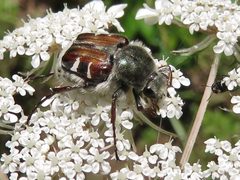
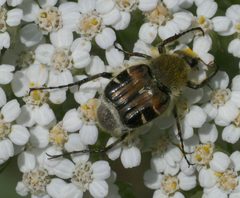
Distinguished from other Trichiotinus by the combination of dense body setae and specific elytral patterning. The -like appearance separates it from most other scarab . Within Cetoniinae, Trichiotinus species can be difficult to distinguish; T. piger is characterized by particular arrangements of pale elytral markings and the of setae. are and found on flowers, unlike many scarabs.
Images
Appearance
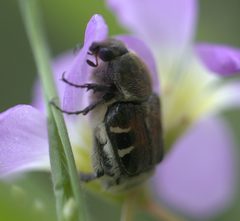
are moderately sized scarab beetles with a robust, oval body form. The body is covered with dense, erect setae giving a distinctly hairy appearance—hence the "hairy flower ." Coloration is typically black or dark brown with variable patterns of lighter markings. The are often marked with yellowish or whitish bands or spots. are (clubbed with plate-like segments), typical of scarab beetles. The overall appearance is notably -like, contributing to its protective mimicry.
Habitat
are found in open areas, woodland edges, and gardens where flowering plants are abundant. Larvae inhabit soil in grassy areas, pastures, gardens, and amenity turf such as golf courses. The shows preference for well-drained soils in areas with herbaceous vegetation or deciduous tree cover.
Distribution
Eastern and central North America: southern Ontario, Canada; throughout the eastern United States from Maine south to Florida, west to Texas, Colorado, and the Great Plains states. Absent from the far western United States and most of Canada outside Ontario.
Seasonality
are active primarily during summer months, typically June through August in most of the range. Peak activity coincides with flowering periods of plants. Larvae are present in soil year-round, with development spanning multiple years.
Diet
feed on pollen and nectar from flowers of deciduous trees, shrubs, and herbaceous plants. Specific recorded include flowers of various Rosaceae and other flowering trees. Larvae feed on plant roots, particularly those of grasses and cereals; occasionally reported feeding on roots of vegetables (lettuce, raspberry, strawberry) and young ornamental trees.
Host Associations
- deciduous trees - food sourceflowers and leaves
- grasses - larval food sourceroot feeding
- cereals - larval food sourceroot feeding
- lettuce - occasional larval food sourceroot feeding in gardens
- raspberry - occasional larval food sourceroot feeding
- strawberry - occasional larval food sourceroot feeding
Life Cycle
Complete with four stages: , larva, pupa, . Eggs are laid in soil. Larvae () feed below ground on plant roots for 3–4 years, reaching 40–45 mm at full growth. Larvae typically rest in a characteristic comma-like position immediately below the soil surface. occurs in soil. Adults emerge in summer and live for several weeks to months.
Behavior
are and active on flowers, where they feed and likely engage in mating. They are capable fliers and readily move between flowering plants. When disturbed, adults may drop from flowers or fly to nearby vegetation. Larvae are sedentary, feeding on roots in a fixed location until mature.
Ecological Role
act as for various flowering plants while feeding on pollen and nectar. Larvae contribute to soil nutrient cycling through root feeding and decomposition processes. The serves as prey for various vertebrate and ; the -like appearance of adults provides protective mimicry against visual predators.
Human Relevance
are generally harmless and sometimes considered beneficial as . Larvae are occasional pests in managed turf, pastures, nurseries, and gardens, where root feeding can damage grasses and young plants. Rarely causes serious economic damage. The is of minor concern compared to more destructive scarab pests such as Japanese beetle or May/June beetles.
Similar Taxa
- Trichiotinus lunulatusOverlapping range and similar flower-visiting habits; distinguished by differences in elytral patterning and setal
- Trichiotinus texanusSimilar appearance and ; T. texanus is more restricted to Texas and Oklahoma region
- Trichiotinus rufobrunneusFlorida with similar flower scarab ; distinguished by coloration and geographic restriction
- Euphoria spp.Other Cetoniinae with similar flower-visiting ; Euphoria often more brightly colored and less hairy