
Trichiotinus texanus
(Horn, 1876)
Texas flower scarab
Trichiotinus texanus, the Texas flower scarab, is a of flower chafer in the Scarabaeidae. It is a regional specialty found primarily in Texas and Oklahoma, where it has been collected on flowers of various native plants including Allium sp., Cirsium undulatum, and Torilis arvensis. The species is part of the Trichiotinus, which contains other North American flower scarabs often associated with blooming vegetation.
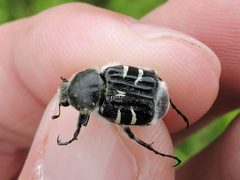
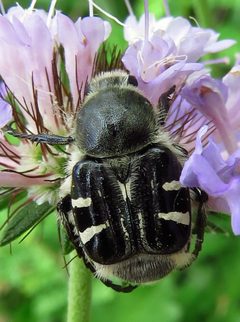
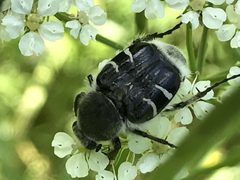
Pronunciation
How to pronounce Trichiotinus texanus: /ˌtrɪkiˈoʊtɪnəs tɛkˈsænəs/
These audio files are automatically generated. While they are not always 100% accurate, they are a good starting point.
Images
Habitat
Native prairie and open woodland with abundant flowering vegetation. Collections have occurred in areas with post oak woodlands, sandstone glades, and mixed grassland-woodland . Associated with native wildflower including Coreopsis, Gaillardia, and Thelesperma.
Distribution
Nearctic region: United States (Colorado, Florida, Kansas, New Mexico, Oklahoma, Texas). Core range appears to be Texas and Oklahoma, with scattered records elsewhere in the south-central United States.
Seasonality
have been collected in June and July, suggesting peak activity during early to mid-summer when flowers are in bloom.
Diet
feed on pollen and nectar of flowers. Documented flower include Allium sp. (wild onion), Cirsium undulatum (wavyleaf thistle), and Torilis arvensis (erect hedge parsley).
Host Associations
- Allium sp. - feedingwild onion
- Cirsium undulatum - feedingwavyleaf thistle
- Torilis arvensis - feedingerect hedge parsley, introduced plant
Behavior
are and actively seek out flowers. They have been observed on multiple flower within the same collecting area, suggesting opportunistic flower visitation rather than strict fidelity.
Ecological Role
function as while feeding on floral resources. As a flower chafer, they contribute to pollen transfer among native and introduced flowering plants in prairie and woodland .
Similar Taxa
- Trichiotinus affinisSimilar flower chafer and flower-visiting ; T. texanus distinguished by geographic range and subtle structural differences
- Euphoria kerniiSympatric flower scarab with similar flower association; E. kernii shows multiple color forms and tends toward more abundant in Opuntia flowers
More Details
Conservation status
Not formally assessed; appears to be locally common within its core range but with limited overall distribution
Subspecies
Two recognized: T. t. texanus and T. t. monticola Casey, 1915