
Cremastocheilus castaneae
Knoch, 1801
anteater scarab beetle
Cremastocheilus castaneae is a myrmecophilous scarab beetle known as an 'anteater scarab' for its specialized predatory relationship with ants. and larvae inhabit colonies, primarily those of mound-building Formica , where they feed on ant . The species exhibits remarkable morphological and behavioral adaptations for colony infiltration and survival, including death-feigning to gain entry and dense, armored for protection. It is one of approximately 35 North American species in the Cremastocheilus, which reaches greatest diversity in the desert southwest but occurs across much of the United States and southern Canada.
Pronunciation
How to pronounce Cremastocheilus castaneae: /krɛˌmæstoʊˈkiːləs kæsˈtæniˌiː/
These audio files are automatically generated. While they are not always 100% accurate, they are a good starting point.
Identification
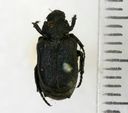
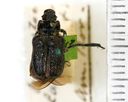
Distinguished from other scarab beetles by the combination of small size (~10 mm), flattened angular body, dull black coloration with dense pitted/wrinkled , and concealed . Most reliably identified by association with colonies. Separated from other Cremastocheilus by subtle morphological differences in surface sculpturing and body proportions; definitive identification often requires examination of genitalia or reference to literature. The trichomes on the pronotal hind angles are characteristic of the but not unique to this species.
Images
Habitat
Associated with colonies, particularly mound-building in the Formica. Found in diverse terrestrial including prairies, woodlands, and open areas where ant species occur. disperse to locate new host colonies, often crash-landing in areas trafficked by scouting ants. Larval habitat consists of soil and decaying organic matter within or adjacent to ant nest mounds.
Distribution
Nearctic region: Canada (Alberta, Manitoba, New Brunswick, Nova Scotia, Saskatchewan) and United States (Colorado, Connecticut, Georgia, Illinois, Indiana, Iowa, Kansas, Maine, Maryland, Michigan, Mississippi, New Jersey, New York, North Carolina, Pennsylvania, South Carolina, Virginia, Washington, Wisconsin).
Seasonality
most frequently encountered during spring period when seeking new colonies. New adults emerge from pupal in late summer or fall, then overwinter within nests. Activity resumes in spring when ant colonies become active and beetles begin feeding on ant .
Diet
Specialized of . feed on ant larvae and pupae, using modified to pierce soft and reduced to transport liquid food. Larvae feed on decaying vegetation and organic matter that ants have composted within nest mounds.
Host Associations
- Formica - primary Mound-building , especially thatching ants
- Myrmecocystus - Honeypot ants
- Lasius - Cornfield ants
- Camponotus - Carpenter ants
- Pogonomyrmex - Harvester ants; southwestern
- Veromessor - Harvester ants; southwestern
- Aphaenogaster - Spine-waisted ants; southwestern
Life Cycle
Females lay singly in soil around periphery of nest mounds. Larvae pass through three instars, feeding on composted organic matter and defending themselves with mandibular strikes and repulsive glandular secretions. occurs in oval chambers constructed from soil particles. Complete development from egg to requires approximately four months. New adults emerge in late summer or fall, acquire colony scent while moving to nest center, and overwinter. Adults are long-lived within colonies, potentially surviving multiple years.
Behavior
employ death-feigning () to infiltrate colonies: they remain motionless with legs outstretched in areas trafficked by scouting ants, which carry the apparently inert beetles into nests. Once inside, beetles acquire colony-specific chemical cues through prolonged contact, rendering them chemically inconspicuous to . Adults are fast, capable fliers during but frequently crash-land when locating new colonies. Larvae defend themselves actively against ant aggression using and defensive secretions.
Ecological Role
within colony , exerting top-down pressure on ant . Represents a specialized case of myrmecophily where is mediated by chemical and behavioral deception rather than mutualistic exchange. Population densities can reach 20-30 beetles per nest, occasionally exceeding 200 individuals in large colonies, suggesting potentially significant impact on ant reproductive success.
Human Relevance
No direct economic importance. Of scientific interest as a model system for studying myrmecophily, chemical deception, and -prey . Rarely encountered by non- due to cryptic lifestyle within colonies. Occasionally found in disturbed or under stones and boards when ant colonies are exposed.
Similar Taxa
- Other Cremastocheilus speciesApproximately 35 North American share similar , size, and myrmecophilous habits; species-level identification requires detailed examination
- Other Cetoniinae scarabsSome small, dark scarabs may resemble Cremastocheilus superficially, but lack the flattened angular body, concealed , and pronotal trichomes
Misconceptions
Early interpretations suggested that pronotal trichome secretions functioned as attractants or pacifying agents for ants; subsequent research indicates this hypothesis is unsupported and the function of these structures remains unresolved.
More Details
Taxonomic note
Authorship is sometimes cited as Kirby, 1826, but Knoch, 1801 has priority. The Cremastocheilus is currently undergoing taxonomic revision.
Morphological adaptations for myrmecophily
Mouthparts highly modified for liquid feeding on : enlarged into shield-like structure, developed into piercing appendages, reduced. These adaptations represent with other myrmecophilous beetles.