
Cremastocheilus armatus
Walker, 1866
anteater scarab beetle
Species Guides
1Cremastocheilus armatus is a myrmecophilous scarab beetle specialized for life within colonies. The exhibits extreme morphological adaptations including reduced , shortened exposing most of the , and dense trichomes on abdominal tergites. Males display prominent pronotal horns absent in females. The integrates into ant colonies where it obtains food through interactions with ants.
Pronunciation
How to pronounce Cremastocheilus armatus: /krɛˌmæstoʊˈkaɪləs ɑrˈmeɪtəs/
These audio files are automatically generated. While they are not always 100% accurate, they are a good starting point.
Identification
Distinguished from other Cremastocheilus by specific pronotal armature in males. Differs from non-myrmecophilous scarabs by combination of reduced , shortened exposing , and dense abdominal trichomes. Most reliably identified by collection from nests. Separation from other Cremastocheilus requires examination of male pronotal horn and geographic distribution.
Images
Appearance
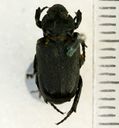
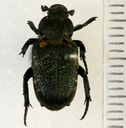
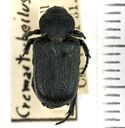
Small, dull black approximately 10 mm in length. Body strongly flattened and angular with exceedingly dense often bearing pits or wrinkles. shortened, exposing most of the . Abdomen with dense trichomes (setae) on tergites. reduced. Males possess prominent horns on pronotum; females lack these horns. normally protected in grooves under .
Habitat
Distribution
Western North America: recorded from California, Idaho, Montana, Nevada, Oregon, and British Columbia. Distribution corresponds to range of in this region.
Seasonality
present in colonies year-round. to locate new colonies occur in spring. New adults emerge from pupal in late summer or early fall.
Diet
Feeds on liquid food obtained from ants through or by soliciting regurgitation from . do not consume solid food; reduced and function only to transport liquid to mouth.
Host Associations
- Formica species - mound-building , primary
- Myrmecocystus - honeypot ants
- Lasius - cornfield ants
- Camponotus - carpenter ants
Life Cycle
Complete . Females lay singly in soil around nest periphery. Larvae feed on decaying vegetation composted by ants, progressing through three instars over approximately four months. Larvae defend against attacks with striking and repulsive secretions from mandibular and anal glands. occurs in oval chambers constructed from soil particles. emerge in late summer or fall, move to nest center to acquire colony scent, and remain through winter. Spring activation triggers feeding on ant larvae and pupae using modified to pierce soft .
Behavior
Employs death-feigning () to gain entry to nests: remains motionless with legs outstretched in areas trafficked by scouting , enabling discovery and transport into nest by ants as presumed food items. move freely within colonies without eliciting aggression, presumably through chemical integration. Acquire colony scent by slow movement to nest center after . Feeds on ant using specialized piercing-sucking mouthpart modifications.
Ecological Role
Myrmecophilous occupying intermediate position between commensalism and . Integrates into colony as recipient of liquid resources and of ant . densities vary: typically 20-30 individuals per excavated nest, occasionally up to 200.
Human Relevance
No direct economic or medical significance. Of scientific interest as example of extreme myrmecophilous specialization and with other -associated beetles.
Similar Taxa
- Other Cremastocheilus speciesShare myrmecophilous lifestyle and general body plan; distinguished by male pronotal horn and geographic range
- Non-myrmecophilous CetoniinaeDiffer in complete covering , well-developed , lack of abdominal trichomes, and free-living habit
More Details
Trichome function
Abdominal trichomes were originally interpreted as producing pacifying or attractant substances for ants; this function has been questioned and their exact role remains unresolved.
Mouthpart modifications
enlarged and shield-like, covering other mouthparts from below. modified into sharp appendages for piercing larvae and pupae.
Sources and further reading
- BugGuide
- Wikipedia
- GBIF taxonomy match
- iNaturalist taxon
- Bug Eric: Anteater Scarab Beetles
- Europe’s most complete stegosaurian skull unearthed in Spain
- Ants invade Beetles in the Bush! | Beetles In The Bush
- Notes on the Life Cycle and Myrmecophilous Adaptations of Cremastocheilus Armatus(Coleoptera: Scarabaeidae)