
Ataenius spretulus
(Haldeman, 1848)
black turfgrass ataenius, black fairway beetle
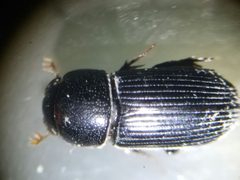
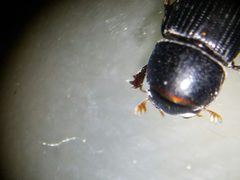
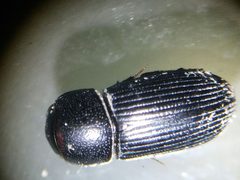
Ataenius spretulus is a scarab beetle (Coleoptera: Scarabaeidae) commonly known as the black turfgrass ataenius or black fairway . It is the most common in golf course fairways in Michigan and throughout much of North America. The has been extensively studied in turfgrass management contexts due to its economic impact as a root-feeding pest. Research indicates its abundance and distribution are influenced by soil moisture levels, mowing height, and natural enemy pressure rather than oviposition preferences alone.
Pronunciation
How to pronounce Ataenius spretulus: /əˈtiːniəs sprɛˈtuːləs/
These audio files are automatically generated. While they are not always 100% accurate, they are a good starting point.
Identification
are small aphodiine scarab beetles. Larvae () are the damaging stage and can be distinguished from other turfgrass scarabs by their association with very closely mowed turf; they are reportedly 3- to 10-fold more abundant in fairways maintained at 1.5 cm height compared to roughs at 5.0 cm or higher. Third instar larvae have been specifically studied for sampling protocols in control trials.
Images
Habitat
Turfgrass systems, particularly golf course fairways and roughs. prefer soil with volumetric moisture content of 13% to 26% over 8% to 9% for selection. feed in the root zone of turfgrass, with highest densities in fairway-height turf despite adult habitat selection being driven by moisture rather than mowing height.
Distribution
North America: documented across the United States (Alabama, Arkansas, California, Colorado, Connecticut, Delaware, Florida, Georgia, Idaho, Illinois, Indiana, Iowa, Kansas, Kentucky, Louisiana, Maryland, Massachusetts, Michigan, Minnesota, Mississippi, Missouri, Nebraska, New Hampshire, New Jersey, New Mexico, New York, North Carolina, North Dakota, Ohio, Oklahoma, Pennsylvania, Rhode Island, South Carolina, South Dakota, Tennessee, Texas, Utah, Virginia, West Virginia, Wisconsin, Wyoming) and Canada (Ontario, Quebec). Also recorded from Portugal (Palaearctic).
Diet
Larvae feed on turfgrass roots, causing damage to fairways and managed turf. feeding habits are not explicitly documented in available sources.
Life Cycle
Development includes , larval (), pupal, and stages. Third instar larvae are a distinct developmental stage that has been targeted in sampling and control studies. Specific timing of life stages or voltinism is not documented in available sources.
Behavior
select based on soil moisture levels rather than mowing height. Despite 3- to 10-fold higher abundance in fairways versus roughs, greenhouse experiments showed no ovipositional preference between fairway-height (1.5 cm) and rough-height (5.0 cm or higher) turf. This discrepancy suggests post-oviposition factors such as differential , , or microhabitat suitability influence observed spatial patterns.
Ecological Role
function as root herbivores in turfgrass . The serves as prey for insects, with rates reportedly greater in roughs than fairways. by sp. has been documented and is more prevalent in roughs, potentially contributing to .
Human Relevance
Economic pest of golf course fairways and managed turfgrass. The U.S. natural grass sod industry is valued at over $1.1 billion, with turf management representing a $40 billion industry covering approximately 50 million acres. Management strategies include monitoring through sequential sampling protocols, adjusting mowing height and irrigation practices, and integrating via natural enemies. Understanding vertical distribution of activity in turfgrass canyons informs targeted management approaches.
Similar Taxa
- Aphodius granariusCo-occurs in golf course fairways and roughs; exhibits distinct spatial distribution patterns across fairway-rough gradients compared to A. spretulus, suggesting differential use or response to management practices
More Details
Population Dynamics and Management Implications
Higher abundance in fairways despite lack of oviposition preference for mowing height indicates that patterns are driven by factors other than initial placement. Greater and in roughs may partially explain fairway outbreaks by reducing rough . This suggests that cultural practices creating rough-like conditions in fairways—such as increased mowing height—could enhance , though adult moisture preferences (13-26% volumetric soil moisture) must also be considered in irrigation management.
Sources and further reading
- BugGuide
- Wikipedia
- GBIF taxonomy match
- iNaturalist taxon
- NCBI Taxonomy
- Catalogue of Life
- How Insect Interactions Vary by Height in Turfgrass
- Sampling distributions and sequential sampling for third instars of black turfgrass ataenius, Ataenius spretulus (Haldeman), in control trials
- Spatial Distribution of Ataenius spretulus, Aphodius granarius (Coleoptera: Scarabaeidae), and Predaceous Insects Across Golf Course Fairways and Roughs
- Impact of Soil Moisture and Mowing Height on Ataenius spretulus (Coleoptera: Scarabaeidae) Selection of Golf Course Turf Habitat in Choice Tests