
Platycerus quercus
(Weber, 1801)
Oak Stag Beetle
Platycerus quercus is a small in the Lucanidae, commonly known as the Oak Stag Beetle. It is distinguished from other North American stag beetles by its relatively modest size and reduced in males. The is widely distributed across eastern and central North America, with associations to oak-dominated forests. Both and larvae are linked to decaying wood .
Pronunciation
How to pronounce Platycerus quercus: //ˌplætɪˈsɪərəs ˈkwɜːrkəs//
These audio files are automatically generated. While they are not always 100% accurate, they are a good starting point.
Identification
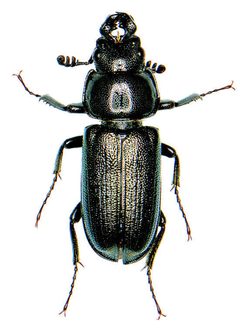
Distinguished from the larger Lucanus elaphus and Lucanus capreolus by smaller size (under 15 mm) and less dramatically developed male . Separated from Platycerus virescens by geographic range—the latter is primarily western North American, while P. quercus occurs east of the Rocky Mountains. Antennal club structure and overall body proportions separate it from other small lucanid such as Ceruchus.
Images
Appearance
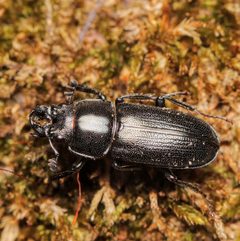
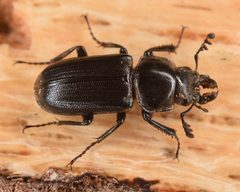
Small to medium-sized , 8–15 mm in length. Body dark brown to black, often with subtle reddish or coppery reflections. Males possess enlarged but relatively short compared to larger Lucanus ; female mandibles are small and functional. with 10 segments, ending in a three-segmented club. smooth or finely punctured, without prominent ridges. Legs short and sturdy, adapted for climbing on wood.
Habitat
Deciduous forests, particularly those dominated by oak (Quercus) . Associated with standing dead trees, stumps, and fallen logs in various stages of decay. frequently found on or near decaying wood; larvae develop within moist, rotting heartwood.
Distribution
Eastern and central North America: Canada (New Brunswick, Nova Scotia, Ontario, Prince Edward Island, Quebec); United States (Arkansas, Colorado, Florida, Georgia, Illinois, Indiana, Iowa, Kansas, Maine, Maryland, Massachusetts, Michigan, Minnesota, Missouri, Nebraska, New Hampshire, New Jersey, New York, North Carolina, Ohio, Oklahoma, Oregon, Pennsylvania, South Carolina, Tennessee, Texas, Virginia, Wisconsin, Vermont). Western records (Colorado, Oregon, Texas) likely represent peripheral or isolated .
Seasonality
active primarily from late spring through summer, with peak activity in June and July in northern portions of range. Larval development occurs year-round within wood.
Diet
Larvae feed on decaying wood, particularly the inner heartwood of dead oaks and other hardwoods. feeding habits are poorly documented; likely consume plant exudates or do not feed substantially.
Host Associations
- Quercus - Primary forest type; larvae develop in decaying oak wood
Life Cycle
Complete with prolonged larval stage. laid in crevices of decaying wood. Larvae tunnel through rotting heartwood, requiring 1–3 years to develop depending on conditions. occurs in wood tunnels; emerge and may remain in pupal chambers before exiting. Adults are relatively short-lived.
Behavior
are or . Males use in ritualized combat for access to females. Both sexes are attracted to lights. Adults are capable of but often found on dead wood.
Ecological Role
Larvae contribute to wood decomposition and nutrient cycling in forest . As primary decomposers of dead hardwoods, they create tunnels that may be used by other . serve as prey for birds, mammals, and other insects.
Human Relevance
Occasionally attracted to outdoor lights, leading to incidental encounters. Not a pest of living trees or structures. Of minor interest to collectors due to relative abundance. for mature deciduous forests with dead wood retention.
Similar Taxa
- Lucanus elaphusMuch larger (20–32 mm); males have dramatically elongated, antler-like ; overlapping range in eastern North America
- Lucanus capreolusLarger (15–25 mm); males have more prominent than P. quercus; similar and range
- Platycerus virescensWestern North American ; replaces P. quercus in Pacific and Rocky Mountain regions; very similar
More Details
Conservation status
Not formally assessed; appears secure throughout core range but dependent on retention of dead wood in managed forests