
Geotrupes stercorarius
(Linnaeus, 1758)
dor beetle, dumbledore, Common Dor Beetle
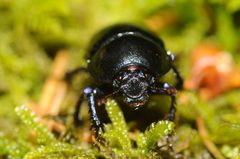
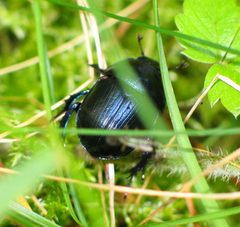
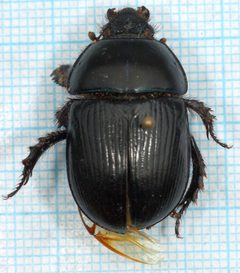
Geotrupes stercorarius is an earth-boring dung beetle in the Geotrupidae, commonly known as the dor or dumbledore. It is widespread throughout Europe and has been introduced to parts of North America. are , feeding primarily on the of herbivorous animals with a documented preference for horse dung. The exhibits distinctive parental care , with both sexes cooperating to construct deep burrows beneath dung and provision chambers for larval development.
Pronunciation
How to pronounce Geotrupes stercorarius: /d͡ʒiːoʊtruːpiːz stɛrkɔːˈreɪriəs/
These audio files are automatically generated. While they are not always 100% accurate, they are a good starting point.
Identification
Distinguished from by the combination of: shovel-shaped forward-projecting ; short with fan-like clubs; seven visible rows of punctures on each ; and spiny digging legs. In Europe, appear slightly later in the year than G. spiniger (April/May versus earlier spring). The overall dark, weakly lustrous appearance with occasional bluish sheen differs from some other Geotrupes with brighter metallic coloration.
Images
Habitat
Pastures, moorland, and hillsides where suitable material (herbivore ) is abundant. Found in cattle pastures and other grazed landscapes.
Distribution
Native to the Palaearctic region, common throughout Europe including Great Britain, Ireland, Scandinavia, and extending east to Russia, Turkey, Iran, and parts of Central Asia. Introduced to eastern North America (Canada: New Brunswick, Newfoundland, Nova Scotia, Prince Edward Island, Quebec).
Seasonality
active from April or May through autumn. Some adults produced in autumn overwinter in burrows; others pupate in spring to produce slightly later adults. Peak activity in evening hours.
Diet
, feeding on droppings of herbivorous animals. Shows documented preference for horse ; also recorded from cattle dung and other herbivore . have been observed at rotting fungi.
Life Cycle
Mating occurs in spring. Both sexes participate in digging a vertical burrow up to 50 cm deep directly beneath . Female constructs horizontal chambers off the main burrow, each provisioned with dung and a single , then sealed with soil. Larval development proceeds through summer. Some larvae pupate in autumn to produce that feed and overwinter in burrows; others remain in brood chambers and pupate in spring.
Behavior
and . fly readily, often observed circling around cattle lying in fields. Both sexes cooperate in burrow construction and provisioning. Creates audible chirping sound by rubbing hind legs against body. Attracted to light in large numbers.
Ecological Role
Contributes to decomposition and nutrient cycling in pasture . Burial of dung reduces fly breeding and accelerates breakdown of organic matter. Soil excavation aerates substrate.
Human Relevance
Generally beneficial in agricultural settings through removal. No documented negative impacts. "dumbledore" is of historical regional usage in parts of Britain.
Similar Taxa
- Geotrupes spinigerOverlapping European range and similar ; distinguished by earlier in spring and subtle morphological differences
- Geotrupes splendidusNorth American with brighter metallic green coloration and different preferences; not native to Europe
- Geotrupes blackburniiNorth American , smaller with nearly impunctate pronotum and all black coloration; prefers for larval development rather than leaf litter