
Geotrupes splendidus
Splendid Earth-boring Beetle
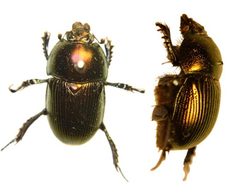
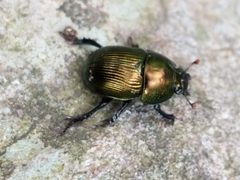
A large, metallic earth-boring in the Geotrupidae, native to eastern North America. are most commonly encountered in late fall and early winter, clumsily on trails through high-quality woodlands in search of mammal for feeding and oviposition. The exhibits notable color , with eastern typically bright green and western populations (including Missouri) ranging from yellow-green with golden or reddish hints to dark purple. Unlike true dung beetles, adults frequently feed on fungus and leaf litter, though dung remains important for larval development.
Pronunciation
How to pronounce Geotrupes splendidus: //dʒiːˈɒtruːpiːz ˈsplɛndɪdəs//
These audio files are automatically generated. While they are not always 100% accurate, they are a good starting point.
Identification
Distinguished from the similar Geotrupes blackburnii by its larger size, distinctly punctured pronotum (lateral areas with obvious punctures), and bright green to yellow-green coloration (though dark purple morphs occur). G. blackburnii is smaller, nearly impunctate on the pronotum, and uniformly black. Key morphological features include punctured elytral , sutural striae ending at the scutellum, and the overall robust, clumsy gait characteristic of the .
Images
Habitat
High-quality woodlands, particularly dry-mesic oak-hickory forests and loess woodlands. Found on trails through these where mammal accumulates. In Missouri, associated with dolomite glades and limestone bluff forests. Appears to require intact forest with sufficient mammal activity to provide dung resources.
Distribution
Eastern North America, broadly distributed across the region. Eastern (nominotypical) generally brighter green; western populations in Missouri and adjacent areas assigned by some authorities to G. s. miarophagus, though this distinction is disputed. Documented from Vermont southward, with particular abundance noted in Missouri Ozark woodlands.
Seasonality
active primarily in late fall and early winter (October until hard winter sets in). occurs in late fall, with adults and mating in spring. Peak observational records from October through early December on mild days.
Diet
feed on mammal , fungus, and leaf litter. Larval development occurs in burrows provisioned with tightly packed leaf litter or dung, though leaf litter appears preferred over dung for this (in contrast to G. blackburnii).
Life Cycle
emerge in late fall, overwinter, and mate in spring. are laid in burrows dug into soil, provisioned with leaf litter or . Larvae develop within these burrows, feeding on the packed organic material. occurs in -lined ; adults emerge the following fall.
Behavior
walk with a characteristic clumsy, lumbering gait. Frequently observed singly on animal or on the ground nearby. When disturbed, may burrow or seek cover. Adults dig burrows for oviposition, provisioning them with organic material. Unlike true dung beetles, does not form dung balls or exhibit elaborate rolling .
Ecological Role
Contributes to nutrient cycling and soil aeration through burrowing activity. Consumes and buries mammal and decaying organic matter, facilitating decomposition. Serves as prey for various vertebrate and in forest .
Human Relevance
Of minor direct economic importance. Occasionally encountered by hikers and naturalists in late fall. Subject of taxonomic interest due to color and disputed subspecific status. Not considered a pest .
Similar Taxa
- Geotrupes blackburniiSimilar size and preference, but distinguished by smaller size, nearly impunctate pronotum, and uniform black coloration. More commonly encountered and more strongly associated with horse .
Misconceptions
Despite and appearance, not a true dung beetle ( Scarabaeinae). True dung beetles exhibit more specialized manipulation ; Geotrupes splendidus is more flexible in diet and nesting habits, with leaf litter often preferred for larval development.
More Details
Color polymorphism and taxonomy
Western , including those in Missouri, show extensive color variation from yellow-green with golden or reddish hints to dark purple. Henry Howden (1955) described western forms as G. s. miarophagus based primarily on color, but this distinction is not universally accepted. Bill Warner, a scarab expert, has labeled Missouri specimens as G. s. miarophagus, while other sources including BugGuide treat G. miarophagus as a synonym of G. splendidus.
Larval biology
Howden (1955) documented a case of G. s. miarophagus utilizing fresh grass clippings for larval development, suggesting considerable dietary flexibility. The larval of many Geotrupidae remains poorly known, and expert opinion would be valuable for clarifying developmental requirements.