
Geotrupes blackburnii
Melsheimer, 1845
Blackburn's earth-boring beetle
Species Guides
2- Geotrupes blackburnii blackburnii(Blackburn's earth-boring beetle)
- Geotrupes blackburnii excrementi(Blackburn's earth-boring beetle)
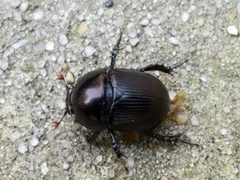
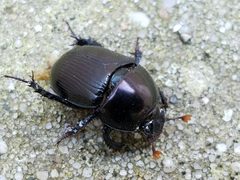
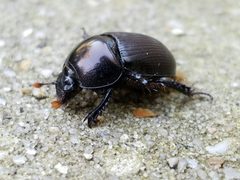
Geotrupes blackburnii is an earth-boring scarab beetle in the Geotrupidae, found in North America. The is primarily active during fall and is commonly encountered on trails through high-quality woodlands, often in association with animal . It is distinguished from the closely related G. splendidus by its smaller size, nearly impunctate pronotum, and all-black coloration. have been observed feeding on dung, though like other geotrupids they may also utilize fungus and leaf litter.
Pronunciation
How to pronounce Geotrupes blackburnii: /ˈdʒiːəˌtruːpiːz ˈblækˌbɜːrnɪaɪ/
These audio files are automatically generated. While they are not always 100% accurate, they are a good starting point.
Identification
Distinguished from Geotrupes splendidus by slightly smaller size, nearly impunctate pronotum (versus obviously punctate lateral pronotal areas in G. splendidus), and uniform black coloration (versus bright green, yellow-green, or dark purple in G. splendidus). Both share punctured elytral and sutural striae ending at the scutellum.
Images
Habitat
High-quality woodlands, particularly dry-mesic upland oak/hickory forests and dry post oak woodlands. Often found on trails through these .
Distribution
Eastern North America. Documented from Canada (Manitoba, Ontario, Quebec) and throughout the eastern and central United States from Connecticut and Maine west to Minnesota and south to Texas.
Seasonality
Fall-active; most commonly encountered during late fall and early winter. Observations from Missouri indicate peak activity in October and November.
Diet
feed on animal and have been observed utilizing scats on trails. Larval development occurs in dung or tightly packed leaf litter in burrows constructed by adults.
Behavior
are often found singly on animal or on the ground nearby. They are clumsy walkers and have been observed lumbering along trails. When disturbed, individuals may play dead or attempt to escape by burrowing.
Ecological Role
Contributes to nutrient cycling through burial of organic matter. As a -associated , it facilitates decomposition and soil aeration.
Similar Taxa
- Geotrupes splendidusLarger size, bright green to yellow-green or dark purple coloration, and obviously punctate lateral pronotal areas distinguish G. splendidus from the all-black, smaller G. blackburnii with nearly impunctate pronotum.