
Cercyon nigriceps
Marsham, 1802
Cercyon nigriceps is a water scavenger beetle ( Hydrophilidae) with a distribution spanning the Palearctic, Nearctic, Afrotropical, Oriental, and Neotropical regions. are frequently found in mammalian and rotting plant material. The has a complex taxonomic history with numerous synonyms due to its wide geographic range and identification challenges.

Pronunciation
How to pronounce Cercyon nigriceps: /ˈsɛrsɪˌɒn naɪˈɡrɪˌsɛps/
These audio files are automatically generated. While they are not always 100% accurate, they are a good starting point.
Identification
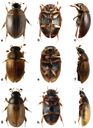
can be recognized by the combination of a black with linear, anteriorly ; transverse brownish pronotum with brownish-yellow or yellow and lateral margins; and yellow to brownish-yellow bearing nine complete deep punctate plus one short stria. The ventrum is dark brown or black, contrasting with yellowish to brownish-yellow legs. The proventrite is tectiform with a fine carina. The metasternal pentagon is flat, shiny, and densely shallowly punctate. Body is oval with slightly convex, shiny dorsum lacking microsculpture.
Images
Habitat
have been observed in horse , cow dung, other mammalian excreta, and rotting plant material. Specific microhabitat preferences beyond these general associations are not well documented.
Distribution
Widely distributed across multiple biogeographic regions. Palearctic: Austria, Azores, Belarus, Britain, Canary Islands, Croatia, Czech Republic, Slovakia, Denmark, Estonia, Finland, France, Germany, Hungary, Ireland, Italy, Japan, Latvia, Lithuania, Madeira, Malta, Netherlands, Norway, Poland, Portugal, Romania, Russia, Sweden, Switzerland, Tunisia, Ukraine. Nearctic: Canada, USA. Neotropical: Jamaica, Tobago (Lesser Antilles), Panama, Paraguay, Argentina. Afrotropical: Botswana, Gambia, Madagascar, Mascarene Islands, Namibia, Rwanda, Saudi Arabia, Seychelles, Tanzania, Democratic Republic of the Congo. Oriental: Bhutan, Nepal, China, Taiwan, India, Sri Lanka, Vietnam, Laos, Thailand, Indonesia, Philippines.
Similar Taxa
- Cercyon paranigricepsRecently described from Russian Far East and Myanmar; distinguished by morphological differences detailed in taxonomic revisions.
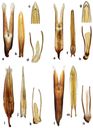
- Other Cercyon nigriceps-group speciesMembers of this subgeneric group share general body plan and associations; require careful examination of punctation patterns, coloration, and genitalic structures for accurate identification.