
Acidocerinae
Zaitzev, 1908
Genus Guides
3- Helobata
- Helochares
- Novochares(water scavenger beetles)
Acidocerinae is a of water scavenger beetles (Hydrophilidae) containing over 500 in 23-24 , making it one of the largest and most morphologically heterogeneous lineages in the . The subfamily occupies a key phylogenetic position as sister to the largely terrestrial Cylominae+Sphaeridiinae clade. Recent taxonomic revisions (2013, 2021) have substantially restructured generic boundaries, establishing new genera such as Colossochares, Novochares, Aulonochares, Ephydrolithus, and Primocerus while synonymizing former subgenera of Helochares.
Pronunciation
How to pronounce Acidocerinae: /əˌsɪdoʊsəˈraɪni/
These audio files are automatically generated. While they are not always 100% accurate, they are a good starting point.
Identification
Distinguished from related by combination of: slender maxillary palps curved inwards (maxillary palpomere 2 with inner margin straight to concave) with palpomeres 2–4 similar in length; uniformly slender tibiae; and five tarsomeres on meso- and . Cylominae and Sphaeridiinae typically have strongly convex to rounded body forms, short and stout maxillary palps, and stout to apically broadened tibiae. Enochrinae and Chaetarthriinae usually have maxillary palps curved outwards, zig-zag oriented, or with shorter palpomere 3. No single universal synapomorphy exists due to rampant in traditionally used characters such as elytral and maxillary palp length.
Images
Appearance
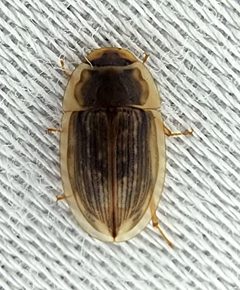
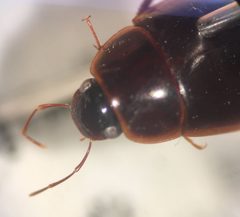
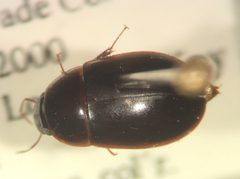
Extremely variable in size, coloration, and body form. Size ranges from 1.1 mm (Nanosaphes) to 14 mm (Colossochares). Coloration spans pale yellowish and orange-brown to nearly black, sometimes mottled. Body shapes vary from compact and convex (e.g., Globulosis) to broadly explanate and dorsoventrally compressed (e.g., Helobata, Helopeltarium). Diagnostic features include: oval and moderately convex body; slender maxillary palps curved inwards with palpomeres 2–4 similar in length and proportions; uniformly slender tibiae; and five tarsomeres on meso- and (vs. four in some related groups).
Habitat
Spans almost the full range of occurring in Hydrophilidae: fully aquatic settings including ponds, streams, and river margins; hygropetric habitats such as rock seepages; and terrestrial including rotting fruits. Most individual have narrow, predictable ecological preferences despite the 's overall habitat breadth. Specific examples include: Globulosis associated with lotic stream margins; Tobochares species primarily in seepage and wet rock habitats (with one species, T. fusus, also collected from rotting Clusia fruits); Ephydrolithus restricted to seepages in mountainous Brazilian Shield regions; and Agraphydrus species in flowing and stagnant water bodies, with some hygropetric.
Distribution
, occurring in all biogeographic regions except Antarctica. distributions range from narrowly restricted to single localities to broadly widespread across continents. Major regional diversity centers include the Neotropical region (especially Guiana Shield, Brazilian Shield, Amazon basin), Africa, Asia (China, Taiwan, Japan), and Australia. The Novochares spans the entire Neotropical region from Mexico to Argentina including Caribbean islands. Chasmogenus is centered in northeastern South America. Agraphydrus has substantial diversity in China, Taiwan, and Japan.
Human Relevance
Subject of extensive recent taxonomic research due to high and challenging classification. Some previously considered introduced (e.g., Novochares sallaei in Florida) have been reevaluated as native. Collecting requires multiple methods due to diversity; inadequate survey of a locality often results from limited sampling techniques.
Similar Taxa
- EnochrinaeMaxillary palps curved outwards, zig-zag oriented, or with shorter palpomere 3; some enochrines have four tarsomeres on meso- and
- ChaetarthriinaeMaxillary palps curved outwards, zig-zag oriented, or with shorter palpomere 3
- CylominaeStrongly convex to rounded body form; short and stout maxillary palps; stout to apically broadened tibiae; largely terrestrial habits
- SphaeridiinaeStrongly convex to rounded body form; short and stout maxillary palps; stout to apically broadened tibiae; largely terrestrial habits
More Details
Taxonomic History
Elevated to status by Short and Fikáček in 2013; comprehensive revision by Girón and Short in 2021 based on phylogenetic analysis established 23 extant with additional genera described subsequently. Major nomenclatural changes included: establishment of Colossochares and Novochares for formerly in Helochares (s. str.); synonymization of Helochares subgenera Helocharimorphus and Hydrobaticus with Helochares; redefinition of Peltochares and Helochares sensu nov.; and description of new genera Aulonochares, Ephydrolithus, Primocerus, Crucisternum, Katasophistes, and Nanosaphes.
Phylogenetic Significance
Sister group to the clade comprising Cylominae and Sphaeridiinae, which are largely terrestrial; this relationship makes Acidocerinae phylogenetically pivotal for understanding the transition to terrestrial habits in Hydrophilidae.
Collection Challenges
Due to diversity across the , comprehensive surveys require multiple collection methods. are often micro- with restricted distributions, suggesting substantial undescribed diversity remains, particularly in under-sampled regions.
Sources and further reading
- BugGuide
- Wikipedia
- iNaturalist taxon
- NCBI Taxonomy
- Catalogue of Life
- The Acidocerinae (Coleoptera, Hydrophilidae): taxonomy, classification, and catalog of species
- Taxonomic review ofAgraphydrusfrom Japan (Coleoptera: Hydrophilidae: Acidocerinae)
- Revision of the Neotropical water scavenger beetle genus Globulosis García, 2001 (Coleoptera: Hydrophilidae: Acidocerinae)
- Taxonomic revision of Agraphydrus Régimbart, 1903 I. China and Taiwan (Coleoptera: Hydrophilidae: Acidocerinae)
- Three new genera of acidocerine water scavenger beetles from tropical South America (Coleoptera, Hydrophilidae, Acidocerinae)
- Revision of the Neotropical water scavenger beetle genus Novochares Girón & Short (Coleoptera, Hydrophilidae, Acidocerinae)
- New species and records of Chasmogenus Sharp, 1882 from the southwestern margin of the Guiana Shield (Coleoptera: Hydrophilidae: Acidocerinae)
- Three additional new genera of acidocerine water scavenger beetles from the Guiana and Brazilian Shield regions of South America (Coleoptera, Hydrophilidae, Acidocerinae)
- Review of the Neotropical water scavenger beetle genus Tobochares Short & García, 2007 (Coleoptera, Hydrophilidae, Acidocerinae): new lineages, new species, and new records
- Review of the genus Chasmogenus Sharp, 1882 of northeastern South America with an emphasis on Venezuela, Suriname, and Guyana (Coleoptera, Hydrophilidae, Acidocerinae)
- Two new species of Helochares, with additional faunistic records from China (Coleoptera, Hydrophilidae, Acidocerinae).