
Pyropyga nigricans
(Say, 1823)
Dark Firefly
Pyropyga nigricans is a of dark firefly in the Lampyridae. Unlike many fireflies, it does not produce bright bioluminescent flashes. The species is widespread across North America, Central America, and central Europe, and is often the most common firefly in arid regions of the southwestern United States and Colorado Front Range. are active during summer months and are frequently encountered in grassy areas near water sources.
Pronunciation
How to pronounce Pyropyga nigricans: //paɪˈroʊpɪɡə ˈnɪɡrɪkænz//
These audio files are automatically generated. While they are not always 100% accurate, they are a good starting point.
Identification
Distinguished from flashing fireflies (Photinus, Photuris, Pyractomena) by the absence of prominent light-producing organs and dark coloration. Separated from other dark fireflies in the Pyropyga by geographic range and subtle morphological features; P. nigricans is the most widespread and commonly encountered Pyropyga across its range. Differs from Ellychnia (another dark firefly genus) by body shape and antennal structure. The combination of small size, dark coloration with reddish pronotal markings, and in open grassy areas near water helps distinguish this species.
Images
Appearance
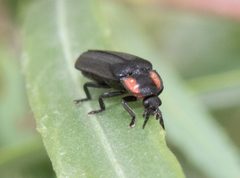
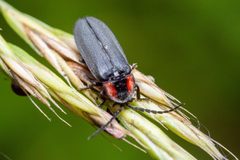
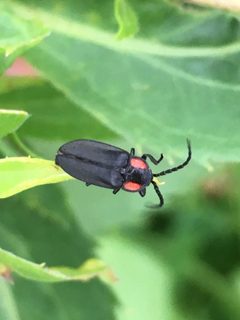
are small, dark-colored beetles typically 5-10 mm in length. The body is predominantly black or dark brown with reddish or orange markings on the pronotum (thoracic shield). (hardened forewings) are dark and may have subtle reddish edges. The lacks the prominent light-producing organs found in flashing fireflies; any luminescence is greatly reduced or absent in adults. are serrate (saw-like) in males and may be slightly clubbed in females.
Habitat
Grassy meadows, riparian corridors, stream margins, and moist areas in otherwise arid landscapes. Often found in suburban lawns, parks, and agricultural fields with adequate moisture. Larvae develop in soil and leaf litter in moist microhabitats.
Distribution
North America (widespread across the continent, especially common in the western and central United States), Central America, and central Europe. Particularly abundant on the Colorado Front Range and in the southwestern United States.
Seasonality
are active from late spring through summer, typically June to August in temperate regions. Activity peaks during warm evenings. In the southwestern United States, adults may be active earlier in the season due to warmer temperatures.
Life Cycle
Complete with , larval, pupal, and stages. Larvae are predatory, feeding on small in soil and leaf litter. Larval stage likely lasts one to two years. occurs in soil. Adults are short-lived, primarily focused on .
Behavior
are active during dusk and early evening but do not produce the conspicuous flashing signals typical of many firefly . Mating communication likely involves or weak luminescence rather than bright flashes. Adults may be found resting on vegetation during the day and become active as temperatures cool in the evening. The species has been observed to be highly tolerant of human-altered .
Ecological Role
Larvae function as in soil and litter , contributing to regulation of small . may serve as prey for birds, bats, and other . As a common and widespread , it contributes to nutrient cycling and dynamics in grassland and riparian .
Human Relevance
Serves as an accessible entry point for firefly observation and study due to its widespread distribution and daytime visibility (unlike flashing ). Frequently encountered by naturalists and citizen scientists. Not an agricultural pest; larvae may provide minor benefits through on soil-dwelling . The species highlights the diversity of firefly communication strategies beyond .
Similar Taxa
- Ellychnia corruscaAnother dark firefly lacking prominent luminescence; differs in having more elongated body and different antennal structure, primarily eastern North American distribution
- Photinus spp.Flashing fireflies with prominent light-producing organs on abdominal segments, typically yellowish or brownish with pale margins, active in true darkness
- Pyractomena spp.Flashing fireflies with distinctive amber or orange and prominent lantern organs, often associated with wetlands
More Details
Notable taxonomic history
Originally described as Lampyris nigricans by Thomas Say in 1823, later transferred to Pyropyga. The genus Pyropyga represents one of several lineages of 'dark fireflies' that have reduced or lost the bioluminescent signaling typical of the .
Bioluminescence note
While commonly called 'dark fireflies,' some Pyropyga including P. nigricans may produce weak luminescence in larvae or , but this is not the conspicuous flashing used for mating communication in better-known firefly .
Observation significance
Eric (Eric Eaton) noted in 2016 that this is 'by far the most common firefly where I live on the Front Range of Colorado, and also in the southwest U.S., but species are found across the entire continent. I have seen them virtually every place I have ever lived.' This observation highlights the species' remarkable ecological versatility.