
Ellychnia
Blanchard, 1845
dark firefly, diurnal firefly
Species Guides
11- Ellychnia californica(California glowworm)
- Ellychnia captiosa(dark firefly)
- Ellychnia corrusca(winter firefly)
- Ellychnia facula
- Ellychnia flavicollis
- Ellychnia greeni
- Ellychnia hatchi(dark firefly)
- Ellychnia irrorata
- Ellychnia lacustris
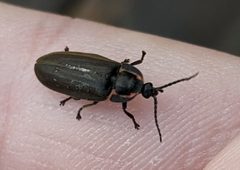
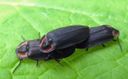
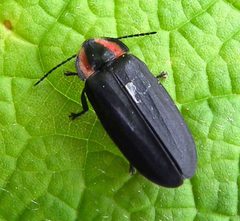
Ellychnia is a of fireflies ( Lampyridae) containing approximately 24 found across the United States. Unlike most fireflies, are diurnally active and lack bioluminescent organs, instead using chemical signals for mate recognition. Adults are characterized by black bodies with distinctive rose-colored markings on the pronotum. Larvae inhabit rotting logs in moist terrestrial environments.
Pronunciation
How to pronounce Ellychnia: //ɛˈlɪk.ni.ə//
These audio files are automatically generated. While they are not always 100% accurate, they are a good starting point.
Identification
Ellychnia can be distinguished from other firefly by the combination of activity, absence of , and rose-colored pronotal markings. It belongs to the 'dark firefly' group (diurnal, non- lampyrids), which includes genera such as Pyropyga and Pyractomena. Pyropyga is notably absent pronotal color patterns and has different preferences. Pyractomena larvae are aquatic or semi-aquatic, whereas Ellychnia larvae are found in rotting wood. The pronotal markings of Ellychnia are distinctive among dark fireflies in North America.
Images
Appearance
Habitat
Larvae inhabit rotting logs and moist terrestrial environments with decaying wood. are found on tree trunks and vegetation where males patrol for mates.
Distribution
Widespread across the United States. Specific collection records include Maryland (Beltsville) and Vermont. The occurs across diverse regions of North America.
Diet
Larvae are in decaying wood environments. diet is not documented.
Host Associations
- Spiroplasma corruscae - bacterial associateBacterium isolated from gut of Ellychnia corrusca; facultative insect
Life Cycle
Larvae develop in rotting logs in moist terrestrial . emerge and are active during daylight hours. Detailed information on , developmental timing, and longevity is not available.
Behavior
are diurnally active, in contrast to the habits of most fireflies. Males patrol tree trunks and vegetation to locate stationary females. Mate recognition relies on contact chemoreception using cuticular hydrocarbons as rather than visual signals. No bioluminescent signaling occurs in adults.
Ecological Role
Larvae function as in decaying wood . may serve as prey for visual predators and contribute to nutrient cycling, though specific ecological impacts are not documented.
Human Relevance
Similar Taxa
- PyropygaBoth are dark fireflies lacking ; Pyropyga lacks distinctive pronotal color patterns and is more widespread in western North America
- PyractomenaBoth are lampyrid ; Pyractomena are and bioluminescent, with larvae in aquatic or semi-aquatic versus terrestrial rotting logs for Ellychnia
More Details
Chemical Communication
Ellychnia corrusca was the first firefly in which contact were behaviorally demonstrated. Males attempt copulation with freeze-killed females based on cuticular hydrocarbon profiles, with hexane-washed females eliciting no response. Sexual differences in cuticular hydrocarbon composition have been documented.
Research Significance
The provides insights into the evolutionary transition from bioluminescent to non-bioluminescent communication in fireflies. Study of Ellychnia contributes to understanding how lampyrids diversified their mating systems.
Sources and further reading
- BugGuide
- Wikipedia
- GBIF taxonomy match
- NCBI Taxonomy
- Catalogue of Life
- Bug Eric: Book Review: Silent Sparks
- Bug Eric: 2016
- Lighting the Way: How Can Students Shape Firefly Conservation?
- Notes on the Life History and Mating Behavior of Ellychnia corrusca (Coloeptera: Lampyridae)
- Mate Recognition and Sex Differences in Cuticular Hydrocarbons of the Diurnal Firefly Ellychnia corrusca (Coleoptera: Lampyridae)
- Complete Genome Sequence of Spiroplasma corruscae EC-1 T (DSM 19793), a Bacterium Isolated from a Lampyrid Beetle (Ellychnia corrusca)