
Pyropyga minuta
(LeConte, 1852)
Flower Elf
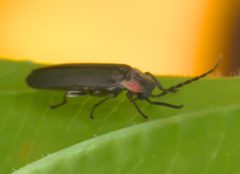
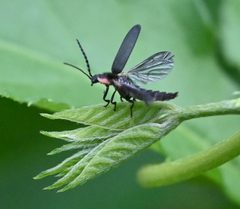
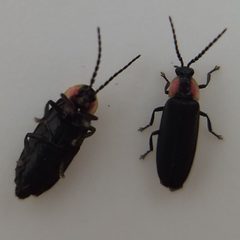
Pyropyga minuta is a tiny, day-active firefly commonly known as the flower elf. measure 3–7 mm and are solid black with a distinctive pale yellow pronotum marked by a dark central bar flanked by red. Unlike most fireflies, adults lack functional bioluminescent lanterns and do not flash; instead, they are believed to use for mate location. The species is widespread across North and Central America.
Pronunciation
How to pronounce Pyropyga minuta: /pɪˈrɒpɪɡə maɪˈnjuːtə/
These audio files are automatically generated. While they are not always 100% accurate, they are a good starting point.
Identification
Distinguished from other fireflies by its minute size, solid black coloration, and distinctive pronotal pattern of pale yellow with a dark central bar and red lateral borders. Unlike flashing fireflies in such as Photinus or Photuris, lack visible lanterns. The day-active separates it from most Lampyridae. Within the genus Pyropyga, identification to requires examination of pronotal pattern details.
Images
Habitat
are found in gardens, yards, open woodlands, fencerows, and open areas, often observed on leaves or flowers. Larvae are believed to be subterranean, living under soil.
Distribution
Occurs in the southern United States, ranging west to New Mexico and north to Kansas and North Carolina. Also found in Mexico, Guatemala, and Honduras. Records extend to South America.
Seasonality
Most commonly observed in June and July, with records from April through September.
Life Cycle
Complete with four stages: , larva, pupa, and . Larvae are bioluminescent and believed to be subterranean. Adults lack functional lanterns.
Behavior
activity pattern; are active during daylight hours rather than at night. Non-flashing fireflies that are believed to locate mates using rather than visual signals.
Ecological Role
Predatory larvae likely contribute to soil dynamics. are flower visitors.
Human Relevance
Subject of citizen science and firefly observation; noted in firefly field guides and natural history literature. are easily observed in gardens and yards due to habits.
Similar Taxa
- Pyropyga nigricansSimilar size and coloration; requires examination of pronotal pattern for separation
- Ellychnia speciesOther 'dark fireflies' lacking lanterns, but Ellychnia are typically larger and have different pronotal patterns
- Photinus speciesFlashing fireflies with functional lanterns and ; pronotum typically with different color pattern
More Details
Sources and further reading
- BugGuide
- Wikipedia
- GBIF taxonomy match
- iNaturalist taxon
- Catalogue of Life
- Bug Eric: Book Review: Silent Sparks
- Tiny raptors: Mantisflies, Mantispidae, and Praying mantises, Mantidae — Bug of the Week
- Bug Eric: Last Night to Blacklight?
- Bug Eric: 2016
- For an Understudied Ant Genus, Two Researchers Choose a "Bird Guide" ID Tool
- Bug Eric: October 2022