
Photinus consimilis
Green, 1956
Cattail Flash-train Firefly
Photinus consimilis, commonly known as the cattail flash-train firefly, is a medium-sized firefly in the Lampyridae. It is native to eastern North America, where it inhabits wetlands and riparian areas. The species is recognized by its distinctive flash pattern of 3 to 9 quick pulses in a series lasting about 2 seconds, with 9 to 12 seconds of darkness between flash trains. Its specific epithet 'consimilis' refers to its morphological similarity to closely related Photinus species.
Pronunciation
How to pronounce Photinus consimilis: /foʊˈtaɪnəs kənˈsɪmɪlɪs/
These audio files are automatically generated. While they are not always 100% accurate, they are a good starting point.
Identification
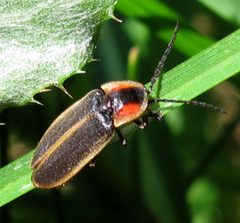
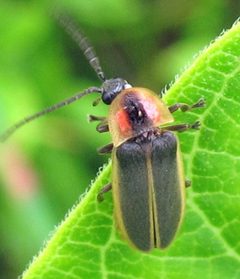
Distinguished from similar Photinus by its characteristic flash pattern: 3 to 9 quick pulses emitted in a flash train approximately 2 seconds in duration, followed by 9 to 12 seconds of darkness before the next train. The female responds with a double flash. Morphologically similar to Photinus carolinus and other ; reliable identification requires observation of flash pattern in the field. The pronotal pattern of pale yellow with dark central bar and red or pink margins provides supporting visual cues.
Images
Habitat
Occupies wetlands, marshes, stream margins, and riverbanks. Associated with cattail stands and other emergent vegetation in freshwater systems.
Distribution
Eastern North America. Documented from the eastern United States west to eastern Oklahoma and north to southern Ontario, Canada.
Seasonality
active in summer. Observations suggest in late May to June, with activity continuing through July. Flashing activity occurs from dusk into night.
Diet
Larvae are predatory, feeding on snails, worms, and other soft-bodied in soil and litter. diet not explicitly documented.
Host Associations
- Cattails (Typha spp.) - indicator derives from association with cattail stands in wetland
Life Cycle
Complete with four stages: , larva, pupa, and . Larval stage is bioluminescent ('' stage) and occupies soil or substrate below the surface. Larvae are the predominant life stage in terms of duration. and adult occur in late spring to early summer.
Behavior
males fly at level or lower, emitting -specific flash patterns to attract females. Females perch on low vegetation and respond to male signals with a double flash. Courtship involves reciprocal signaling until physical contact and mating occur. Males provide a of protein to females during mating, which females use to provision .
Ecological Role
Human Relevance
Subject to declines from light pollution, which disrupts courtship signaling and reduces mating success. destruction and lawn use are suspected additional threats. Serves as an for wetland health and is valued for its bioluminescent display.
Similar Taxa
- Photinus carolinusMorphologically similar; both have comparable pronotal patterns and size. Distinguished by flash pattern: P. carolinus exhibits synchronous flashing in , while P. consimilis produces asynchronous flash trains of 3–9 pulses
- Photinus pyralisOverlapping range and general . Distinguished by flash pattern: P. pyralis produces a single long flash or J-shaped flash pattern rather than a multi-pulse train
- Photuris spp.Females of Photuris mimic Photinus flash patterns to prey upon males. Photuris species are generally larger, with different pronotal patterns and continuous glow or different flash cadences
More Details
Etymology
The name Photinus derives from Greek for 'shining' or 'bright'. The specific epithet consimilis means 'with similarity', referencing morphological resemblance to related .
Flash Pattern Variation
Flash train characteristics vary with temperature; the 9–12 second interval between flash trains is temperature-dependent.
Sources and further reading
- BugGuide
- Wikipedia
- GBIF taxonomy match
- iNaturalist taxon
- NCBI Taxonomy
- Catalogue of Life
- Bug Eric: Firefly Tag
- Mother Nature's Fireworks - Lightning bugs, Lampyridae — Bug of the Week
- Summer nights and Lucifer’s lights – Lightning bugs, Lampyridae — Bug of the Week
- Mother Nature’s summer light show: Lightning bugs, Lampyridae — Bug of the Week
- Just in time for the 4th of July: Firefly fireworks - Lampyridae — Bug of the Week
- Synchronous Fireflies in Pennsylvania are Rare and Unusual