
Photinus carolinus
Green, 1956
Smokies Synchronous Firefly, Synchronous Firefly
Photinus carolinus is a North American firefly renowned for its spectacular synchronous bioluminescent mating displays, where thousands of males flash in coordinated unison. This was the first documented in North America to exhibit such , which produces traveling waves of light across forest landscapes. are active in early summer, with peak displays in late May to early June. The species inhabits mature hardwood forests in the Appalachian Mountains and has become a significant ecotourism attraction, particularly at Great Smoky Mountains National Park.
Pronunciation
How to pronounce Photinus carolinus: /foʊˈtaɪnəs kɛˈroʊlɪnəs/
These audio files are automatically generated. While they are not always 100% accurate, they are a good starting point.
Identification
Distinguished from other Photinus by its synchronous flashing —males emit 4–8 bright flashes over 2–4 seconds followed by 8–12 seconds of darkness, with achieving near-perfect synchrony. Flash pattern is species-specific and differs from the asynchronous, individual flashing of . Females respond with dim pulsed signals during male dark periods. Visual confirmation requires observing the coordinated group display, as morphological features overlap with other Photinus species.
Images
Appearance
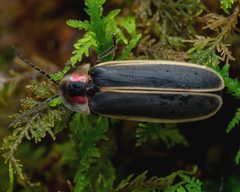
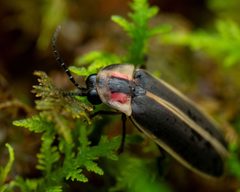
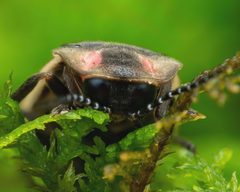
measure 11–15 mm in length. Dark with light-colored lateral margins. Pronotum pale yellow with a central dark rectangular mark and thin black edging on sides. Males possess paired pale lanterns on abdominal segments 6 and 7; females have a single lantern on segment 6. Remainder of uniformly dark.
Habitat
Mature hardwood forests 65 years or older in mountain river valleys. In southern Appalachia, occurs at elevations of 430–1,830 m (1,400–6,000 ft); in Pennsylvania and New York, found at lower elevations of 300–610 m (1,000–2,000 ft). Requires moist forest floor conditions supporting larval prey.
Distribution
Disjunct throughout the Appalachian Mountains: northern Georgia, Tennessee, South Carolina, North Carolina, Virginia, West Virginia, Pennsylvania, and New York. Best-known population at Elkmont, Tennessee, in Great Smoky Mountains National Park.
Seasonality
active late May through early June, with peak displays typically in early June. Timing varies with temperature, weather, and rainfall. Larval stage persists through remaining months underground.
Diet
Larvae feed on soft-bodied including snails, worms, and other soil-dwelling prey. diet not well documented; adults may feed little or not at all, focusing energy on .
Life Cycle
Complete with four stages: , larva, pupa, and . Larval stage is predominant life phase, spent below soil surface. Larvae are bioluminescent ('glowworms'). Adults emerge in early summer for approximately two-week mating period.
Behavior
Males fly singly or in loose 0.6–3 m above ground, flashing in synchrony to attract females. Synchronization creates collective dark periods enabling males to detect female responses without interference. Upon detecting a female reply, males cluster around her location; up to 20 males may compete, , flashing, and attempting to mount. Females exercise mate choice, often rejecting initial suitors. Copulation proceeds through two stages, with rival males abandoning pursuit once pair achieves tail-to-tail position. Synchronization emerges through local visual interactions, with flash bursts nucleating and propagating across swarms in relay-like patterns dependent on firefly and environmental visibility.
Ecological Role
Larvae function as soil-dwelling regulating of soft-bodied . serve as prey for Photuris fireflies, which mimic female P. carolinus flashes to attract and consume males, thereby acquiring defensive lucibufagins. Bioluminescent displays contribute to nutrient cycling through adult mortality pulse. Role as flagship supports conservation of mature Appalachian forest .
Human Relevance
Premier ecotourism attraction at Great Smoky Mountains National Park, drawing thousands of visitors annually to Elkmont viewing area. National Park Service implements lottery system for vehicle access and operates shuttle buses to manage crowds; demand substantially exceeds capacity (22,000 applicants for 1,800 passes in 2018). Pennsylvania support firefly festival in Forest County. Scientific study subject for research on collective , biological synchrony, and self-organization. Concerns exist regarding impacts of tourism on mating success and integrity.
Similar Taxa
- Photinus pyralisCommon eastern firefly with asynchronous flashing; males flash individually while flying rather than in synchronized groups. Flash pattern is single flash repeated at intervals, not burst pattern of 4–8 flashes.
- Photuris spp.Predatory fireflies that mimic P. carolinus female flashes to lure males; distinguished by larger size, different flash timing, and predatory . Photuris females are aggressive , not passive signal responders.
- Other Photinus speciesNumerous occur sympatrically in Appalachia but lack synchronous flashing ; identification requires flash pattern analysis or dissection of light organ .
Misconceptions
Often mistakenly believed to be the only synchronous firefly in the world; in fact, synchronous flashing is common in Southeast Asian fireflies (e.g., Pteroptyx spp.), which achieve synchrony through different behavioral mechanisms (males perch on vegetation in rather than flying). Also sometimes assumed that all individuals flash simultaneously throughout the entire range; actual synchrony is local, with waves of coordination traveling through .
More Details
Etymology
name Photinus derives from Greek for 'shining' or 'bright'. Specific epithet carolinus refers to North Carolina, where the was first discovered.
Conservation Concerns
Biologists have expressed concern that high visitor numbers at Elkmont may disrupt mating through light pollution, trampling, and general disturbance. The ' restriction to mature forests makes it vulnerable to logging and development in isolated Appalachian .
Synchronization Mechanism
Research indicates synchrony emerges through local visual interactions rather than global coordination. Fireflies adjust flash timing based on immediate neighbors, with terrain and vegetation creating occlusion that defines interaction networks. At low densities, flashes remain uncorrelated; high- swarms produce periodic synchronous bursts that propagate across the landscape.
Sources and further reading
- BugGuide
- Wikipedia
- GBIF taxonomy match
- iNaturalist taxon
- NCBI Taxonomy
- Catalogue of Life
- Synchronous Fireflies in Pennsylvania are Rare and Unusual
- A Night With the Synchronous Fireflies in the Great Smoky Mountains
- Great Smoky Mountains National Park | Beetles In The Bush
- Bug Eric: Firefly Tag
- Mother Nature's Fireworks - Lightning bugs, Lampyridae — Bug of the Week
- Summer nights and Lucifer’s lights – Lightning bugs, Lampyridae — Bug of the Week
- Self-organization in natural swarms of Photinus carolinus synchronous fireflies
- Behavioral Consequences of Sensory System Constraints in the FireflyPhotinus carolinus
- A model for the collective synchronization of flashing in Photinus carolinus