
Photinus pyralis
(Linnaeus, 1767)
Common Eastern Firefly, Big Dipper Firefly
Photinus pyralis is the most common firefly in North America, distributed east of the Rocky Mountains. Males perform distinctive J-shaped patterns while flashing to attract females, earning the "big dipper firefly." The species produces yellow through a chemical reaction involving luciferin and luciferase in specialized abdominal organs. Larvae are predatory, spending up to two years underground before pupating and emerging as short-lived .
Pronunciation
How to pronounce Photinus pyralis: //foʊˈtaɪnəs pɪˈreɪlɪs//
These audio files are automatically generated. While they are not always 100% accurate, they are a good starting point.
Identification
Distinguished from similar Photuris by flash pattern and : P. pyralis males flash every 5–7 seconds (temperature-dependent) while flying in a J-shaped trajectory, whereas Photuris exhibit different flash patterns and lack the characteristic big dipper flight path. P. pyralis produces yellow light; some Photuris species produce green flashes. Pronotum color pattern (pale yellow with black central dot and red/pink surround) differs from most Photuris species.
Images
Appearance
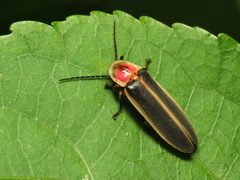
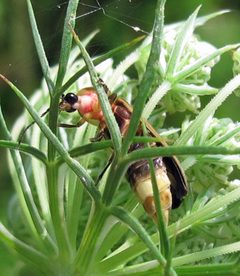
Small soft-bodied 9–19 mm in length. Black or brown body with yellow-bordered extending the full length of and . Pronotum pale yellow with central black dot surrounded by pink or red margin. Males have light-emitting organs on side of last three abdominal segments; females have light organs restricted to second-to-last segment. Large adapted for vision.
Habitat
Found in meadows, fields, wetlands, forest edges, and urban lawns. Requires moist soil at all life stages. Strongly associated with damp soils and tall grassy vegetation that conceals females and larvae. Tolerates temperate to tropical conditions across its range.
Distribution
Eastern North America from Texas to the Atlantic coast, north to southern Canada. Most abundant east of the Mississippi River. Genetic evidence indicates ancestral North American originated in Texas during the Miocene, with subsequent northward expansion to central states and more recent of the Northeast coast.
Seasonality
active from late May through July, with peak activity in June. Most visible at twilight and during early night hours. Larval stage lasts approximately two years with two periods.
Diet
Larvae are predatory, feeding on earthworms, slugs, snails, and other soft-bodied soil . They inject prey with paralyzing and secrete digestive to liquify tissues. do not feed or have limited feeding on pollen and nectar; all reproductive activity fueled by energy reserves accumulated during larval stage.
Life Cycle
Complete with four stages: , larva, pupa, . Eggs laid in moist soil and hatch in approximately one month. Larval stage lasts up to two years with multiple instars and two periods; larvae live underground and are bioluminescent as aposematic warning. occurs in rotting logs or bark furrows, lasting 1–3 weeks. Adult lifespan approximately three weeks to two months. time may extend to two years due to prolonged larval development.
Behavior
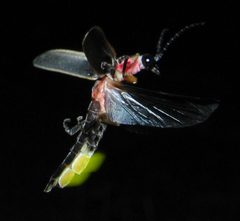
Males initiate courtship by flying in J-shaped patterns while flashing every 5–7 seconds; flash interval shortens with increasing temperature. Females remain sedentary on vegetation and respond with delayed flash (1–2 second delay) if receptive. Females direct flash toward males by twisting . Males show aggression toward competitors when multiple males locate same female. are ; larvae also bioluminescent as defensive warning signal.
Ecological Role
Larvae function as controlling of soil-dwelling including pest such as slugs and snails. serve as prey for Photuris fireflies, which acquire defensive lucibufagins by consuming P. pyralis males. Bioluminescent signals contribute to interactions and species recognition. Luciferase has become foundational tool in and biotechnology research.
Human Relevance
Cultural icon of summer evenings in eastern North America; subject of childhood collection activities and ecological tourism. Threatened by light pollution, which disrupts mating success; use; destruction; and climate change. sequenced in 2018, with luciferase widely used as reporter gene in biomedical research, detection assays, and cellular imaging. Listed as Least Concern by IUCN but declining in many areas.
Similar Taxa
- Photuris spp.Similar appearance and overlapping range; distinguished by different flash patterns, lack of J-shaped male , and predatory including of P. pyralis signals to capture males
Misconceptions
Often confused with Photuris due to similar-sounding name; some sources incorrectly list as Photuris pyralis. Despite "lightning ," it is a (Coleoptera), not a true bug (Hemiptera) or fly (Diptera). Larvae are sometimes called "glow-worms," though this term technically refers to different firefly with flightless females.
More Details
Bioluminescence mechanism
Light production occurs via luciferase-catalyzed oxidation of luciferin in specialized photocytes, requiring oxygen and . Unlike neural control, flashing is regulated by light-activated proteins rather than rhythmic impulses. Pupae emit continuous low-intensity glow rather than discrete flashes.
Sexual selection and nuptial gifts
Males with larger light organs and longer are favored during signaling phase due to increased visibility and potentially faster location of females. Males transfer protein-rich () during mating, which females use to provision . Females are polyandrous, mating with multiple males across multiple nights, which increases and lifespan.
Chemical defense
Contains defensive steroids called lucibufagins that deter . When disturbed, excretes sticky fluid containing these compounds from and pronotum (reflexive bleeding), which can entangle small predators like ants or cause revulsion in vertebrate predators.
Sources and further reading
- BugGuide
- Wikipedia
- GBIF taxonomy match
- iNaturalist taxon
- NCBI Taxonomy
- Catalogue of Life
- Bug Eric: Firefly Tag
- Fireflies are busy flashing for mates! Lampyridae spp. — Bug of the Week
- Fireflies celebrate 20 years of Bug of the Week – Fireflies, Lightning Bugs, Lampyridae — Bug of the Week
- Bug Eric: Home Bioblitz, Ongoing
- Bug Eric: 2021
- Mother Nature's Fireworks - Lightning bugs, Lampyridae — Bug of the Week
- On the inference of a southern origin of the North American firefly Photinus pyralis
- Behavior of fire-flies (Photinus pyralis)? With special reference to the problem of orientation.