
Pyractomena lucifera
Melsheimer, 1846
Marsh imp
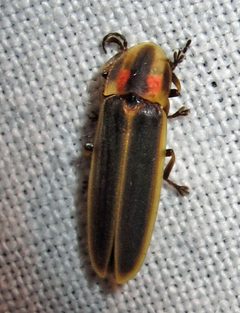
Pyractomena lucifera is a firefly in the Lampyridae, commonly known as the marsh imp. It is a wetland with a disjunct distribution across eastern North America. The species produces bioluminescent signals for mate communication and is threatened by destruction and light pollution.
Pronunciation
How to pronounce Pyractomena lucifera: //ˌpaɪɹæktoʊˈmiːnə luːˈsɪfərə//
These audio files are automatically generated. While they are not always 100% accurate, they are a good starting point.
Identification
Distinguished from other firefly by characteristics of the genus Pyractomena; specific identification requires examination of flash patterns and morphological details. Distinguished from Photinus and Photuris by genus-level traits in lantern structure and signaling . As a wetland , its association helps distinguish it from more firefly species.
Images
Habitat
Wetland . Associated with marshy environments, wet meadows, and other moist . Requires undisturbed wetland conditions for larval development and activity.
Distribution
North America. Range divided into two disjunct subpopulations: (1) Great Lakes region east to New York and south to Maryland; (2) North Carolina south to Florida and west to Texas and Oklahoma. Present in Ontario, Canada.
Seasonality
active in late spring through summer, with peak activity typically in June and July. Activity begins at dusk and continues into night hours.
Life Cycle
Complete with four stages: , larva, pupa, . Larvae are terrestrial, predatory, and known as glowworms. Larval stage likely spans one or more years before . Adults have relatively short lifespan focused on .
Behavior
use bioluminescent flashing for mate location and courtship. Males fly and emit -specific flash patterns; females respond from perches in vegetation. Flashing activity peaks after dusk and may continue for several hours. Males provide (protein packets) to females during mating, which females use to provision .
Ecological Role
Larvae function as of soft-bodied in soil and wetland substrates, potentially contributing to of pest invertebrates. serve as prey for various predators. Bioluminescent signaling may contribute to nutrient cycling through interactions.
Human Relevance
Subject to conservation concern due to declines from wetland destruction for development and light pollution disrupting mating . Valued for aesthetic and cultural significance as part of North American firefly fauna. Potential for wetland health.
Similar Taxa
- Photinus spp.Different flash patterns and preferences; Photinus generally occupy more open and drier habitats compared to the wetland- P. lucifera.
- Photuris spp.Predatory fireflies that may mimic other ; distinguished by aggressive predatory and different morphological features.
- Pyropyga spp.Dark fireflies that lack functional lanterns as ; distinguished by absence of in adults and activity patterns.
More Details
Conservation status
Threatened by destruction for housing and commercial development, as well as light pollution which disrupts courtship and reduces mating success.
Common name origin
Known as marsh imp, reflecting its wetland association and small size.
Sources and further reading
- BugGuide
- Wikipedia
- GBIF taxonomy match
- iNaturalist taxon
- NCBI Taxonomy
- Catalogue of Life
- Spooky eyes on the Stygian rainforest floor: Headlight beetles, fire beetles, Pyrophorus spp. — Bug of the Week
- Mother Nature's Fireworks - Lightning bugs, Lampyridae — Bug of the Week
- Summer nights and Lucifer’s lights – Lightning bugs, Lampyridae — Bug of the Week
- Mother Nature’s summer light show: Lightning bugs, Lampyridae — Bug of the Week
- Just in time for the 4th of July: Firefly fireworks - Lampyridae — Bug of the Week
- Bug Eric: Book Review: Silent Sparks
- Biology of the Firefly Pyractomena lucifera (Coleoptera: Lampyridae)