
Ambrosiodmus rubricollis
Wood & Bright, 1992
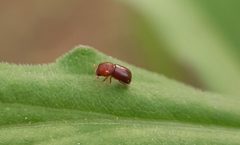
Ambrosiodmus rubricollis is an ambrosia beetle native to eastern and southern Asia that has been introduced to Europe and North America. As a member of the Ambrosiodmus, it maintains a mutualistic with the white-rot fungus Flavodon ambrosius, which is capable of true wood decomposition—an unusual trait among ambrosia beetles. The has been documented attacking young Tasmanian blue gum trees (Eucalyptus globulus) in Portugal and has been detected in Slovenia and Italy. Its introduction to non-native regions raises concern given the potential of Ambrosiodmus species to pathogenic fungi.
Pronunciation
How to pronounce Ambrosiodmus rubricollis: //æmˌbroʊ.siˈɒd.məs ˌruː.brɪˈkɒl.ɪs//
These audio files are automatically generated. While they are not always 100% accurate, they are a good starting point.
Identification
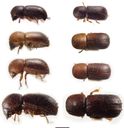
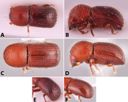
Distinguished from other ambrosia beetles by asperities (small, rough projections) covering the entire surface of the pronotum. This characteristic was specifically noted as the key diagnostic feature enabling identification of specimens in Slovenia.
Images
Habitat
Deciduous temperate forests; commercial plantations of Tasmanian blue gum (Eucalyptus globulus).
Distribution
Native to eastern and southern Asia; introduced to Europe (Italy, Slovenia, Portugal) and North America. GBIF records indicate presence in Australia, Europe and Northern Asia (excluding China), Middle America, North America, and Southern Asia.
Diet
Feeds on ambrosia fungus cultivated in -constructed galleries. Based on -level research, the primary fungal is Flavodon ambrosius, a white-rot decay fungus capable of decomposing wood and converting it into nutritious food for the beetle.
Behavior
Attracted to ethanol-baited traps. Constructs galleries in wood where fungal gardens are cultivated. remain in galleries to reproduce, enabling development of semi-social colonies.
Ecological Role
As an ambrosia beetle, participates in a mutualism with Flavodon ambrosius that facilitates wood decomposition. The its fungal between trees. May contribute to tree decline in plantation settings, though its specific role as a primary or secondary pest remains unclear.
Human Relevance
Potential forest pest in non-native ranges. Documented attacking young Eucalyptus globulus in commercial plantations in Portugal. Concern exists regarding ability to pathogenic fungi, though direct evidence of tree mortality caused by this is limited.
Similar Taxa
- Xylosandrus germanusBoth are non-native ambrosia beetles in Europe detected through similar monitoring methods (ethanol-baited traps). Distinguished by pronotal asperities in A. rubricollis versus different pronotal sculpturing in X. germanus.
- Ambrosiophilus atratusCo-occurs as a non-native ambrosia beetle in Slovenia; both were first recorded in the same 2017 monitoring effort. Separated by morphological characteristics including pronotal features.
- Other Ambrosiodmus speciesShare the unusual wood-decomposing fungal with Flavodon ambrosius. Specific identification requires examination of pronotal asperities and other subtle morphological differences.
Sources and further reading
- BugGuide
- Wikipedia
- GBIF taxonomy match
- iNaturalist taxon
- NCBI Taxonomy
- Catalogue of Life
- Ambrosiodmus-lecontei - Entomology Today
- Ambrosiodmus Archives - Entomology Today
- Research on Fungus-farming Beetles Reveals a New Wood-decaying Fungus
- Beetle Farmers 2.0: A Super-symbiont Fungus Supports a Complex Beetle Society
- Ambrosiodmus rubricollis (Eichhoff) (Coleoptera; Curculionidae; Scolytinae) associated with young Tasmanian blue gum trees
- The first record of two non-native ambrosia beetles in Slovenia: Ambrosiodmus rubricollis (Eichhoff, 1875) and Ambrosiophilus atratus (Eichhoff, 1875) (Coleoptera: Curculionidae, Scolytinae)