
Ips plastographus
Wood & Bright, 1992
California pine engraver, Forgery Bark Weevil
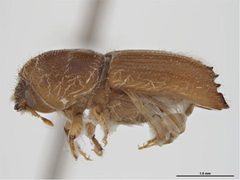
Ips plastographus, commonly known as the California pine engraver, is a bark beetle in the weevil Curculionidae. It is native to western North America and primarily associated with pine , particularly lodgepole pine. New beetles have been documented in short tunnels within the sapwood of windfelled trees. The is provisionally accepted in taxonomic databases and has limited published natural history documentation.

Pronunciation
How to pronounce Ips plastographus: /ɪps plæstoʊˈɡræfəs/
These audio files are automatically generated. While they are not always 100% accurate, they are a good starting point.
Identification
Ips plastographus can be distinguished from other Ips by the number and arrangement of spines on the declivity of the , a characteristic used to identify members of this . Close relatives such as I. grandicollis (fivespined engraver), I. calligraphus (sixspined engraver), and I. avulsus (small southern pine engraver) differ in spine count and preferences. Accurate identification requires examination of the declivital spines and associated host tree species.
Images
Habitat
Windfelled lodgepole pine forests at montane elevations; specifically observed at 6,100 feet elevation in Montana. hibernate in short tunnels penetrating the bole sapwood of previously unattacked, windfelled trees.
Distribution
Western North America. Documented from Parsnip Mountain, Kootenai National Forest (Lincoln County), Montana. GBIF records indicate presence in North America broadly.
Seasonality
New beetles observed in hibernation on September 27, 1950, suggesting autumn entry into condition. Specific seasonal activity periods beyond overwintering are undocumented.
Host Associations
- Pinus contorta - lodgepole pine; windfelled trees used for hibernation
Life Cycle
New beetles overwinter in short tunnels within the sapwood of trees. This hibernation represents a documented life stage, though complete developmental details from to adult remain unreported.
Behavior
Hibernation in short tunnels penetrating the bole sapwood of windfelled, previously unattacked trees. This shelter-seeking in dead wood distinguishes the strategy from active of living or freshly killed .
Similar Taxa
- Ips grandicollisBoth are Ips engravers with overlapping western North American ranges; distinguished by declivital spine number (five in I. grandicollis versus different count in I. plastographus)
- Ips calligraphusSixspined engraver with similar bark beetle ; spine count and geographic distribution differ
- Ips avulsusSmall southern pine engraver primarily southeastern; distribution and preferences assist differentiation
More Details
Taxonomic note
The was described by Wood & Bright in 1992 and is listed as provisionally accepted in the Catalogue of Life. The 'Forgery Bark Weevil' appears in iNaturalist databases, though 'California pine engraver' is more widely used in entomological literature.
Data limitations
Natural history information for I. plastographus is sparse compared to economically significant such as I. typographus. Most available documentation derives from a single 1950 hibernation observation, highlighting the need for additional field studies on this ' , range, and .
Sources and further reading
- BugGuide
- GBIF taxonomy match
- iNaturalist taxon
- NCBI Taxonomy
- Catalogue of Life
- Congrats to Antoine Abrieux, Innovator Fellow Award | Bug Squad
- Beetle Mania to Descend on the Bohart | Bug Squad
- Unhappy Christmas tree - Fivespined engraver, Ips grandicollis — Bug of the Week
- A thrips is a thrips… | Beetles In The Bush
- Insect-resistant Maize Could Increase Yields and Decrease Pesticide Use in Mexico
- How Systematic Entomology Will Thrive in the Age of Artificial Intelligence
- A Hibernation Record of Ips plastographus Leconte (Coleoptera: Scolytidae)