
Dendroctonus murrayanae
Hopkins, 1909
Lodgepole Pine Beetle
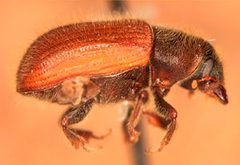
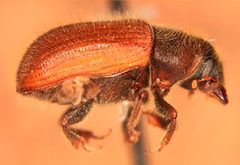
Dendroctonus murrayanae, commonly known as the lodgepole pine , is a bark beetle in the Scolytinae. It is native to North America and primarily associated with lodgepole pine (Pinus contorta). Unlike more aggressive Dendroctonus species, it is not a primary agent of tree mortality and typically attacks individual, predisposed trees rather than conducting mass attacks. The species has one , as larvae.
Pronunciation
How to pronounce Dendroctonus murrayanae: //dɛnˈdrɒktənəs ˌmʌrəˈjaɪˌni//
These audio files are automatically generated. While they are not always 100% accurate, they are a good starting point.
Images
Habitat
Found in forests dominated by lodgepole pine (Pinus contorta). Beetles attack trees near ground level at low . Susceptible trees are typically physically damaged, have thin foliage, or are otherwise predisposed to . Often co-occurs with Pseudips (=Ips) mexicanus, Ips pini, and Hylurgops porosus in the same trees; seldom found with mountain pine (Dendroctonus ponderosae).
Distribution
North America. Documented in Idaho and Montana based on biological studies. Distribution records also include Alberta, British Columbia, Manitoba, and Ontario in Canada.
Seasonality
One indicated. Overwinters as larvae. activity and -laying occur during the growing season.
Diet
Larvae and feed on phloem of lodgepole pine (Pinus contorta).
Host Associations
- Pinus contorta - lodgepole pine; primary tree
Life Cycle
galleries constructed upward and usually have short spurs. Mating occurs in the egg gallery. Eggs laid in elongated group in shallow excavation along one side of egg gallery, not in individual . Larvae aggregate in communal chamber, feeding side by side, but separate before . Four larval instars. One ; overwinters as larvae.
Behavior
Attacks individual trees, not in groups. Constructs galleries upward from entrance point. Larvae exhibit communal feeding in shared chamber before separating for .
Ecological Role
Secondary bark beetle that contributes to decomposition of weakened or damaged lodgepole pines. Not a primary tree-killing agent. No natural enemies or commensal insects observed in chambers in studied .
Human Relevance
Minor forest pest compared to other Dendroctonus . Not a primary economic concern due to non-aggressive attack and preference for already-stressed trees.
Similar Taxa
- Dendroctonus ponderosaeBoth are Dendroctonus bark beetles associated with pines, but D. murrayanae is distinguished by non-aggressive, individual tree attacks near ground level versus mass attacks by D. ponderosae; D. murrayanae seldom co-occurs with D. ponderosae
- Dendroctonus rufipennisTaxonomically related ; D. murrayanae has been discussed in relation to spruce beetle based on morphological characters, though they occupy different tree
More Details
Taxonomic Character
A new character on the has been described for this , contributing to its distinction from related .
Sources and further reading
- BugGuide
- Wikipedia
- GBIF taxonomy match
- iNaturalist taxon
- NCBI Taxonomy
- Catalogue of Life
- The Day That The Beetles Invaded the Bohart | Bug Squad
- Publications | Entomology Research Museum
- Southern Pine Beetle: How a Fellow Species May Help in Host Location
- Managing Southern Pine Beetle Infestations in a Changing Forest Environment
- Eastern Larch Beetle Outbreak Keeps Going When Winter's Not So Cold
- Pheromone Treatment Puts Up the "No Vacancy" Sign for Douglas-Fir Beetles
- Biology of Dendroctonus murrayanae (Coleoptera: Curculionidae: Scolytinae) in Idaho and Montana and Comparative Taxonomic Notes