
Dryocoetes
Eichhoff, 1864
Species Guides
4- Dryocoetes affaber(Faber Spruce Bark Beetle)
- Dryocoetes autographus
- Dryocoetes betulae(birch bark beetle)
- Dryocoetes granicollis
Dryocoetes is a of bark beetles ( Scolytinae) in the weevil Curculionidae. are distributed across North America, Europe, Asia, and Africa. The genus includes both conifer- and hardwood-associated species, with documented including fir, spruce, pine, alder, birch, beech, poplar, liquidambar, and walnut. Several species are economically significant forest pests or .
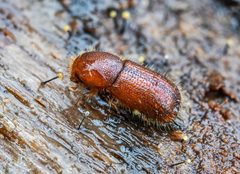
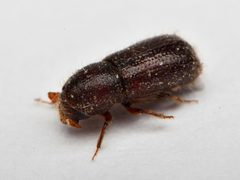
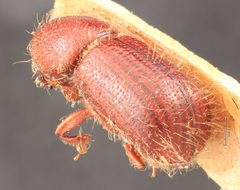
Pronunciation
How to pronounce Dryocoetes: //ˌdraɪoʊˈsiːtiːz//
These audio files are automatically generated. While they are not always 100% accurate, they are a good starting point.
Images
Habitat
Bark and phloem of living, weakened, or recently dead trees. Specific varies by : D. confusus occurs in subalpine fir forests; D. alni is found in recently dead alder wood; D. himalayensis infests walnut trees in lowland regions.
Distribution
North America, Europe, Asia, and Africa. Specific ranges vary by : D. confusus in western North America; D. himalayensis native to the Himalayas, in central Europe (Czech Republic, etc.); D. alni in central and northern Europe to Russia, with scattered western European records.
Seasonality
Varies by and region. D. confusus: and attack primarily during growing season. D. himalayensis: throughout vegetation period with peak in June. D. alni: active in May-June.
Diet
Phloem and inner bark of trees. feed on specific host rather than indiscriminately.
Life Cycle
Complete with , larval, pupal, and stages. D. himalayensis develops in thin stems (<5 cm diameter) but is most numerous in thicker trunk bases. Development time varies with temperature and condition.
Behavior
Mass via communication. D. confusus: males initiate attack and produce aggregation pheromone (exo- and endo-brevicomin blend) within 6 hours; females produce anti-aggregation pheromone after mating. D. himalayensis: aggressive able to attack apparently healthy trees, not just stressed . Secondary attraction to host tree volatiles documented in multiple species.
Ecological Role
Primary colonizers of weakened or recently dead wood; some act as for pathogenic fungi. D. confusus associated with Ceratocystis and Grosmannia dryocoetidis in fir mortality. D. alni vectors Ceratocystiopsis synnemata and Leptographium alneum. D. himalayensis vectors Ophiostoma juglandis, a phytopathogenic fungus causing walnut decline.
Human Relevance
Several are significant forest pests. D. confusus (western balsam bark beetle) causes substantial mortality in subalpine fir, managed with baits. D. himalayensis is an pest of walnut trees in Europe with potential for significant economic impact. D. alni is of conservation interest due to extreme rarity. Pheromone-based monitoring and management tools have been developed for D. confusus.
Sources and further reading
- BugGuide
- Wikipedia
- GBIF taxonomy match
- iNaturalist taxon
- NCBI Taxonomy
- Catalogue of Life
- Dryocoetes himalayensis Strohmeyer. [Distribution map].
- Nematodes Associated WithDryocoetes uniseriatus(Coleoptera: Scolytidae)
- Dryocoetes alni(Georg), un scolyte méconnu (Coleoptera Curculionidae Scolytinae)
- THE BIOLOGY OF CANADIAN BARKBEETLES: THE SEASONAL HISTORY OF DRYOCOETES CONFUSUS SW
- SECONDARY ATTRACTION IN THE WESTERN BALSAM BARK BEETLE, DRYOCOETES CONFUSUS (COLEOPTERA: SCOLYTIDAE)
- More on the life cycle of Malamoeba scolyti (Amoebidae: Sarcomastigophora) parasitizing: the bark beetle Dryocoetes autographus (Scolytidae, Coleoptera)
- Two new species of Ophiostomatales (Sordariomycetes) associated with the bark beetle Dryocoetes alni from Poland
- Observations on the Biology ofDryocoetes betulae(Coleoptera: Curculionidae) in Paper Birch in Northern Idaho
- The Flight Periodicity, Attack Patterns, and Life History ofDryocoetes confususSwaine (Coleoptera: Curculionidae: Scolytinae), the Western Balsam Bark Beetle, in North Central Colorado
- Evaluation of Two Pheromone Baits for Containment and Concentration of Attack by the Western Balsam Bark Beetle, Dryocoetes confusus (Coleoptera: Curculionidae)
- New Ophiostoma species associated with Dryocoetes himalayensis and decline of Juglans regia in Czechia
- A NEW CERATOCYSTIS AND ITS VERTICICLADIELLA IMPERFECT STATE ASSOCIATED WITH THE BARK BEETLE DRYOCOETES CONFUSUS ON ABIES LASIOCARPA
- Host compounds as kairomones for the western balsam bark beetleDryocoetes confususSw. (Col., Scolytidae)
- Invasive bark beetle Dryocoetes himalayensis (Coleoptera: Curculionidae: Scolytinae) – A threat for walnut trees (Juglans spp.) in Europe?
- Comparative Behavioural Responses ofDryocoetes confususSwaine,Dendroctonus rufipennis(Kirby), andDendroctonus ponderosaeHopkins (Coleoptera: Scolytidae) to Angiosperm Tree Bark Volatiles