
Crypturgus
Erichson, W.F., 1836
Species Guides
4- Crypturgus alutaceus
- Crypturgus borealis(Boreal Cryptic Bark Beetle)
- Crypturgus hispidulus
- Crypturgus pusillus
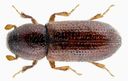
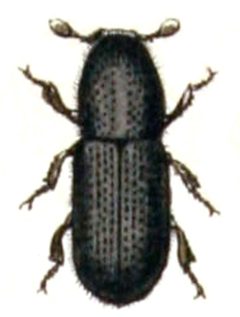
Crypturgus is a of bark beetles in the Curculionidae, first described by Erichson in 1836. The genus contains at least 30 described . These beetles are associated with woody substrates, though specific ecological details remain poorly documented for many species.
Pronunciation
How to pronounce Crypturgus: //krɪpˈtɜːr.ɡəs//
These audio files are automatically generated. While they are not always 100% accurate, they are a good starting point.
Identification
Distinguished from other bark beetle primarily by subtle morphological characters of the and pronotum. -level identification requires examination of male genitalia and fine details of elytral punctation. Crypturgus species are generally small, cylindrical bark beetles with the characteristic rostrum of Curculionidae.
Images
Habitat
Associated with bark and wood of trees, consistent with the of bark beetles in Curculionidae. Specific associations vary by .
Distribution
Recorded from Denmark, Norway, Sweden, and the northeastern United States (Vermont). The appears to have a Holarctic distribution pattern.
Ecological Role
Functions as a bark beetle, contributing to wood decomposition and nutrient cycling in forest . Some may act as secondary colonizers of stressed or dead trees.
Human Relevance
Some bark beetles in related are forest pests, though specific economic impacts of Crypturgus are not well documented.
Similar Taxa
- ScolytusAnother bark beetle in Curculionidae; Crypturgus can be distinguished by antennal club structure and pronotal shape.
- IpsLarger bark beetle with similar habits; Crypturgus are generally smaller with different declivital armature.
More Details
Taxonomic note
Crypturgus has been historically placed in the Scolytinae (bark beetles), though modern classifications often treat Scolytinae as a tribe within Curculioninae. The authority is sometimes cited as Erichson, 1836.