
Heilipus
Germar, E.F., 1823
pine weevils
Species Guides
1- Heilipus squamosus(Avocado Weevil)
Heilipus is a of New World weevils in the Curculionidae, containing over 280 described distributed from the southern United States to northern Argentina. The genus is characterized by two primary feeding guilds: seed borers that develop within fruits of Lauraceae, and trunk borers that tunnel into stems of trees. Several species are significant agricultural pests, particularly of avocado (Persea americana) and other commercial crops. The Brazilian Atlantic Forest has been proposed as a possible center of origin for the genus based on high diversity of both weevils and host plants.
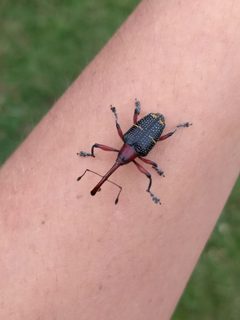
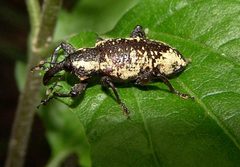
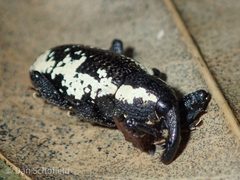
Pronunciation
How to pronounce Heilipus: /ˈhaɪlɪpʊs/
These audio files are automatically generated. While they are not always 100% accurate, they are a good starting point.
Identification
Members of Heilipus are distinguished from related weevil by their association with Lauraceae and Annonaceae plants, though specific morphological characters distinguishing the genus require examination of rostrum shape, elytral , and male genitalia. -level identification often relies on subtle differences in color pattern, rostrum curvature (humped versus evenly arcuate in lateral view), and detailed examination of and spermatheca. Several species pairs are sympatric and morphologically similar, necessitating careful comparison of and genitalia dissections.
Images
Habitat
Tropical and subtropical forests, particularly areas supporting Lauraceae and Annonaceae trees. Agricultural orchards of avocado and other crops. Seed-boring inhabit developing fruits on trees; trunk-boring species inhabit basal stem regions near ground level.
Distribution
Americas, from the southeastern United States (Arkansas, Florida, Kansas, Kentucky, Louisiana, Missouri, Oklahoma, Texas) through Mexico, Central America, and South America to northern Argentina. Highest recorded in Brazil, particularly in the Atlantic Forest region.
Diet
Larvae of seed-boring feed on seeds within fruits of Lauraceae; larvae of trunk-boring species tunnel into stems of Lauraceae and Annonaceae. feed on plant tissues, though specific adult diet details are poorly documented for most species.
Host Associations
- Persea americana (avocado) - seed borer, trunk borerprimary agricultural ; multiple Heilipus documented
- Ocotea puberula - seed borerdocumented for H. draco and H. vividaensis
- Nectandra angustifolia - seed borerdocumented for H. draco and H. vividaensis
- Annona squamosa (sugar-apple) - trunk borerdocumented for H. gibbus
- Annona cherimola (cherimoya) - trunk borerdocumented for H. gibbus
- Other Lauraceae genera (Ocotea, Nectandra, Persea, etc.) - seed borer, trunk borer33 across 12 documented as
- Other Annonaceae - trunk borer5 in one documented as
Life Cycle
Complete with four stages: , larva, pupa, . Eggs laid in oviposition chambers within fruits or stem tissue; multiple eggs may be deposited in single chambers by multiple females. Larvae develop as borers within seeds or trunk tissue, with development time varying by and . occurs within host tissue. Adults emerge to feed and reproduce. Specific developmental durations and voltinism vary by species and climate.
Behavior
activity patterns observed for oviposition, feeding, and in studied . Females preferentially oviposit in middle and bottom thirds of fruits. Multiple females may add to shared oviposition chambers; no evidence of oviposition-deterring use. Willingness to oviposit in artificial wounds suggests opportunistic use of mechanical damage. capability documented but distance and duration decline with age and successive flights.
Ecological Role
Primary group of pre- seed for Lauraceae in the Americas. Seed reduces seed viability and recruitment of trees. Trunk-boring may function as stem borers affecting tree vigor. Potential role in regulating of Lauraceae and Annonaceae in native ; pest status in agricultural systems indicates capacity for population when host availability increases.
Human Relevance
Several are significant pests of avocado production in Latin America, causing restrictions on fruit export. H. lauri is considered an incursion risk for U.S. avocado production. H. squamosus was historically a pest of avocado in Florida. Management requires integrated pest monitoring, with patterns documented at 5-35 meter . Chemical, cultural, and tactics have been applied. Misidentifications in collections and literature have complicated pest management and quarantine responses.
Similar Taxa
- Other Hylobiini generaShared tribe characteristics; distinguished by associations and detailed morphological examination of rostrum and genitalia
- H. catagraphus / H. gibbusVery similar color pattern; distinguished by rostrum shape in lateral view (humped versus evenly arcuate) and genitalia
- H. draco / H. vividaensisSympatric with similar ; distinguished by external morphology and genitalia, with support
Sources and further reading
- BugGuide
- Wikipedia
- GBIF taxonomy match
- iNaturalist taxon
- NCBI Taxonomy
- Catalogue of Life
- Avocado weevils of the genus Heilipus.
- Sympatric species of Heilipus Germar (Coleoptera: Curculionidae: Hylobiini) on fruits of Lauraceae: a new species from Brazil and redescription of Heilipus draco (Fabricius, 1801)
- On the Distribution of Heilipus squamosos (Lec.), a Pest of the Avocado
- Host plants of the weevil genus Heilipus Germar, 1824 (Coleoptera, Curculionidae, Molytinae, Molytini, Hylobiina)
- Supplementary material 1 from: Anzaldo SS, Díaz-Grisales V (2022) Heilipus squamosus (LeConte, 1824): clarification of the correct name for the “avocado tree girdler” with updates on its biology and distribution (Coleoptera, Curculionidae, Molytinae, Hylobiini). Biodiversity Data Journal 10: e85499. https://doi.org/10.3897/BDJ.10.e85499
- Figure 1 from: Anzaldo SS, Díaz-Grisales V (2022) Heilipus squamosus (LeConte, 1824): clarification of the correct name for the “avocado tree girdler” with updates on its biology and distribution (Coleoptera, Curculionidae, Molytinae, Hylobiini). Biodiversity Data Journal 10: e85499. https://doi.org/10.3897/BDJ.10.e85499
- Heilipus squamosus (LeConte, 1824): clarification of the correct name for the “avocado tree girdler” with updates on its biology and distribution (Coleoptera, Curculionidae, Molytinae, Hylobiini)
- Figure 2 from: Anzaldo SS, Díaz-Grisales V (2022) Heilipus squamosus (LeConte, 1824): clarification of the correct name for the “avocado tree girdler” with updates on its biology and distribution (Coleoptera, Curculionidae, Molytinae, Hylobiini). Biodiversity Data Journal 10: e85499. https://doi.org/10.3897/BDJ.10.e85499
- Figure 1 from: Díaz-Grisales V, Romero-Nápoles J, González-Hernández H, Girón Duque JC, Bautista-Martínez N, Castañeda-Vildózola Álvaro, Anzaldo S, Lourenção AL (2024) Host plants of the weevil genus Heilipus Germar, 1824 (Coleoptera, Curculionidae, Molytinae, Molytini, Hylobiina). Contributions to Entomology 74(2): 217-234. https://doi.org/10.3897/contrib.entomol.74.e129094
- Oviposition damage and immature stages of Heilipus lauri Boheman (Coleoptera: Curculionidae) in fruits of Persea americana Miller (Lauraceae)
- A new species of Heilipus Germar (Coleoptera: Curculionidae: Molytinae) <br />associated with commercial species of Annonaceae in Brazil, and comments on other species of the genus causing damage to avocado trees in Brazil
- Spatial distribution of damage by Heilipus lauri (Coleoptera: Curculionidae) and Stenoma catenifer (Lepidoptera: Elachistidae) on avocado Persea americana cv. Hass
- Supplementary material 2 from: Anzaldo SS, Díaz-Grisales V (2022) Heilipus squamosus (LeConte, 1824): clarification of the correct name for the “avocado tree girdler” with updates on its biology and distribution (Coleoptera, Curculionidae, Molytinae, Hylobiini). Biodiversity Data Journal 10: e85499. https://doi.org/10.3897/BDJ.10.e85499
- Oviposition biology, behavior, and avocado cultivar preferences of Heilipus lauri Boheman (Coleoptera: Curculionidae)
- Assessment of Age, Gender, Mating Status, and Size on Single and Repeat Flight Capabilities of Heilipus lauri Boheman (Coleoptera: Curculionidae)
- Does larval diet prior to Hass avocado seed consumption and seed size impact the fitness of adult Heilipus lauri (Coleoptera: Curculionidae)?