
Hypera rumicis
(Linnaeus, 1758)
Dock Hyper Weevil
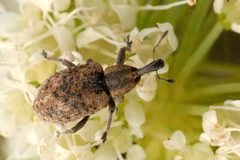
Hypera rumicis is a small true weevil in the Curculionidae, known as the Dock Hyper Weevil. The is native to Europe and has been introduced to North America. It is a herbivore associated with dock and sorrel plants (Rumex spp.), where both larvae and feed on tissues. The species has been investigated as a potential agent for Rumex weeds, though it can also cause damage to crops. Adults show complex behavioral responses to plant volatile compounds, with attraction and repellency depending on concentration and mating status.
Pronunciation
How to pronounce Hypera rumicis: //ˈhaɪpərə ˈrʌmɪsɪs//
These audio files are automatically generated. While they are not always 100% accurate, they are a good starting point.
Identification
A small pale buff-colored weevil approximately 5 mm in length. As a member of Curculionidae, it possesses the characteristic elongated rostrum with mouthparts at the tip. Specific diagnostic features distinguishing it from congeneric are not documented in available sources.
Images
Habitat
Found in where dock and sorrel (Rumex) plants occur, including crop fields and areas supporting Rumex confertus and Rumex crispus.
Distribution
Europe (native range, reported throughout the continent); North America (introduced, established in lower 48 states). GBIF records confirm presence in Belgium and North America.
Seasonality
Active during late spring and summer; this corresponds to the growing season of its Rumex plants.
Diet
Herbivorous; feeds exclusively on docks and sorrel (Rumex spp.). Larvae and both consume plant tissues, with larvae feeding on inflorescence stems and developing seeds.
Host Associations
- Rumex confertus - primary plant; larval development and feeding occur on this
- Rumex crispus - primary plant; larval development and feeding occur on this
Life Cycle
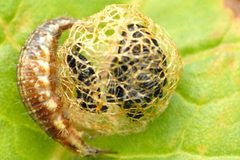
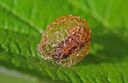
Larvae develop inside woven spherical cages constructed on the plant. They feed on inflorescence stems and destroy developing seeds. occurs within or near the larval cage. emerge and continue feeding on host plants for one to two weeks. Heavy reduce plant height and aerial , and prevent seed production.
Behavior
exhibit sex-specific and mating-status-dependent responses to synthetic plant volatile blends. Unmated females are attracted to males, while mated females shift attraction to green leaf volatile blends (specifically Blend 1: Z-3-hexenal, E-2-hexenal, Z-3-hexenol, E-2-hexenol, and Z-3-hexen-1-yl acetate), suggesting post-mating behavioral changes related to -seeking for oviposition. Both unmated and mated males are attracted only to females, not to volatile blends. Both sexes are repelled by high concentrations (125 ng) of green leaf volatiles and by moderate to high concentrations (25-125 ng) of terpene-based blends (Z-ocimene, linalool, benzyl acetate, methyl salicylate, β-caryophyllene, and E-β-farnesene). Attraction to green leaf volatiles occurs only at lower concentrations (1-25 ng).
Ecological Role
Herbivore specializing on Rumex . Functions as a potential biocontrol agent for Rumex weeds through feeding damage that reduces plant and prevents seed production. May also act as a crop pest when Rumex species are present in agricultural settings.
Human Relevance
Investigated as a agent for dock and sorrel weeds. Can cause economic damage to crops when plants are present in agricultural fields. Heavy reduce forage quality and yield in alfalfa and other systems where Rumex occurs.
Similar Taxa
- Hypera postica (alfalfa weevil)Both are congeneric weevils in Curculionidae with similar body plans and agricultural pest status. Hypera postica is larger, more economically significant in western North America, and specializes on alfalfa (Medicago sativa) rather than Rumex. Hypera rumicis is smaller (~5 mm), pale buff in color, and restricted to Rumex .
Sources and further reading
- BugGuide
- Wikipedia
- GBIF taxonomy match
- iNaturalist taxon
- NCBI Taxonomy
- Catalogue of Life
- Shedding New Light on Honey Bee Chromosomes | Bug Squad
- Who's Speaking at the UC Davis Entomology/Nematology Seminars? | Bug Squad
- Waxy lady beetles come to the rescue of pest-plagued crapemyrtles, Hyperaspis spp. — Bug of the Week
- Alfalfa Weevil: New Integrated Pest Management Guide Available
- Uncategorized | Blog - Part 23
- Beware the bee fly - Bombylius sp. — Bug of the Week
- Responses of Adult Hypera rumicis L. to Synthetic Plant Volatile Blends