
Diaprepes abbreviatus
(Linnaeus, 1758)
Diaprepes root weevil, Citrus root weevil, Sugarcane rootstock borer weevil, Chichí
is a root-feeding weevil native to the Caribbean, where it is known colloquially as "chichí." It is a major agricultural pest that was accidentally introduced to Florida in 1964 and has since spread to California and Texas. The causes significant economic damage to citrus, avocado, and other crops through larval feeding on root systems.
Pronunciation
How to pronounce Diaprepes abbreviatus: /ˌdaɪəˈpriːpiːz əˌbriːviˈeɪtəs/
These audio files are automatically generated. While they are not always 100% accurate, they are a good starting point.
Identification
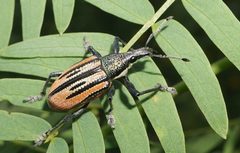
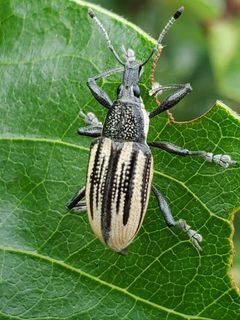
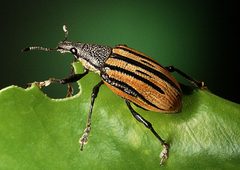
Distinguished from similar weevils by the distinctive pattern of yellowish-orange stripes on black . The combination of small size, dark coloration with pale striping, and association with citrus or other plants aids identification. Larvae are recognized as pale, plump root-feeding with dark found in soil around host plant roots.
Images
Appearance
are somewhat variable in size, averaging just over 1 cm in length. The are black with large stripes of tiny yellowish-orange . The and legs are black. The legs bear adhesive pads that allow the weevil to adhere to very smooth surfaces. Larvae are plump pale with dark heads, reaching up to 2.5 cm in length.
Habitat
Agricultural and natural environments where plants occur. inhabit foliage and stems of host plants. Larval is below ground in the root systems of host plants, where they burrow and feed.
Distribution
Native to the Caribbean, including Puerto Rico, Guadeloupe, and Martinique. Introduced to the United States: first detected in Florida in 1964, southern California in 2005, Texas (Rio Grande Valley) in 2000 with subsequent detections near Houston in 2009 and Pearland in 2022. Also present in French Guiana.
Diet
Larvae feed on root tissue of plants, often consuming the taproot. feed on foliage of host plants, though larval feeding causes the most damage.
Host Associations
- Citrus spp. - larval and feedingMajor economic
- Persea americana (avocado) - larval and feedingSignificant in California
- Sugarcane - larval feeding
- Carica papaya (papaya) - larval feedingSupports complete larval development
- Mangifera indica (mango) - larval feedingSupports complete larval development
- Psidium guajava (guava) - larval feedingSupports complete larval development
- Coffea arabica (coffee) - larval feedingSupports complete larval development
- Colocasia esculenta (taro) - larval feedingSupports complete larval development
- Annona spp. (custard apple) - larval feedingSupports complete larval development
- Spondias spp. - larval feedingSupports complete larval development
Life Cycle
Females deposit in clusters on leaves, then fold and glue the leaves together. After approximately one week, larvae emerge, fall to the ground, and burrow to plant roots. Larvae feed on roots for several months before pupating in soil. A single female may lay up to 5,000 eggs.
Behavior
are capable of adhering to smooth surfaces using specialized pads on their legs. The spreads primarily through human-mediated transport of infested plants, soil, and containers. Larval feeding on taproots can kill plants by disrupting water and nutrient uptake or by creating entry points for fungal and oomycete such as Phytophthora.
Ecological Role
Agricultural pest causing extensive root damage to economically important plants. Larval feeding disrupts plant health and can lead to plant death. The has no known native ecological role in introduced ranges.
Human Relevance
Major economic pest of citrus, avocado, and nursery industries. trigger measures. Management includes agents such as the Steinernema riobravis, parasitic , and fungal adulticides. Subject to programs.
Similar Taxa
- Other Diaprepes speciesSame ; D. abbreviatus distinguished by elytral pattern and distribution
- Pachnaeus litus (blue-green citrus root weevil)Similar size and citrus association; distinguished by coloration and elytral pattern
More Details
Biological Control
Multiple agents are under study or in use, including ants, parasitic , Bacillus thuringiensis, and fungi. Steinernema riobravis are released in irrigation water in Florida infested fields.
Colloquial Names
Known as "chichí" in Spanish-speaking Caribbean regions.
Sources and further reading
- BugGuide
- Wikipedia
- GBIF taxonomy match
- iNaturalist taxon
- NCBI Taxonomy
- Catalogue of Life
- The 13 Bugs of Christmas | Bug Squad
- On the First Day of Christmas... | Bug Squad
- Revisiting 'The 13 Bugs of Christmas' | Bug Squad
- A Buggy Kind of Christmas: A Poem Revisited | Bug Squad
- A Bugworthy Kind of Christmas | Bug Squad
- 'The 13 Bugs of Christmas'--Revisited | Bug Squad
- Diaprepes Root Weevil, Diaprepes abbreviatus (Linnaeus) (Insecta: Coleoptera: Curculionidae)
- Diaprepes abbreviatus . [Distribution map].
- Diaprepes abbreviatus (Coleoptera: Curculionidae): Host Plant Associations
- Flight Behavior and Dispersal of Diaprepes abbreviatus
- Biology of Diaprepes abbreviatus (Coleoptera: Curculionidae) Reared on an Artificial Diet
- Semiochemicals and Diaprepes abbreviatus (Coleoptera: Curculionidae) Behavior: Implications for Survey
- Gut microbial community structure of the adult citrus root weevil Diaprepes abbreviatus.