
Eustylini
Lacordaire, 1863
Genus Guides
4- Achrastenus
- Brachystylus
- Compsus
- Diaprepes(Diaprepes weevils)
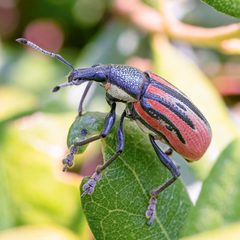
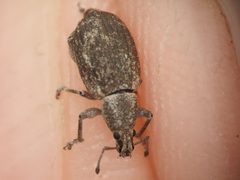
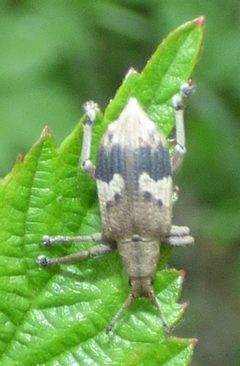
Eustylini is a tribe of broad-nosed weevils (Curculionidae: Entiminae) primarily restricted to the Neotropical region. The tribe comprises approximately 25 and 339 described , with highest diversity in the Caribbean, Central America, and northern South America. Species are medium to large (10–25 mm) and often strikingly colored with variable coverage. The tribe includes notable agricultural pests, particularly Diaprepes abbreviatus, which causes significant economic damage to citrus and other crops. Taxonomic boundaries remain unclear due to phylogenetic clustering with Geonemini.
Pronunciation
How to pronounce Eustylini: //juːˈstaɪlɪnaɪ//
These audio files are automatically generated. While they are not always 100% accurate, they are a good starting point.
Identification
Eustylini can be distinguished from related tribes by the combination of: subrectangular nearly as long or longer than wide; antennal scrobe generally fully visible in view; margin of prothorax straight to slightly sinuate in lateral view, never with conspicuous postocular lobe; and postocular setae forming a fringe rather than tuft if present. The tribe is challenging to distinguish from Geonemini due to unclear phylogenetic boundaries. Within Eustylini, identification to relies on characters such as elytral shoulder development (absent in Brachyomus), rostral carination, and femoral .
Images
Habitat
Neotropical ranging from southwestern USA to Argentina; highest diversity in Caribbean, Central America, and northern South America. Specific microhabitat preferences vary by and .
Distribution
Ranges from southwestern USA to Argentina, with highest diversity in the Caribbean, Central America, and northern South America. Northernmost records include southern USA (e.g., Compsus auricephalus ranging to Illinois, west to Colorado and Arizona, east to Georgia).
Diet
feeding habits, characteristic of Entiminae. Some are serious agricultural pests attacking roots and foliage. Specific associations are documented for individual species (e.g., Diaprepes abbreviatus attacks citrus, sugar cane, coffee, and over 40 plant species in Puerto Rico), but general feeding habits for the tribe as a whole are not well characterized beyond polyphagy.
Host Associations
- Citrus - pestDiaprepes abbreviatus causes significant damage
- Sugar cane - pestDiaprepes abbreviatus
- Coffee - pestDiaprepes abbreviatus
Behavior
Some are serious agricultural pests. Diaprepes abbreviatus causes approximately 70 million dollars in damage annually in Florida and infests more than 100,000 acres of citrus.
Ecological Role
Includes agricultural pest causing significant economic damage to crops. Broader ecological roles (e.g., as decomposers, , or food sources) are not well documented for the tribe.
Human Relevance
Eustylini includes economically important agricultural pests, most notably Diaprepes abbreviatus (citrus root weevil), which causes extensive damage to citrus, sugar cane, coffee, and other crops. The tribe's high diversity and morphological similarity among creates challenges for accurate identification of introduced at ports of entry.
Similar Taxa
- GeoneminiPhylogenetic clustering with Eustylini; some Geonemini group with eustylines, contributing to unclear tribal boundaries
- NaupactiniFormerly contained Aptolemus, now placed in Naupactini; both tribes share Entiminae characteristics
- PhyllobiiniFormer members transferred to Eustylini by Franz in 2012, indicating historical taxonomic confusion
- TanymeciniFormer members transferred to Eustylini by Franz in 2012
More Details
Taxonomic History
First named by Lacordaire in 1863 as 'Groupe Eustylides' with three (Aptolemus, Brachystylus, Eustylus). Major revision by Kuschel in 1986 established most current genera. Recent additions by Franz in 2012 transferred former members of Geonemini, Phyllobiini, and Tanymecini. Type of several genera (Compsus, Diaprepes, Eustylus, Exorides, Exophthalmus) redescribed by Franz.
Species Complexes
The tribe contains two major : the 'Exophthalmus complex' (Caribbean/Central American) and the 'Compsus genus complex' (South American, approximately 180 ).
Taxonomic Uncertainty
Most are only known from their original descriptions, and comprehensive taxonomic revisions are lacking for many . The tribe's boundaries remain unclear due to phylogenetic clustering with Geonemini.
Sources and further reading
- BugGuide
- Wikipedia
- iNaturalist taxon
- NCBI Taxonomy
- Catalogue of Life
- Variability and distribution of the golden-headed weevil Compsus auricephalus (Say) (Curculionidae: Entiminae: Eustylini)
- Figure 9 from: Girón JC, Chamorro ML (2020) Variability and distribution of the golden-headed weevil Compsus auricephalus (Say) (Curculionidae: Entiminae: Eustylini). Biodiversity Data Journal 8: e55474. https://doi.org/10.3897/BDJ.8.e55474
- Figure 7 from: Girón JC, Chamorro ML (2020) Variability and distribution of the golden-headed weevil Compsus auricephalus (Say) (Curculionidae: Entiminae: Eustylini). Biodiversity Data Journal 8: e55474. https://doi.org/10.3897/BDJ.8.e55474
- Figure 2 from: Girón JC, Chamorro ML (2020) Variability and distribution of the golden-headed weevil Compsus auricephalus (Say) (Curculionidae: Entiminae: Eustylini). Biodiversity Data Journal 8: e55474. https://doi.org/10.3897/BDJ.8.e55474
- Figure 1 from: Girón JC, Chamorro ML (2020) Variability and distribution of the golden-headed weevil Compsus auricephalus (Say) (Curculionidae: Entiminae: Eustylini). Biodiversity Data Journal 8: e55474. https://doi.org/10.3897/BDJ.8.e55474
- Figure 8 from: Girón JC, Chamorro ML (2020) Variability and distribution of the golden-headed weevil Compsus auricephalus (Say) (Curculionidae: Entiminae: Eustylini). Biodiversity Data Journal 8: e55474. https://doi.org/10.3897/BDJ.8.e55474
- Figure 3 from: Girón JC, Chamorro ML (2020) Variability and distribution of the golden-headed weevil Compsus auricephalus (Say) (Curculionidae: Entiminae: Eustylini). Biodiversity Data Journal 8: e55474. https://doi.org/10.3897/BDJ.8.e55474
- Figure 5 from: Girón JC, Chamorro ML (2020) Variability and distribution of the golden-headed weevil Compsus auricephalus (Say) (Curculionidae: Entiminae: Eustylini). Biodiversity Data Journal 8: e55474. https://doi.org/10.3897/BDJ.8.e55474
- Figure 6 from: Girón JC, Chamorro ML (2020) Variability and distribution of the golden-headed weevil Compsus auricephalus (Say) (Curculionidae: Entiminae: Eustylini). Biodiversity Data Journal 8: e55474. https://doi.org/10.3897/BDJ.8.e55474
- Figure 10 from: Girón JC, Chamorro ML (2020) Variability and distribution of the golden-headed weevil Compsus auricephalus (Say) (Curculionidae: Entiminae: Eustylini). Biodiversity Data Journal 8: e55474. https://doi.org/10.3897/BDJ.8.e55474
- Figure 4 from: Girón JC, Chamorro ML (2020) Variability and distribution of the golden-headed weevil Compsus auricephalus (Say) (Curculionidae: Entiminae: Eustylini). Biodiversity Data Journal 8: e55474. https://doi.org/10.3897/BDJ.8.e55474
- Supplementary material 1 from: Girón JC, Chamorro ML (2020) Variability and distribution of the golden-headed weevil Compsus auricephalus (Say) (Curculionidae: Entiminae: Eustylini). Biodiversity Data Journal 8: e55474. https://doi.org/10.3897/BDJ.8.e55474