
Strophosoma melanogrammum
(Forster, 1771)
Nut Leaf Weevil
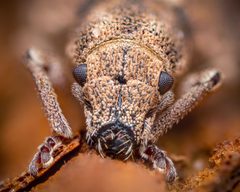
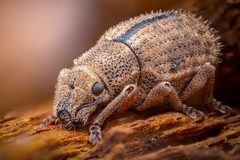
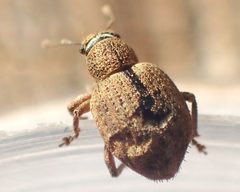
Strophosoma melanogrammum is a parthenogenetic weevil native to Europe and introduced to North America. It is one of the most common Strophosoma species in Europe and has been studied extensively for its reproductive and association with endosymbionts. The species reproduces through , with all-female , and is known as a pest in young forest stands.
Pronunciation
How to pronounce Strophosoma melanogrammum: /ˌstrɒfoʊˈsoʊmə ˌmɛləˈnɒɡræməm/
These audio files are automatically generated. While they are not always 100% accurate, they are a good starting point.
Identification
Distinguishable from the congeneric Strophosoma capitatum by mitochondrial markers; the bisexual S. capitatum exhibits greater mitochondrial diversity while S. melanogrammum shows heterozygosity in nuclear DNA consistent with hybrid origin. External morphological differences between the two are subtle and require molecular or detailed morphological examination for reliable separation.
Images
Habitat
Young forest stands
Distribution
Native to Europe; introduced to North America. Documented from São Miguel (Azores) and Belgium.
Life Cycle
Parthenogenetic ; all-female . Developmental stages not documented in available sources.
Ecological Role
Pest in young forest stands
Human Relevance
Recognized as a pest affecting young forest stands; 'Nut Leaf Weevil' suggests association with nut-bearing trees
Similar Taxa
- Strophosoma capitatumReproduces bisexually (vs. parthenogenetic in S. melanogrammum); lower mitochondrial diversity in S. melanogrammum and heterozygous nuclear pattern distinguish the two molecularly
More Details
Wolbachia infection
All individuals of S. melanogrammum carry endosymbionts, with two distinct strains detected. This contrasts with S. capitatum, where less than half of populations are infected and three strains occur. Research suggests in this is of hybrid origin and that Wolbachia may have played a role in speciation.
Reproductive biology
S. melanogrammum is parthenogenetic (thelytokous), producing only female offspring without . This represents one of the few well-documented cases of in weevils and has been hypothesized to result from hybridization rather than direct induction.