
Strophosoma
Billberg, 1820
Species Guides
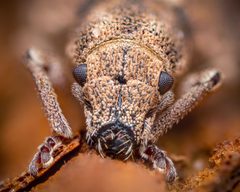
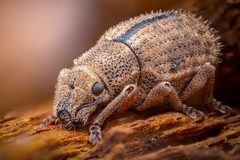
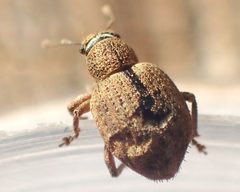
1- Strophosoma melanogrammum(Nut Leaf Weevil)
Strophosoma is a of weevils (Curculionidae: Entiminae) established by Billberg in 1820. The genus includes both bisexual and parthenogenetic , with documented variation in reproductive mode between species such as S. capitatum (bisexual) and S. melanogrammum (parthenogenetic). These weevils are known to occur in forest , where some species have been reported as pests in young forest stands. The genus has been subject to taxonomic revision, with subgenera Leucostrophus and Morphostrophus distinguished by morphological characters.
Pronunciation
How to pronounce Strophosoma: /ˌstɹɒfoʊˈsoʊmə/
These audio files are automatically generated. While they are not always 100% accurate, they are a good starting point.
Identification
Subgenera within Strophosoma can be distinguished by presence or absence of cruciform grooves on the ; subgenus Leucostrophus lacks these grooves, a character that has led to its elevation to generic status in some treatments. A dichotomous key for distinguishing subgenera is available for West-Palearctic .
Images
Habitat
Forest , particularly young forest stands where some have been reported as pests.
Distribution
Europe and North America; West-Palearctic have been subject to detailed taxonomic revision.
Ecological Role
Some have been identified as pests in young forest stands, suggesting a role as herbivores of woody vegetation.
Human Relevance
Some are reported as pests in young forest stands, indicating potential economic impact on forestry.
Similar Taxa
- LeucostrophusFormerly treated as a subgenus of Strophosoma, elevated to generic status based on absence of cruciform grooves on the ; includes such as L. albosignatum.
- NeliocarusDistinguished from subgenus Morphostrophus in taxonomic treatments of West-Palearctic Strophosoma.
More Details
Reproductive Biology
Strophosoma exhibits contrasting reproductive modes: S. capitatum reproduces bisexually while S. melanogrammum is parthenogenetic. The parthenogenetic shows lower mitochondrial diversity but high nuclear heterozygosity, suggesting hybrid origin of . endosymbiont is present in both species, with all S. melanogrammum individuals infected compared to less than half of S. capitatum ; multiple Wolbachia strains have been detected (two in S. melanogrammum, three in S. capitatum). Wolbachia may have played a role in speciation through modification of breeding systems.
Taxonomic History
Subgenus Leucostrophus was elevated to generic status based on morphological characters, with L. albolineatus synonymized with L. albosignatus. Subgenus Morphostrophus is maintained as distinct from Strophosoma s. str., limited to single S. edmundi.
Sources and further reading
- BugGuide
- Wikipedia
- GBIF taxonomy match
- iNaturalist taxon
- NCBI Taxonomy
- Catalogue of Life
- Contrasting patterns of molecular diversity and Wolbachia infection in bisexual and parthenogenetic Strophosoma weevils (Coleoptera: Curculionidae)
- Révision des espèces ouest-paléarctiques du genre Strophosoma Billberg 1820 : HI, les sous-genres Leucostrophus Flach et Morphostrophus Flach (Coleoptera, Curculionidae)