
Rhinusa neta
(Germar, 1821)
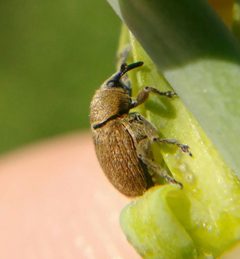
Rhinusa neta is a seed-feeding weevil in the Curculionidae, native to Europe and introduced to North America as a agent for toadflax . are active from May to August. Larvae develop inside seed capsules of plants, feeding on seeds. The complete development cycle from to adult averages approximately 60 days under standard laboratory conditions.
Pronunciation
How to pronounce Rhinusa neta: /rɪˈnuːsə ˈneːta/
These audio files are automatically generated. While they are not always 100% accurate, they are a good starting point.
Identification
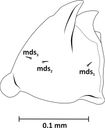
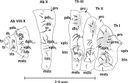
Diagnostic features of the preimaginal stages distinguish R. neta from the R. bipustulata. Larvae feed inside seed capsules without causing seed swelling, unlike R. antirrhini which induces swelling. are small weevils typical of the Rhinusa. Precise adult morphological diagnostic features are not detailed in available sources.
Images
Habitat
Dry, warm places including fields, land, roadsides, gravel pits, moors, rock , sunny thickets, pastures, sunlit slopes, sandbars, uncultivated strips between fields, vegetation, meadows, and lawns.
Distribution
Native to southern and central Europe, Belgium, Caucasus, Afghanistan, Kazakhstan, Iran, Algeria, and Morocco. Introduced to the United States in 1937 and Canada in 1957. In Poland, found in lowlands, highlands (central and eastern), Eastern Sudetes, and Eastern Beskids. Established in northern California, USA, where it has spread since introduction.
Seasonality
active from May to August.
Diet
Larvae feed on seeds inside seed capsules of plants. Primary hosts include Linaria vulgaris, L. genistifolia, L. repens, L. spuria, Antirrhinum orontium, and A. majus. In North America, also L. dalmatica in field conditions. Laboratory feeding observed on Chaenorrhinum and Kickxia, but field confirmation lacking.
Host Associations
- Linaria vulgaris - primary - larval feeding on seedsField confirmed in native and introduced ranges
- Linaria dalmatica - primary - larval feeding on seedsField confirmed in North America introduced range
- Linaria genistifolia - - larval feeding on seedsNative European range
- Linaria repens - - larval feeding on seedsNative European range
- Linaria spuria - - larval feeding on seedsNative European range
- Antirrhinum orontium - - larval feeding on seedsNative European range
- Antirrhinum majus - - larval feeding on seedsNative European range
- Chaenorrhinum - laboratory Laboratory conditions only; no field confirmation
- Kickxia - laboratory Laboratory conditions only; no field confirmation
Life Cycle
Complete development cycle averages approximately 60 days under standard conditions (25°C day/20°C night, 40-50% humidity): period ~11 days, larval period ~29 days, pupal period ~18 days. Larvae develop inside seed capsules, feeding on seeds. occurs within the seed capsule.
Behavior
Larvae feed internally within seed capsules without causing visible swelling of seeds, distinguishing their feeding damage from that of R. antirrhini. When both R. neta and R. antirrhini infest Linaria simultaneously, seed losses may reach 90%.
Ecological Role
Seed reducing seed production of plants. agent for toadflax (Linaria vulgaris and L. dalmatica) in North America. Larvae serve as hosts for hymenopterans in the superfamily Chalcidoidea.
Human Relevance
Intentionally introduced to the United States (1937) and Canada (1957) for of toadflax . Less common and more dispersed than R. antirrhini in North America.
Similar Taxa
- Rhinusa antirrhiniAlso a seed of Linaria ; distinguished by larval feeding that causes seed swelling, whereas R. neta feeding does not cause swelling
- Rhinusa bipustulata with similar ; distinguished by diagnostic features of preimaginal stages
Sources and further reading
- BugGuide
- GBIF taxonomy match
- iNaturalist taxon
- NCBI Taxonomy
- Catalogue of Life
- For the Love of Butterflies | Bug Squad
- Bug Eric: Spring White
- Bug Eric: Fly Day Friday: Biting Midges, No-See-Ums, Punkies
- Bug Eric: Wasp Wednesday: Eupelmidae
- Bug Eric: Forestflies (Spring Stoneflies)
- The morphology of the preimaginal stages of Rhinusa neta (Germar, 1821) and notes on its biology (Coleoptera, Curculionidae, Mecinini)
- Figure 1 from: Ścibior R, Łętowski J (2018) The morphology of the preimaginal stages of Rhinusa neta (Germar, 1821) and notes on its biology (Coleoptera, Curculionidae, Mecinini). ZooKeys 807: 29-46. https://doi.org/10.3897/zookeys.807.28365
- Figure 4 from: Ścibior R, Łętowski J (2018) The morphology of the preimaginal stages of Rhinusa neta (Germar, 1821) and notes on its biology (Coleoptera, Curculionidae, Mecinini). ZooKeys 807: 29-46. https://doi.org/10.3897/zookeys.807.28365
- Reproductive success of the invasive weed Linaria dalmatica and seed loss due to predation by Rhinusa neta in northern California, USA
- Figure 5 from: Ścibior R, Łętowski J (2018) The morphology of the preimaginal stages of Rhinusa neta (Germar, 1821) and notes on its biology (Coleoptera, Curculionidae, Mecinini). ZooKeys 807: 29-46. https://doi.org/10.3897/zookeys.807.28365
- Figure 8 from: Ścibior R, Łętowski J (2018) The morphology of the preimaginal stages of Rhinusa neta (Germar, 1821) and notes on its biology (Coleoptera, Curculionidae, Mecinini). ZooKeys 807: 29-46. https://doi.org/10.3897/zookeys.807.28365
- Figure 9 from: Ścibior R, Łętowski J (2018) The morphology of the preimaginal stages of Rhinusa neta (Germar, 1821) and notes on its biology (Coleoptera, Curculionidae, Mecinini). ZooKeys 807: 29-46. https://doi.org/10.3897/zookeys.807.28365
- Figure 2 from: Ścibior R, Łętowski J (2018) The morphology of the preimaginal stages of Rhinusa neta (Germar, 1821) and notes on its biology (Coleoptera, Curculionidae, Mecinini). ZooKeys 807: 29-46. https://doi.org/10.3897/zookeys.807.28365
- Figure 3 from: Ścibior R, Łętowski J (2018) The morphology of the preimaginal stages of Rhinusa neta (Germar, 1821) and notes on its biology (Coleoptera, Curculionidae, Mecinini). ZooKeys 807: 29-46. https://doi.org/10.3897/zookeys.807.28365
- Figure 6 from: Ścibior R, Łętowski J (2018) The morphology of the preimaginal stages of Rhinusa neta (Germar, 1821) and notes on its biology (Coleoptera, Curculionidae, Mecinini). ZooKeys 807: 29-46. https://doi.org/10.3897/zookeys.807.28365
- Figure 7 from: Ścibior R, Łętowski J (2018) The morphology of the preimaginal stages of Rhinusa neta (Germar, 1821) and notes on its biology (Coleoptera, Curculionidae, Mecinini). ZooKeys 807: 29-46. https://doi.org/10.3897/zookeys.807.28365