
Rhinusa antirrhini
Stephens, 1829
toadflax seedhead weevil, toadflax capsule weevil, seed-gall weevil, Toadflax Seed Weevil
Rhinusa antirrhini is a seed-parasitic true weevil (Curculionidae) native to Europe that has been introduced to North America. It specializes on toadflax (Linaria spp.), particularly Dalmatian toadflax (L. dalmatica) and yellow toadflax (L. vulgaris). Despite intentional redistribution as a agent in the 1990s, it has not proven effective at suppressing toadflax . Population genetic studies reveal -associated genetic differentiation driven by associations with different Linaria species.
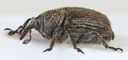
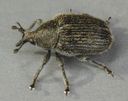
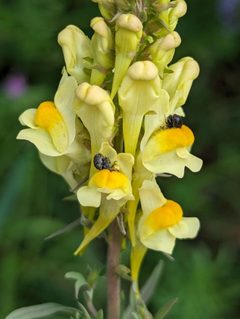
Pronunciation
How to pronounce Rhinusa antirrhini: //rɪˈnuː.sə æn.tɪˈraɪ.naɪ//
These audio files are automatically generated. While they are not always 100% accurate, they are a good starting point.
Images
Distribution
Native to Europe; introduced to North America in the early 1900s. Established documented in Denmark, Norway, and Sweden.
Diet
Seed parasitic; larvae develop within toadflax seed capsules, consuming developing seeds.
Host Associations
- Linaria dalmatica - primary Dalmatian toadflax; in North America
- Linaria vulgaris - primary yellow toadflax; in North America
- Linaria genistifolia -
- Linaria repens -
Ecological Role
Seed ; reduces seed production in toadflax .
Human Relevance
Intentionally redistributed and introduced to North America as a agent for toadflax in the 1990s. Not considered effective for biological control despite establishment.