
Rhinusa
Stephens, 1829
Species Guides
5- Rhinusa antirrhini(toadflax seedhead weevil)
- Rhinusa asellus
- Rhinusa linariae(root-gall weevil)
- Rhinusa neta
- Rhinusa tetra(Mullein Weevil)
Rhinusa is a of true weevils (Curculionidae) comprising at least 20 described . Species in this genus are specialized herbivores associated with plants in the Scrophulariaceae and Plantaginaceae, particularly genera Linaria, Verbascum, and Scrophularia. Several species have been evaluated or employed as agents for plants, notably yellow toadflax (Linaria vulgaris) and common mullein (Verbascum thapsus). The genus exhibits complex -associated diversification patterns, with some species groups showing strict host conservatism while others display variable feeding habits including stem-galling, seed-capsule feeding, and inquilinism.
Pronunciation
How to pronounce Rhinusa: /raɪˈnusa/
These audio files are automatically generated. While they are not always 100% accurate, they are a good starting point.
Identification
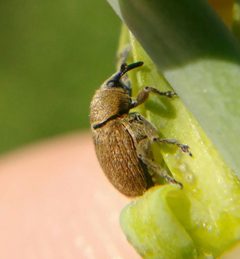
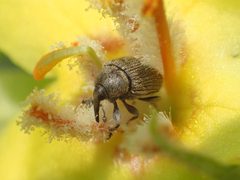
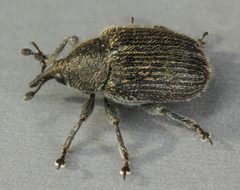
Rhinusa are small to medium-sized weevils distinguished from related by morphological characters of the rostrum, , and body . Species-level identification relies on subtle differences in rostrum shape, integument texture, and punctation patterns. Within the R. pilosa , diagnostic features include rostrum shape and integument characteristics, though these require careful examination. A key to the four species of the R. tetra complex (R. tetra, R. comosa, R. moroderi, R. verbasci) has been published based on morphological and biological characters. Preimaginal stages show species-specific diagnostic characters useful for identification when adults are unavailable.
Images
Habitat
Temperate regions of the Northern Hemisphere. are found in supporting their plants, including open fields, disturbed areas, and riparian zones where Linaria, Verbascum, and Scrophularia species occur.
Distribution
Europe (native range for most ); distribution records include Denmark, Norway, Sweden, and the United States (including Vermont). Some species have been introduced to North America as agents.
Diet
Herbivorous; larvae and feed on plants in Scrophulariaceae and Plantaginaceae. Specific feeding habits vary by : stem-galling (e.g., R. pilosa on Linaria vulgaris), seed-capsule feeding (e.g., R. antirrhini group), stem-boring (some R. tetra group species), or inquilinism within galls of other Rhinusa species (some R. neta group species).
Host Associations
- Linaria vulgaris - primary authentic field for R. pilosa
- Linaria purpurea - primary authentic field for R. brondelii
- Linaria genistifolia - primary authentic field for R. rara
- Linaria dalmatica - primary authentic field for R. rara
- Verbascum thapsus - for R. tetra ; proposed target
- Scrophularia - for R. bipustulata group
- Verbascum - for R. tetra group
- Plantaginaceae (Antirrhineae) - plesiomorphic association for
Life Cycle
Development varies by . R. neta completes development in approximately 60 days under standard conditions: 11-day period, 29-day larval period, and 18-day pupal period. R. pilosa is . Larval development occurs within plant tissue (galls, stems, or seed capsules).
Behavior
weevils exhibit high fidelity, with most restricted to specific host plant or . Shoot-galling species induce gall formation on host stems through oviposition. Some species are , living within galls induced by other Rhinusa species rather than inducing their own. Adults of R. pilosa show minimal feeding and survival on non-host native North American Antirrhineae species.
Ecological Role
Herbivores that can significantly impact plant through gall formation, seed , or stem boring. Some serve as hosts for Hymenoptera in the superfamily Chalcidoidea. Evaluated and used as agents to suppress plant populations.
Human Relevance
Several are important agents. R. pilosa was approved for release in North America in 2013 to control yellow toadflax (Linaria vulgaris). R. tetra was evaluated for control of common mullein (Verbascum thapsus). specificity testing is required for biocontrol candidates to assess non-target risks to native flora.
Similar Taxa
- GymnetronHistorical confusion and synonymy; multiple Rhinusa were previously described under Gymnetron; both are in tribe Mecinini and share plant associations with Scrophulariaceae and Plantaginaceae
- Gymnetron tetrumFormerly placed in Gymnetron, now Rhinusa tetra; many historical specimens and literature references use the Gymnetron combination
More Details
Phylogenetic Structure
The comprises three main : Assemblage A (R. bipustulata and R. tetra groups on Scrophulariaceae), Assemblage B (R. antirrhini and R. linariae groups on Plantaginaceae), and Assemblage C (six groups including R. pilosa, R. herbarum, R. neta, R. vestita, R. mauritii, and R. melas on Plantaginaceae). Assemblages A and B are well-supported as monophyletic; Assemblage C has weaker support.
Host Plant Conservatism
Feeding on Plantaginaceae is the plesiomorphic condition for Rhinusa. associations are generally phylogenetically conserved, though some groups show variation in feeding habits (stem-galling vs. seed-capsule feeding vs. inquilinism) without corresponding host shifts.
Species Diversity
At least 20 described ; the R. pilosa alone contains three cryptic species (R. pilosa, R. brondelii, R. rara) distinguished by molecular data and subtle despite overlapping ranges.
Sources and further reading
- BugGuide
- Wikipedia
- GBIF taxonomy match
- iNaturalist taxon
- NCBI Taxonomy
- Catalogue of Life
- Taxonomic and nomenclatural notes on the Rhinusa tetra (Fabricius) species complex (Coleoptera: Curculionidae)
- Biology and host specificity of Rhinusa pilosa, a recommended biological control agent of Linaria vulgaris
- Host‐associated genetic divergence and taxonomy in the Rhinusa pilosa G yllenhal species complex: an integrative approach
- Figure 1: Bayesian ancestral state reconstructions for different traits of host plant use by Rhinusa and Gymnetron weevils.
- Figure 3: Estimated extinction rates associated with different traits of host plant use by Rhinusa and Gymnetron weevils.
- Figure 4: Posterior probability density plots of net diversification rates (λ—μ) for Rhinusa and Gymnetron weevils associated with two traits of host plant use.
- Phylogeny of the weevil genus Rhinusa Stephens based on adult morphological characters and host plant information (Coleoptera: Curculionidae)
- The morphology of the preimaginal stages of Rhinusa neta (Germar, 1821) and notes on its biology (Coleoptera, Curculionidae, Mecinini)
- Description of immature stages of Rhinusa species (Coleoptera, Curculionidae, Mecinini) with a focus on diagnostic morphological characters at the species and genus levels.