
Cylindrocopturus adspersus
LeConte, 1876
sunflower stem weevil
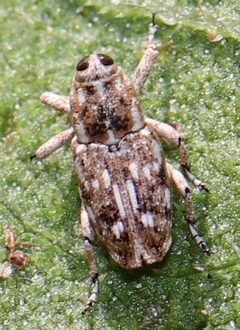
Cylindrocopturus adspersus, commonly known as the sunflower stem weevil, is a true weevil in the Curculionidae. are small, grayish-brown beetles with irregular whitish markings, approximately 5 mm in length. The has a single per year, with larvae developing inside sunflower stems and in chambers hollowed out at the base of the plant. It is recognized as an occasional but potentially serious pest of cultivated sunflowers in North America, capable of reducing yields by up to 50% in heavily infested fields.
Pronunciation
How to pronounce Cylindrocopturus adspersus: /sɪˌlɪndroʊˈkɒptərəs ædˈspɜːrsəs/
These audio files are automatically generated. While they are not always 100% accurate, they are a good starting point.
Identification
are distinguished from similar stem weevils by their small size (approximately 5 mm), grayish-brown coloration with irregular whitish markings, and mottled appearance. The black sunflower stem weevil (Apion occidentale) is smaller (approximately 3 mm), entirely black, and belongs to the Brentidae. The sunflower head-clipping weevil (Haplorhynchites aeneus) is larger (approximately 8 mm), metallic black, and belongs to the family Attelabidae. Larvae of C. adspersus are creamy white with brown and found tunneling in sunflower stem pith, whereas larvae of the cocklebur weevil (Rhodabaenus quinquepunctatus) are larger and leave more conspicuous tunnels.
Images
Habitat
Agricultural fields and natural areas supporting sunflower plants; specifically associated with cultivated sunflower (Helianthus annuus) and wild sunflower . are found on sunflower stems and foliage. Larvae develop within the pith of sunflower stems. chambers are located in the woody basal tissue of old sunflower stalks.
Distribution
North America: recorded in the United States from Colorado, Texas, North Dakota, South Dakota, and Minnesota; present in the Canadian Prairie Provinces including Saskatchewan (first recorded 1984 near Carnduff, with subsequent establishment in the Carnduff, Estevan, and Weyburn areas). Distribution corresponds to major sunflower-growing regions of the northern Great Plains.
Seasonality
emerge from chambers in May or June. Oviposition occurs over a 2- to 5-week period following adult . Larvae develop through summer, descending to stem bases in late summer or fall. Single per year; adults and larvae enter through winter, resuming activity in spring.
Diet
feed on sunflower leaves and stems without causing significant economic damage. Larvae feed internally on sunflower stem pith, destroying vascular tissue and weakening plant structure.
Host Associations
- Helianthus annuus - primary cultivated and wild sunflower; larvae tunnel in stems, feed on foliage
- Helianthus spp. - wild sunflower
Life Cycle
: deposited singly in holes chewed at the base of sunflower stems by females, protected with . Larva: hatches and feeds internally within the stem, burrowing downward through the pith; multiple larvae may occupy a single stem (up to 100 reported). Mature larva: descends to base of plant and hollows out an chamber in woody tissue. Pupa: develops within the overwintering chamber in spring. : emerges from chamber, feeds briefly on foliage, mates, and oviposits. Single per year with overwintering larval .
Behavior
females exhibit specific oviposition site selection , chewing holes in sunflower stem bases and depositing single protected by . Larvae exhibit negative geotaxis, burrowing downward through stem pith toward the base. Mature larvae construct chambers by excavating woody tissue at the stem base. Adults are cryptic and easily overlooked due to resemblance to plant debris when resting on stems.
Ecological Role
Primary consumer of sunflower stem tissue; significant pest of cultivated sunflower. Larval tunneling predisposes plants to lodging (stem breakage) under wind stress. Stem damage has been associated with increased susceptibility to charcoal rot (Macrophomina phaseolina) and Fusarium solani collar rot. Serves as for , particularly Nealiolus curculionis (Braconidae), which provides . Parasitization rates and parasitoid composition vary regionally in the northern Great Plains.
Human Relevance
Agricultural pest of sunflower, an important oilseed crop in North America. Yield losses up to 50% documented in heavily infested, non-rotated, early-planted fields. Economic damage results from stem lodging prior to harvest and predisposition to fungal . Management strategies include crop , delayed planting (after mid-June in Texas High Plains), tillage to destroy stalks, and application when action thresholds are exceeded (two or more per plant from third alternate leaf stage to early bud stage; or one per three plants in North Dakota). Insecticides including carbofuran and acephate are effective but also toxic to , potentially disrupting .
Similar Taxa
- Apion occidentaleAlso called black sunflower stem weevil; smaller (3 mm), entirely black, Brentidae; causes minimal damage; larvae yellow and found among C. adspersus larvae
- Haplorhynchites aeneusSunflower head-clipping weevil; larger (8 mm), metallic black, Attelabidae; girdles stems below flower causing them to fall, rather than tunneling in stems
- Rhodabaenus quinquepunctatusCocklebur weevil; larger (6–10 mm), red with black spots; larvae larger and leave conspicuous tunnels in stem pith; associated with cocklebur and sunflower
More Details
Parasitoid relationships
The braconid Nealiolus curculionis is the primary ; females lay in first-instar weevil larvae. The wasp larva enters within the weevil larva, resuming development in spring and killing the approximately 20 days after activity resumes. Both host and parasitoid have single with synchronized .
Management considerations
Double-crop or late-planted sunflowers rarely develop severe . Non-rotated, early-planted fields in continuous sunflower production are at highest risk. Cultural control through stalk destruction and crop is emphasized in programs.
Sources and further reading
- BugGuide
- Wikipedia
- GBIF taxonomy match
- iNaturalist taxon
- Managing Insect Pests of Texas Sunflowers - AgriLife Extension Entomology
- Bug Eric: More Insects From Sunflowers
- Ovipositional Behavior and Site Selection by a Sunflower Stem Weevil, Cylindrocopturus Adspersus (Coleoptera: Curculionidae)1
- DISTRIBUTION AND ABUNDANCE OF THE SUNFLOWER STEM WEEVIL, CYLINDROCOPTURUS ADSPERSUS (LECONTE) (COLEOPTERA: CURCULIONIDAE), IN SASKATCHEWAN
- Toxicity of Insecticides on a Stem Weevil, Cylindrocopturus adspersus (Coleoptera: Curculionidae), and its Parasitoids in Sunflower1
- Distribution and Abundance of a Stem Weevil, Cylindrocopturus adspersus (Coleoptera: Curculionidae), in Cultivated Sunflower in the Northern Plains 1
- Parasitoids of a Stem Weevil, Cylindrocopturus Adspersus (Coleoptera: Curculionidae), in Sunflower: Incidence and Parasitization Rates in the Northern Great Plains1