
Trichobaris
LeConte, 1876
flower weevils
Species Guides
6- Trichobaris bridwelli
- Trichobaris compacta(datura weevil)
- Trichobaris major
- Trichobaris mucorea(tobacco stalk borer)
- Trichobaris texana
- Trichobaris trinotata(potato stalk borer)
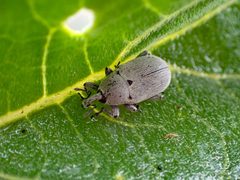
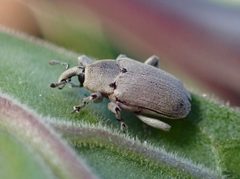
Trichobaris is a of flower weevils in the Curculionidae, comprising 8–13 described distributed from the southwestern United States through Mexico. These weevils are specialized herbivores associated with plants in the family Solanaceae, particularly the genus Datura, with which they likely coevolved. Several species are notable agricultural pests, including T. mucorea (tobacco stalk borer) and T. trinotata (potato stalk borer), which also feed on cultivated solanaceous crops. Research on this genus has contributed to understanding -herbivore , chemical of host selection, and the decoupling of maternal oviposition cues from larval performance.
Pronunciation
How to pronounce Trichobaris: /ˈtrɪk.oʊˌbɛə.rɪs/
These audio files are automatically generated. While they are not always 100% accurate, they are a good starting point.
Identification
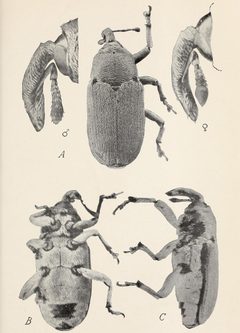
-level identification within Trichobaris requires examination of morphological characters including body size, elytral , and male genitalia; geometric morphometrics has been applied to distinguish species. The can be recognized within Curculionidae by its association with Solanaceae and the typical weevil body plan with an elongated rostrum. T. compacta (Datura weevil), T. mucorea (tobacco stalk borer), and T. trinotata (potato stalk borer) are among the more frequently encountered species and can be distinguished by host associations and subtle morphological differences.
Images
Habitat
Associated with supporting plants in the Solanaceae, particularly Datura in arid and semi-arid regions including the Sonoran Desert and Mexican Pacific coastal ranges.
Distribution
Southwestern United States (Arizona, New Mexico, Texas, California) south through Mexico to the Tehuantepec Isthmus on the Pacific coast; distribution corresponds to the range of principal plants in the Datura.
Diet
Larvae are stem borers in Solanaceae; feeding has been documented on Datura wrightii, D. discolor, D. reburra, D. inoxia, D. pruinosa, D. stramonium, Nicotiana attenuata, Solanum carolinense, and cultivated Solanum tuberosum (potato), Nicotiana tabacum (tobacco), and Lycopersicon esculentum (tomato).
Host Associations
- Datura wrightii - primary ; oviposition and larval developmentPrincipal for T. compacta in southwestern USA
- Datura discolor - ; oviposition and larval developmentUsed across multiple geographic regions
- Datura stramonium - ; oviposition and larval developmentTarget for using T. bridwelli
- Datura reburra - Pacific coast Mexico
- Datura inoxia - Southern Mexico
- Datura pruinosa - Southern Mexico
- Nicotiana attenuata - ; oviposition site for T. mucoreaPreferred oviposition for T. mucorea despite
- Solanum carolinense - native for T. trinotataHorsenettle; native with negligible impact from herbivory
- Solanum tuberosum - agricultural Potato; T. trinotata known as potato stalk borer
- Nicotiana tabacum - agricultural Tobacco; T. mucorea known as tobacco stalk borer
- Lycopersicon esculentum - agricultural Tomato
Life Cycle
Complete with , larval, pupal, and stages. Larvae are stem borers that develop within plant stems and fruits; adult females oviposit into host plant tissues. Specific developmental durations vary by and host plant.
Behavior
females use volatile chemical cues to discriminate among toxic plants for oviposition, but these sensory cues do not necessarily predict larval performance on those hosts. T. compacta oviposits exclusively on Datura wrightii, while T. mucorea prefers Nicotiana attenuata for oviposition despite both feeding on D. wrightii as adults. This represents a decoupling of maternal host choice from offspring . Adults feed on host plant leaves.
Ecological Role
Specialized herbivore and stem borer in Solanaceae-dominated ; contributes to top-down regulation of native Datura . T. trinotata has negligible impact on its native Solanum carolinense despite being a destructive pest of cultivated potatoes, suggesting context-dependent herbivore effects.
Human Relevance
Several are significant agricultural pests: T. trinotata (potato stalk borer) damages cultivated potatoes, T. mucorea (tobacco stalk borer) infests tobacco, and both species affect tomato. T. bridwelli has been investigated as a agent for Datura stramonium (jimsonweed), an weed and agricultural pest. Research on Trichobaris has advanced understanding of insect-plant chemical and the evolution of specialization.
Sources and further reading
- BugGuide
- Wikipedia
- GBIF taxonomy match
- iNaturalist taxon
- NCBI Taxonomy
- Catalogue of Life
- Evolution of Trichobaris (Curculionidae) in relation to host plants: Geometric morphometrics, phylogeny and phylogeography
- Evolution Among Weevils and Their Host Plants: Interaction Between the Genera Trichobaris Le Conte and Datura L.
- Trichobaris weevils distinguish amongst toxic host plants by sensing volatiles that do not affect larval performance
- The notoriously destructive potato stalk borer (Trichobaris trinotata) has negligible impact on its native host, Solanum carolinense (horsenettle)
- Biology of Trichobaris bridwelli (Coleoptera: Curculionidae), a Possible Agent for the Biological Control of Datura stramonium (Solanaceae)
- A single genealogical lineage from the Sonoran Desert and the Mexican Pacific Coast explains the haplotype distribution of Trichobaris compacta