
Arrenodes minutus
(Drury, 1773)
Oak Timberworm
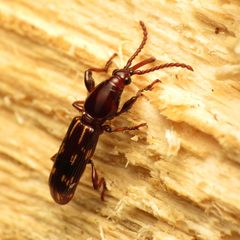
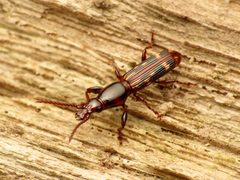
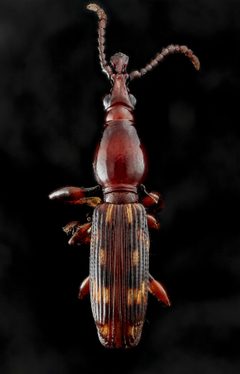
Arrenodes minutus, commonly known as the oak timberworm, is the sole in the Arrenodes, a primitive weevil genus in the Brentidae. This wood-boring is a pest of hardwoods in North America, with larvae tunneling through the xylem of wounded or recently felled trees. The species exhibits extreme in mouthpart structure: females possess elongated, slender rostra for drilling holes into wood, while males have shortened, broadened used for combat and courtship. The spans two to four years, with active from May through August.
Pronunciation
How to pronounce Arrenodes minutus: /ˌærɪˈnoʊdiːz mɪˈnjuːtəs/
These audio files are automatically generated. While they are not always 100% accurate, they are a good starting point.
Identification
Distinguished from other North American Brentidae by its larger size and distinctive coloration with yellow-spotted . The extreme in rostrum shape is diagnostic: females have long, thin, straight beaks while males have short, broad . Separated from true weevils (Curculionidae) by the straight, non-geniculate characteristic of Brentidae. May be confused with other wood-boring beetles such as Buprestidae or Cerambycidae, but the weevil-like form and spotted elytra are distinctive. Larvae are elongate, cylindrical, white, and curved with three pairs of jointed thoracic legs and one pair of near the abdominal tip—distinctive among wood borers.
Images
Habitat
Found in hardwood forests, particularly where oaks and other trees occur. are attracted to fresh wounds on living trees, exposed sapwood, and recently felled logs or stumps. Larvae develop within the xylem of wounded or cut trees. Upland oak forests appear particularly susceptible. Also found in timber operations, sawmills, and areas where hardwood lumber is processed or stored.
Distribution
Native to eastern North America, ranging from southern Ontario and Quebec through most of the eastern United States to the Gulf of Mexico. Isolated reported in Montana and Central America. Introduced and established in the Maritime Provinces of Canada (Nova Scotia, New Brunswick, Prince Edward Island) via wooden furniture shipments. Intercepted but not established in Europe (France, 2005).
Seasonality
emerge in May and remain active through August. Peak activity presumably coincides with tree wounding events such as storm damage or timber harvest. Two- to four-year means adults may be present in any given year from overlapping cohorts.
Diet
feed on sap oozing from wounds on trees. Larvae bore through xylem tissue, feeding on wood; they do not consume living phloem or cambium. The is a secondary pest that exploits pre-existing tree wounds rather than attacking healthy, intact bark.
Host Associations
- Quercus spp. - primary Especially upland including black oak (Q. velutina) and scarlet oak (Q. coccinea)
- Ulmus spp. - Elm
- Fagus spp. - Beech
- Populus spp. - Aspen and poplar
- Acer negundo - Boxelder
- Gleditsia triacanthos - Honeylocust
Life Cycle
are deposited singly in minute holes drilled by females into exposed sapwood, then covered with and secretions. Eggs are less than 1 mm in diameter and develop in several days to three weeks. Larvae bore directly into xylem, creating straight, horizontal galleries that enlarge as larvae grow. Larvae tunnel nearly through the tree, execute a sharp U-turn, and bore back toward the entrance. occurs within the gallery. emerge through original entrance holes. Complete requires two to four years. Larvae are elongate, cylindrical, white, curved, with three pairs of jointed thoracic legs and one pair of near the abdominal tip.
Behavior
Males are aggressive and territorial, using enlarged for combat with rival males. Males guard females during oviposition, positioning themselves over or adjacent to the female. Males have been reported to assist females if the rostrum becomes stuck in wood by pressing the against the female's , using her forelegs as a fulcrum—potentially a rare instance of tool use in insects, though this has not been directly observed by modern entomologists. frequently congregate under loose bark near wounds on trees. Several adults may aggregate at a single wound site.
Ecological Role
Secondary colonizer of wounded or stressed hardwood trees; accelerates wood degradation in damaged trees but does not kill healthy trees. of Bretziella fagacearum, the fungus causing , a major cause of oak mortality in 24 US states. The transports fungal spores on its body and through gallery construction, potentially contributing to disease spread.
Human Relevance
Economic pest of hardwood timber in eastern North America. Larval galleries degrade lumber quality, reducing value for flooring, barrel making, and factory-grade products. Listed on European Food Safety Authority Annex IAI as potential introduced pest; importation banned. Regulatory concern in Europe due to potential establishment and fungus transmission. Subject to phytosanitary inspection of oak and poplar products (lumber, barrels, logs, solid wood packing materials, wood chips) imported from North America. Managed through forest , rapid removal of felled timber, wound prevention, and post-harvest treatments (, kiln drying, steaming).
Similar Taxa
- Brentidae (other primitive weevils)Other Brentidae in eastern North America (three ) are Neotropical and restricted to southern Florida; A. minutus is the only species ranging throughout the eastern US and Canada.
- Curculionidae (true weevils)True weevils have geniculate (elbowed) ; Brentidae including A. minutus have straight antennae. True weevils typically lack the extreme mandibular seen in A. minutus.
- Buprestidae (jewel beetles)Wood-boring beetles with similar use, but have short, serrate and typically metallic coloration without spotted patterns; body shape more flattened and less cylindrical.
- Cerambycidae (longhorn beetles)Wood-boring beetles with very long (often longer than body), lacking the rostrum and weevil-like form of A. minutus.
More Details
Pathogen vector status
Confirmed of fungus (Bretziella fagacearum), which causes sudden mortality in oaks by disrupting xylem water transport. This vector role amplifies regulatory concern for international trade.
Introduced range status
Established in Maritime Canada since discovery in 2005; intercepted in France 2005 but not known to be established in Europe. Climatic suitability and availability in Europe create ongoing invasion risk.
Historical nomenclature
Originally described as Eupsalis minutus by Drury in 1773; transferred to Arrenodes. The has been referenced in entomological literature since the 19th century, with Riley (1874) documenting mate-guarding .