
Arrenodes
Schoenherr, 1823
Species Guides
1- Arrenodes minutus(Oak Timberworm)
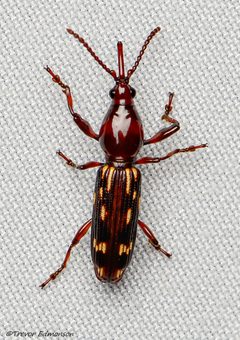
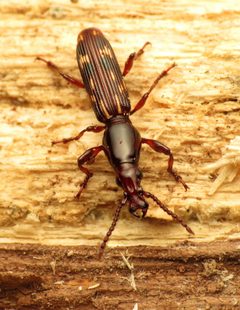
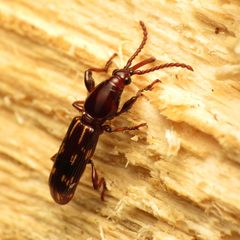
Arrenodes is a of primitive weevils in the Brentidae, containing only Arrenodes minutus, the oak timberworm. This is a significant pest of hardwoods in eastern North America, with larvae boring into the xylem of oak, elm, beech, and poplar trees. are sexually dimorphic, with females possessing long slender mouthparts for oviposition and males having broadened used for combat and courtship. The species has been introduced to the Maritime Provinces of Canada and is regulated internationally due to its potential to fungus.
Pronunciation
How to pronounce Arrenodes: //ˌærɪˈnoʊdiːz//
These audio files are automatically generated. While they are not always 100% accurate, they are a good starting point.
Identification
Distinguished from other Brentidae by the combination of yellow-spotted and extreme in mouthpart . Males are recognizable by their broad, flattened ; females by their elongated, slender rostrum. Larval galleries are diagnostic: straight or U-shaped tunnels in xylem, 0.2–4.0 mm in diameter, becoming progressively wider toward the center.
Images
Habitat
Hardwood forests and woodlands; specifically associated with wounded or recently felled trees. congregate under loose bark around wounds on trees. Larvae develop within the xylem of living or recently killed hardwoods.
Distribution
Native to eastern North America from southern Ontario and Quebec through the eastern United States to the Gulf of Mexico. Introduced and established in the Maritime Provinces of Canada (Nova Scotia). Isolated reported in Montana and Central America. Intercepted but not established in Europe (France, 2005).
Seasonality
emerge in May and remain active through August. duration is two to four years.
Diet
feed on sap oozing from fresh wounds on trees. Larvae bore into and consume xylem tissue.
Host Associations
- Quercus spp. - primary especially Quercus velutina, Q. coccinea
- Ulmus spp. - primary
- Fagus spp. - primary
- Populus spp. - primary aspen, poplar
- Acer negundo - secondary
- Gleditsia triacanthos - secondary
Life Cycle
are deposited singly in minute holes bored into exposed sapwood by females, then covered with and secretions. Larvae bore into xylem, tunnel horizontally nearly through the trunk, execute a U-turn, and bore back toward the entrance. occurs within the gallery. emerge through original entrance holes. Duration: 2–4 years.
Behavior
Males are aggressive and use their enlarged for combat with other males. Males guard females during oviposition, defending against rival males and . Mandibles are also employed in . aggregate under loose bark near wounds on trees. Larvae push and boring dust from galleries.
Ecological Role
Secondary pest that exploits wounded or stressed trees. of Bretziella fagacearum, the causal agent of . Larval tunneling contributes to wood decomposition in forest .
Human Relevance
Economic pest of hardwood timber. Larval galleries degrade lumber quality, rendering wood unfit for flooring, barrel making, and high-grade factory uses. Listed on European Food Safety Authority Annex IAI; importation of oak and poplar products from the US is restricted. Potential in Europe due to climatic suitability and availability.
Similar Taxa
- Other BrentidaeArrenodes is distinguished by the combination of yellow elytral spots and extreme in mouthpart structure; most other brentids lack these features or show different patterns of dimorphism
More Details
Pathogen vector
Documented of Bretziella fagacearum ( fungus), a major cause of oak mortality in 24 US states. Concerns about establishment in Europe include potential spread of this .
Phytosanitary status
Subject to strict EU regulations on imported oak and poplar products including lumber, barrels, logs, solid wood packing materials, and wood chips.