
Belidae
Schoenherr, 1826
Primitive Weevils, Belids, Cycad Weevils (restricted usage)
Genus Guides
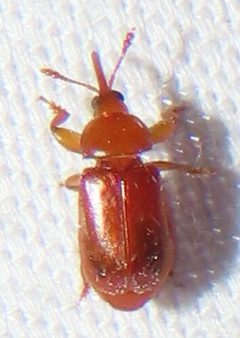
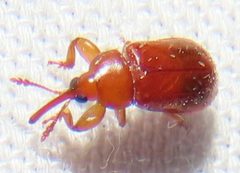
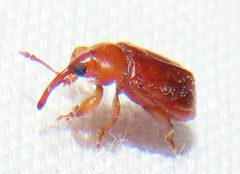
1- Rhopalotria(Cycad Weevils)
is an ancient of weevils distinguished from true weevils (Curculionidae) by straight rather than elbowed . The family exhibits a relictual Gondwanan distribution, with extant found primarily in the Australia–New Guinea–New Zealand region, South and Central America, Southeast Asia, Pacific islands, and scattered African localities. Belidae comprises two living : Belinae and Oxycoryninae. The family has undergone significant -plant shifts from ancestral conifer associations to diverse angiosperm lineages, including cycads, palms, and parasitic flowering plants.
Pronunciation
How to pronounce Belidae: /ˈbɛl.ɪ.daɪ.iː/
These audio files are automatically generated. While they are not always 100% accurate, they are a good starting point.
Identification
Distinguished from Curculionidae (true weevils) by straight, non-elbowed . Separated from other ancient weevil lineages by combination of: fore tibial apparatus ( groove with setal comb), V-shaped endocarina, elongated spermathecal gland, and typically reduced mandibular setation. Belinae generally elongated and cylindrical; Oxycoryninae more variable. Some Belinae superficially resemble Lixus (Curculionidae) or brentids; mimetic require careful examination of antennal structure. Molecular phylogenetic analysis may be necessary for definitive placement of some .
Images
Habitat
Coastal scrub vegetation documented for Proterhinus tauai; larvae typically associated with wood of diseased, dying, or dead plants, flower buds, or fruits. Many associated with specific plant microhabitats: cones of cycads (Allocorynina), flowers and fruits of root-parasitic angiosperms (Hydnoraceae, Balanophoraceae), or decayed female strobili of Araucariaceae. Host specificity varies: some (Proterhinus) exhibit adaptive radiation across diverse plant on isolated islands.
Distribution
Essentially Gondwanan distribution: Australia–New Guinea–New Zealand region, Southeast Asia, South and Central America (barely reaching North America), Pacific islands (including Hawaiian Islands), and scattered African localities. Highly relictual distribution patterns documented: Aglycyderini occur in two disjunct areas on opposite sides of Earth with no intermediate . Historical range during Late Jurassic to Early Cretaceous (161–100 million years ago) included Central Asia, Spain, and Brazil. Paleogene fossil from extant tribes known from Europe and North America.
Diet
primarily feed on pollen. Larvae feed on wood of diseased or dying plants, deadwood, flower buds, or fruits; some specialized on reproductive structures of cycads or parasitic angiosperms. generally avoid healthy plants, occurring instead as secondary inhabitants of plants already affected by pests or .
Host Associations
- Zamia pumila - pollinationRhopalotria slossoni maintains of this rare cycad in Florida
- Zamia integrifolia - pollinationRhopalotria slossoni documented as
- Araucaria araucana - larval developmentOxycraspedus cribricollis larvae in decayed female strobili
- Prosopanche americana - larval developmentHydnorobius hydnorae larvae develop inside flower and fruit bodies
- Balanophoraceae - larval developmentBalanophorobius gamezi reared from unidentified , possibly Helosis cayennensis
- Cassytha filiformis - plantProterhinus tauai collected from this parasitic vine (Lauraceae)
Life Cycle
Complete (holometabolous). Larval development typically in plant tissues: wood, cones, flower buds, or fruits. Specific developmental details vary by association. Larval described for several oxycorynine including Hydnorobius hydnorae and Oxycraspedus cribricollis.
Behavior
documented as of cycads. Some exhibit in rostrum shape with evidence of . generally avoid healthy plants, acting as secondary colonizers of stressed or damaged vegetation. Proterhinus tauai shows strong sexual dimorphism in rostrum with significantly different allometric relationships between sexes.
Ecological Role
function as , particularly of cycad . Larvae serve as for poor condition of plants. Some species maintain of rare or endangered plants: Rhopalotria slossoni critical for Zamia pumila survival in Florida, indirectly supporting the endangered Atala butterfly (Eumaeus atala). Larval feeding on decaying or stressed plant material contributes to nutrient cycling in forest .
Human Relevance
Generally harmless to agriculture and forestry; do not attack healthy plants. Ecological importance in maintaining cycad and supporting dependent . Some cycad-associated species (Rhopalotria, Parallocorynus) of conservation interest due to plant rarity. No significant economic pests documented.
Similar Taxa
- CurculionidaeTrue weevils with geniculate (elbowed) versus straight antennae in ; convergent body forms in some Belinae (e.g., Lixus-like )
- BrentidaeSimilar elongated cylindrical body form in some Belinae; distinguished by antennal structure and tibial features
- LycidaeSome Belinae exhibit mimicry of net-winged beetles; distinguished by antennal and tibial characters
- PyrochroidaeMimicry documented in some Belinae; true pyrochroids distinguished by different antennal and mouthpart structure
Misconceptions
The "cycad weevils" is often applied to the entire , but properly refers only to in Parallocorynus and Rhopalotria. Not all are associated with cycads; many feed on conifers, angiosperms, or parasitic plants. Despite larval association with dying plants, Belidae are not significant pests and do not cause primary damage to healthy vegetation.
More Details
Evolutionary History
represents an ancient weevil lineage with fossil record extending to Late Jurassic. Ancestral associations were with Araucariaceae (conifers). Major host shifts occurred with rise of angiosperms, including transitions to cycads, palms, and parasitic flowering plant (Hydnoraceae, Balanophoraceae, Lauraceae). Phylogenetic studies support classification into two : Belinae (tribes Pachyurini, Agnesiotidini, Belini) and Oxycoryninae (tribes Oxycorynini, Aglycyderini, Metrioxenini). Gondwanan distribution pattern reflects vicariance associated with continental breakup.
Adaptive Radiation
The Pacific Proterhinus underwent vigorous adaptive radiation on Hawaiian Islands, evolving to utilize diverse limited plant fauna. This represents one of the most striking examples of island radiation within the .
Conservation Significance
Several belid are of conservation concern due to dependence on rare plants. The relationship between Rhopalotria slossoni and Zamia pumila in Florida exemplifies mutualism critical for maintaining both partners, with cascading effects on dependent species such as the Atala butterfly.
Sources and further reading
- BugGuide
- Wikipedia
- GBIF taxonomy match
- iNaturalist taxon
- NCBI Taxonomy
- Catalogue of Life
- New species of the genus Orthorhynchoides Legalov, 2007 (Coleoptera: Belidae) from the Papuan Region
- First record of the genus Orthorhynchus Kirby, 1819 (Coleoptera, Belidae) from Papuan Region
- Phylogeny of the Oxycoryninae sensu lato (Coleoptera : Belidae) and evolution of host-plant associations
- New Oxycoryninae from Central and South America: phylogenetic and biogeographical implications (Coleoptera: Belidae)
- A new species of Proterhinus Sharp, 1878 (Coleoptera: Curculionoidea: Belidae) from Miti‘aro, Cook Islands, South Pacific
- On the rare species of Dicordylus Lacordaire and Homalocerus Schoenherr (Coleoptera, Belidae) with notes on male terminalia of D. vanini Mermudes
- Revision of the New World cycad weevils of the subtribe Allocorynina, with description of two new genera and three new subgenera (Coleoptera: Belidae: Oxycoryninae)
- Larval morphology and biology of oxycorynine weevils and the higher phylogeny of Belidae (Coleoptera, Curculionoidea)
- Behavior and Feeding of Two Beetle Pollinators of Zamia integrifolia (Cycadales): Rhopalotria slossoni (Coleoptera: Belidae) and Pharaxanotha floridana (Coleoptera: Erotylidae)
- The evolutionary history of the ancient weevil family Belidae (Coleoptera: Curculionoidea) reveals the marks of Gondwana breakup and major floristic turnovers, including the rise of angiosperms.