
Exapion fuscirostre
(Fabricius, 1775)
Scotch broom seed weevil
Exapion fuscirostre is a small introduced as a agent for the plant Scotch broom (Cytisus scoparius). feed on new stem growth while larvae develop inside seed pods, consuming seeds. Native to Europe, it has been established in the western United States and New Zealand.
Pronunciation
How to pronounce Exapion fuscirostre: /ɛkˈsæpiˌɒn fʊˈskaɪrɒstri/
These audio files are automatically generated. While they are not always 100% accurate, they are a good starting point.
Identification
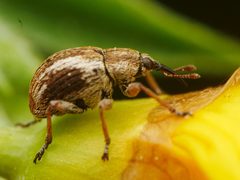
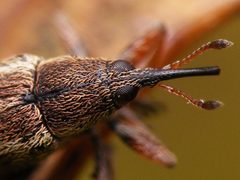
The combination of small size (2–3 mm), dark gray coloration with a distinct dark band across the , laterally compressed body, and elongated straight snout distinguishes this from other small weevils. The light brown legs contrast with the darker body.
Images
Appearance
Dark gray body with a dark band across the . Laterally compressed body shape with a long, straight snout. Legs are light brown. Length 2–3 mm.
Habitat
Areas supporting Scotch broom (Cytisus scoparius) patches, particularly in Mediterranean climates in its native range and introduced regions. Oviposition is greater in patches with low to medium plant densities.
Distribution
Native to Europe (Palearctic distribution). Introduced to western United States, now widespread in the Pacific Northwest. Also introduced to New Zealand. Records from Belgium and Norway in native range.
Diet
feed on new growth at stem tips. Larvae feed on seeds inside Scotch broom pods.
Host Associations
- Cytisus scoparius - obligateScotch broom; sole known for oviposition and larval development
Life Cycle
females lay inside seed pods of the plant. Larvae hatch and consume seeds over several weeks, developing within the pod. Specific details and number of per year are not documented in available sources.
Behavior
feeding occurs on new growth at stem tips. Oviposition site selection is influenced by pod width and plant patch , with preference for wider pods and low-medium density patches. Oviposition is negatively related to seed abortion rate and presence of other seed-eating insects.
Ecological Role
Seed of Cytisus scoparius. Acts as a agent reducing reproductive output of this plant. Serves as for parasitic wasp Pteromalus sequester.
Human Relevance
Intentionally introduced as a agent against Scotch broom in the United States and New Zealand. Established show promise for reducing Scotch broom spread, though by Pteromalus sequester may hinder establishment success.
Similar Taxa
- Other Exapion speciesShare similar body plan and association with legume ; require examination of genitalia or host specificity for definitive identification
- Other small brentid weevilsSimilar size and elongated snout; distinguished by specific color pattern and association
More Details
Taxonomic note
Formerly classified in Apionidae, now placed in Brentidae ( Apioninae) following molecular phylogenetic studies. GBIF lists status as 'DOUBTFUL' though this appears to reflect data quality rather than taxonomic uncertainty.
Biocontrol considerations
The parasitic wasp Pteromalus sequester uses E. fuscirostre as a , potentially limiting biocontrol efficacy. Further study of this relationship is needed.