
Stelidota geminata
(Say, 1825)
strawberry sap beetle
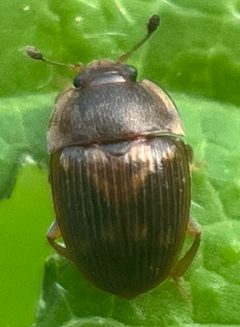
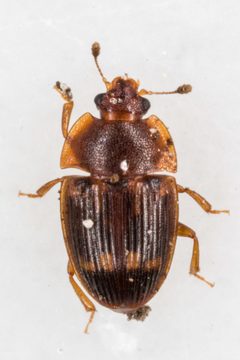
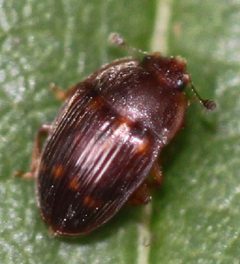
Stelidota geminata, commonly known as the strawberry sap beetle, is a of sap-feeding beetle in the Nitidulidae. This small has a broad range and is widely distributed across Central America, North America, Oceania, South America, Europe, and temperate Asia. Research indicates it functions as a chemical '' in host-finding , responding to a wide variety of host volatiles rather than specializing on specific chemical cues. It is known to be associated with fermenting fruit, particularly strawberries (Fragaria spp.), and exhibits both phototactic and host-orienting flights when locating food sources. The species has been introduced to various regions outside its native range and is considered a pest of strawberry crops.
Pronunciation
How to pronounce Stelidota geminata: //stɛlɪˈdoʊtə ˌdʒɛmɪˈneɪtə//
These audio files are automatically generated. While they are not always 100% accurate, they are a good starting point.
Identification
Small nitidulid ; specific morphological distinguishing features from such as Stelidota octomaculata not detailed in available sources. The can be differentiated from S. octomaculata by its broader range and more generalized host-finding , though visual identification likely requires examination of subtle morphological characters.
Images
Habitat
Associated with fermenting fruit substrates; specific preferences beyond food source associations not detailed in available sources.
Distribution
Native to North America; introduced and established in Central America, South America, Oceania, Europe (Austria, Belgium, France, Germany, Gibraltar, Hungary, Italy, Portugal, Serbia, Slovenia, Spain, Switzerland), and temperate Asia (Turkey). Within North America, recorded from Canada (Ontario), Mexico, and numerous U.S. states including Arkansas, California, Delaware, Florida, Georgia, Hawaii, Illinois, Indiana, Iowa, Kansas, Maryland, Massachusetts, Michigan, New Hampshire, New Mexico, New York, Ohio, Pennsylvania, Tennessee, Texas, Virginia, and Wisconsin. Also recorded from Caribbean and Atlantic islands including Bahamas, Cuba, Puerto Rico, and the Azores (Faial, Flores, Graciosa, Pico, São Jorge).
Diet
Feeds on fermenting fruit; specifically associated with strawberries (Fragaria spp.) and other fermenting substrates.
Host Associations
- Fragaria spp. - primary strawberry plants
- fermenting fruit - food sourcebroad range of fermenting fruit substrates
Behavior
Exhibits phototactic and -orienting flights when locating food sources. Functions as a chemical '' in host-finding , responding to a broad range of host volatiles rather than specific chemical cues. Upwind- response to food odors occurs at approximately 0.54 cm/s, significantly faster than the congeneric Stelidota octomaculata. Readily flies to food odor sources, in contrast to S. octomaculata which does not exhibit this behavior.
Ecological Role
Sap-feeding beetle that exploits fermenting fruit resources; likely contributes to nutrient cycling in decaying fruit substrates.
Human Relevance
Considered a pest of strawberry crops; the 'strawberry sap beetle' reflects its economic association with this crop.
Similar Taxa
- Stelidota octomaculataCongeneric with restricted range primarily limited to acorns; exhibits behavioral '' host-finding strategy with reduced locomotion rate, no phototactic , and no response to food odors by flying, in contrast to the of S. geminata
Sources and further reading
- BugGuide
- Wikipedia
- GBIF taxonomy match
- iNaturalist taxon
- NCBI Taxonomy
- Cimbicidae | Beetles In The Bush
- Insecta | Beetles In The Bush | Page 3
- weevils | Beetles In The Bush
- Stelidota geminata . [Distribution map].
- Stelidota geminata (Say): Studies of Its Biology (Coleoptera: Nitidulidae1)
- Chemical ‘generalists' and behavioral ‘specialists‘: a comparison of host finding by Stelidota geminata and Stelidota octomaculata
- Electrophysiological and behavioral identification of a volatile blend involved in host location of female strawberry sap beetle, Stelidota geminata