
Epuraea ocularis
Fairmaire, 1849
sap beetle, sap-feeding beetle
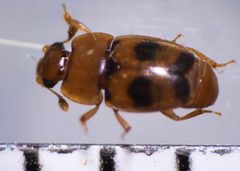
Epuraea ocularis is a small sap-feeding in the Nitidulidae, characterized by its association with fermenting plant material. The has a broad global distribution spanning multiple continents. Laboratory studies in India have documented its complete , including -laying in clusters on fermenting overripe fruits, four larval instars, and in soil.

Pronunciation
How to pronounce Epuraea ocularis: /ˌɛpjuˈriːə ɒˈkjʊlərɪs/
These audio files are automatically generated. While they are not always 100% accurate, they are a good starting point.
Images
Habitat
Fermenting overripe fruits serve as the primary breeding substrate; mature larvae migrate to soil for .
Distribution
Africa; Europe and Northern Asia (excluding China); North America; Oceania; Southern Asia. Presence confirmed across all listed regions.
Diet
Fermenting overripe fruits. Feeding habits on other substrates have not been documented.
Life Cycle
are laid in clusters on fermenting fruit and hatch in 1-2 days. Larvae pass through four instars over 12-17 days. Mature larvae migrate to soil to pupate. emerge from pupae in 4-5 days. Developmental timing based on laboratory conditions in Kolkata, India.
Behavior
Mature larvae exhibit substrate , leaving fermenting fruit to pupate in soil. Mating pairs have been observed to copulate in laboratory settings.
More Details
Taxonomic Note
The has been treated as Epuraea (Haptoncus) ocularis in some taxonomic works, reflecting subgeneric classification within Epuraea.
Research Context
Detailed descriptions are based on laboratory studies conducted in the Kolkata area, India. Field observations of natural may differ from laboratory conditions.
Sources and further reading
- BugGuide
- Wikipedia
- GBIF taxonomy match
- iNaturalist taxon
- NCBI Taxonomy
- Magical Mantis Moments | Bug Squad
- Spiked Forelegs of a Praying Mantis: There Is No Escape | Bug Squad
- Life History of Epuraea (Haptoncus) ocularis Fairmaire, 1849 in Kolkata area, India and descriptions of the immature stages (Coleoptera: Nitidulidae: Epuraeinae)