
Lobiopa insularis
(Laporte de Castelnau, 1840)
strawberry sap beetle
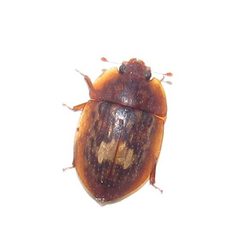
Lobiopa insularis is a sap-feeding beetle in the Nitidulidae, widely distributed across the Americas from North America through Central America to South America and the Caribbean. It is a significant agricultural pest of strawberry and other soft fruits, causing direct feeding damage and indirect losses through fungal . The has been extensively studied for its , , and control options, including using and .
Pronunciation
How to pronounce Lobiopa insularis: //loʊˈbaɪəpə ɪnˈsuːlərɪs//
These audio files are automatically generated. While they are not always 100% accurate, they are a good starting point.
Identification
is present in terminal abdominal segments: males possess a triangular and angulate hypopygidium, while females have a membranous pygidium without triangular projection and broad hypopygidium. These morphological differences allow precise sex identification using stereomicroscopy.
Images
Habitat
Agricultural crops, particularly strawberry fields; natural include subcortical spaces of dead or decaying trees, sap flows, fermenting fruit, flower falls, and decomposing leaf litter. Oviposition occurs in soil at approximately 1 cm depth, not on fruit.
Distribution
Caribbean Sea, Central America, North America, and South America; specifically documented in Brazil (São José dos Pinhais, Paraná), Argentina (Buenos Aires province), and the United States.
Diet
Frugivorous: feeds primarily on ripe strawberry fruits; also documented on melon, blueberry, raspberry, pineapple, apple, peach, fig, tomato, corn, and dried fruit products. In natural , feeds on subcortical fungi and serves as fungal agent.
Host Associations
- Fragaria × ananassa - food plantprimary agricultural
- Cerchysiella insularis - gregarious endoparasitoid ; rates 33.85-45.90% in strawberry crops in Brazil
- Heterorhabditis bacteriophora - ; VEli strain pathogenic to larvae, pupae, and
Life Cycle
→ three larval instars → pupa → . Preimaginal stages represent approximately 18.5% of total duration; adult stage approximately 81.5%. Egg-to-adult survival 64.20%. Larvae develop inside strawberry fruits, then fall to ground and bury to pupate.
Behavior
Mating sequence involves three stages: pre-copulation (male approaches female laterally, vibrates hind legs, touches female with ), copulation (male trembles with everted for approximately 5 seconds), and post-copulation (male maintains guarding position over female for less than 1 minute). Females only oviposit when males are present, indicating paternity protection . disperse long distances and overwinter. Strong attraction to ripe fruits in agricultural settings.
Ecological Role
Agricultural pest causing 20-70% economic losses in severe strawberry ; direct feeding damage to ripe fruits and indirect damage through spread of rot-causing microorganisms. In natural , functions as subcortical mycophagous contributing to decomposition. Serves as for agents including and .
Human Relevance
Major pest of strawberry in Brazil and Argentina; chemical control difficult due to harvest frequency and residue concerns on edible fruits. Subject of research using Cerchysiella insularis and Heterorhabditis bacteriophora .
Sources and further reading
- BugGuide
- Wikipedia
- GBIF taxonomy match
- iNaturalist taxon
- NCBI Taxonomy
- Encyrtid Holdings | Entomology Research Museum
- Look Out, Franklin's Bumble Bee, They're Coming for You! | Bug Squad
- Pensoft Editorial Team | Blog - Part 13
- Inspiring a new generation of taxonomists | Blog
- First record of Cerchysiella insularis (Howard, 1897) (Hymenoptera: Encyrtidae) parasitizing Lobiopa insularis (Castelnau, 1840) (Coleoptera: Nitidulidae) on strawberries
- Mating behavior and sexual dimorphism of the Lobiopa insularis (Coleoptera: Nitidulidae) strawberry pest
- Life history traits and life table analysis of Lobiopa insularis (Coleoptera: Nitidulidae) fed on strawberry
- Heterorhabditis Bacteriophora Pampean-Strain Veli (Nematoda): Identification and Pathogenicity against the Strawberry Pest Lobiopa Insularis (Coleoptera: Nitidulidae)