
Lobiopa
Erichson, 1843
sap beetles
Species Guides
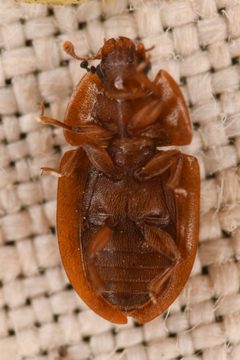
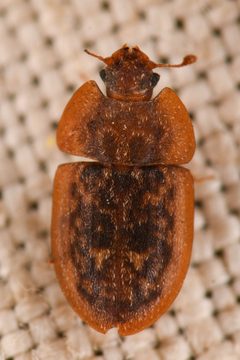
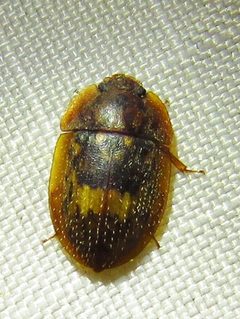
7Lobiopa is a of sap-feeding beetles in the Nitidulidae, containing approximately seven described . The genus includes economically significant agricultural pests, particularly Lobiopa insularis (strawberry ), which causes direct fruit damage and indirect losses through fungal transmission in strawberry crops across the Americas. Members of this genus exhibit frugivorous feeding habits on ripe fruits and display complex reproductive including mate guarding and soil oviposition.
Pronunciation
How to pronounce Lobiopa: /loʊˈbaɪəpə/
These audio files are automatically generated. While they are not always 100% accurate, they are a good starting point.
Images
Habitat
Agricultural settings with ripe fruit crops including strawberry, peach, blueberry, raspberry, pineapple, apple, melon, tomato, and corn; natural encompassing subcortical spaces of dead or decaying trees, sap flows, fermenting fruit, flower falls, and decomposing leaf litter; occasionally recorded in honeybee hives.
Distribution
Neotropical, Nearctic, and Palearctic regions; documented in Argentina (Buenos Aires province), Brazil (Paraná, São Paulo, Santa Catarina, Espírito Santo), USA, and Mexico (Baja California Sur); introduced in the Palearctic region.
Diet
Frugivorous; larvae and feed on ripe fruits causing superficial and deep perforations. Documented include strawberry, peach, blueberry, raspberry, pineapple, apple, melon, tomato, corn, fig, guava, carambola, and dried fruit products. In natural , associated with fermenting fruit, sap flows, and fungal food sources.
Host Associations
- Fragaria × ananassa - plantstrawberry; primary agricultural
- Cerchysiella insularis - Hymenoptera: Encyrtidae; natural rates 33-46%
- Heterorhabditis bacteriophora - ; VEli strain pathogenic to larvae and pupae
- Prunus persica - plantpeach
- Vaccinium sect. Cyanococcus - plantblueberry
- Ficus carica - plantfig
- Ananas comosus - plantpineapple
- Psidium guajava - plantguava
- Averrhoa carambola - plantcarambola
Life Cycle
Complete : → three larval instars → pupa → . Preimaginal development approximately 28 days (egg ~4.6 days; larval instars 1-3 ~1.2, 1.2, 13.1 days; pupa ~7.6 days). Full-grown larvae fall to ground and bury themselves to pupate. Adult longevity averages ~120 days with maximum recorded 219 days (females) and 211 days (males). Generational overlap occurs due to extended adult lifespan.
Behavior
Strong attraction to ripe fruits. capable of long-distance . documented. Mating involves three-stage sequence: pre-copulation with male courtship (hind leg vibration, contact), copulation with male trembling and everted (~5 seconds), and post-copulation with male guarding position maintained for less than one minute. Females only oviposit when males are present; oviposition occurs in soil at approximately 1 cm depth, not on fruit.
Ecological Role
Agricultural pest causing direct feeding damage to fruits and indirect damage as of rot-causing microorganisms; economic losses of 20-70% reported in severe strawberry . In natural , contributes to decomposition processes through association with sap flows, fermenting fruit, dead wood, and leaf litter; mycophagous in subcortical . Serves as for agents including and .
Human Relevance
Significant pest of strawberry production in Argentina, Brazil, and USA, causing up to 70% production loss in severe . Chemical control largely ineffective due to feeding on ripe fruits at harvest time, making application incompatible with harvest schedules. Target of research including (Cerchysiella insularis) and (Heterorhabditis bacteriophora VEli strain).
Similar Taxa
- Other Nitidulidae generaLobiopa distinguished by specific morphological features of the and hypopygidium; detailed review available in taxonomic literature
More Details
Species diversity
Seven described : Lobiopa brunnescens, L. falli, L. insularis, L. oblonga, L. punctata, L. setosa, and L. undulata
Reproductive biology
Females require continuous male presence for oviposition; no sperm storage or re-mating observed. Mean total ~1655 per female with daily oviposition rate ~18 eggs. Eggs deposited in masses averaging 13.5 eggs.
Taxonomic review
reviewed in 2012 with description of new from Baja California Sur, Mexico ( & Kinnee, The Pan-Pacific Entomologist 88(2):202-211)
Sources and further reading
- BugGuide
- Wikipedia
- GBIF taxonomy match
- iNaturalist taxon
- NCBI Taxonomy
- The Pan-Pacific Entomologist 88(2)—Penrose Memorial issue | Beetles In The Bush
- Mating behavior and sexual dimorphism of the Lobiopa insularis (Coleoptera: Nitidulidae) strawberry pest
- Life history traits and life table analysis of Lobiopa insularis (Coleoptera: Nitidulidae) fed on strawberry
- First record of Cerchysiella insularis (Howard, 1897) (Hymenoptera: Encyrtidae) parasitizing Lobiopa insularis (Castelnau, 1840) (Coleoptera: Nitidulidae) on strawberries
- Heterorhabditis Bacteriophora Pampean-Strain Veli (Nematoda): Identification and Pathogenicity against the Strawberry Pest Lobiopa Insularis (Coleoptera: Nitidulidae)